 18 minutes read
A fast remote hire can create a slow, expensive compliance problem. The candidate says yes, someone sends a login, and only afterward does the firm ask whether the worker is authorized, properly classified, covered by insurance, bound by confidentiality terms, and working from a jurisdiction where the firm has payroll obligations. That's not a hiring process. It's an access-control experiment with client data.
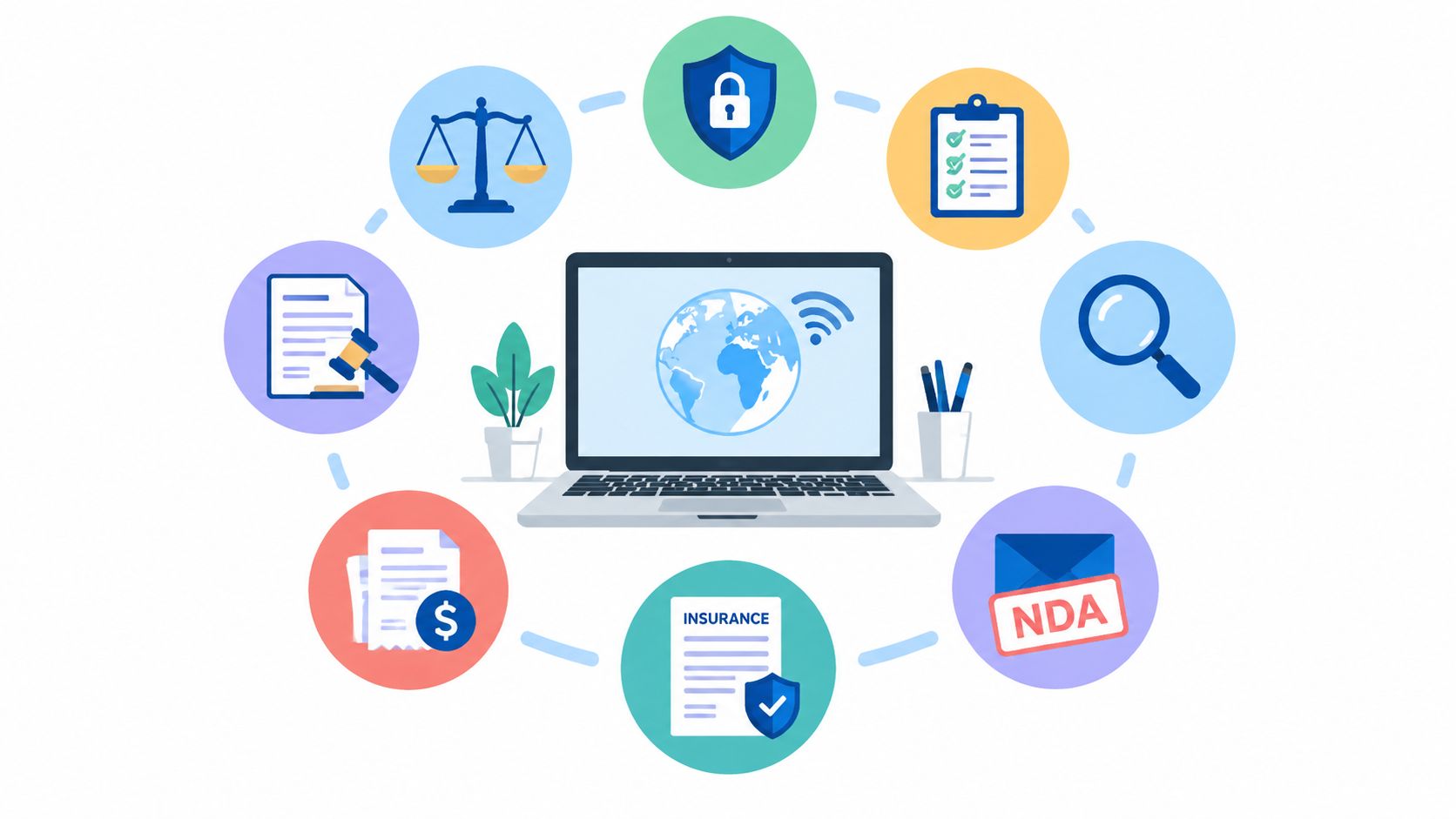
A practical recruitment compliance checklist for a US law firm should follow the actual risk chain of a remote paralegal hire. Start with fair selection, then verify identity and credentials, resolve classification and pay obligations, protect confidential information, and document onboarding before access is granted.
Platforms can reduce the administrative load. A vetted service may help with sourcing, screening, background verification, payroll management, or compliance guidance. It doesn't eliminate the firm's responsibility to confirm its own legal obligations, supervision model, insurance coverage, and client-access controls. The paperwork may be less glamorous than recruiting, but it's considerably cheaper than reconstructing it during a complaint, audit, or breach investigation.
A job posting can create risk before a candidate ever speaks with the firm. Language such as “digital native,” “young and energetic,” or “recent graduate” may signal an age preference even when the hiring manager intended nothing more than comfort with technology. The relevant question is whether the language describes a genuine job requirement and whether the firm applies the same standard to everyone.
Federal EEO protections cover race, color, religion, sex, national origin, age, disability, and genetic information. The EEOC's recordkeeping requirements also make clear that employers must preserve personnel or employment records for one year from the date the record or personnel action was made, or longer where the rule requires it. A firm should use that baseline as a retention checkpoint, while confirming whether another applicable rule calls for a longer period.
For every remote paralegal applicant, retain the posting, application materials, interview notes, evaluation rubric, selection decision, and rejection reason. “They just felt like a better fit” is not documentation. It's a future headache wearing business-casual clothing.
Use job-related questions and a consistent scoring framework. Evaluate legal writing, practice-area experience, technology proficiency, communication, and availability against criteria approved before interviews begin. If a platform uses matching technology, ask how candidate information is used and whether the firm can review the reasoning behind a recommendation.

Practical rule: If two candidates receive different questions, different standards, or different explanations, document why.
The EEOC received 88,531 new discrimination charges in FY 2024, compared with 81,055 in FY 2023, according to Littler's summary of EEOC developments. That enforcement volume is a useful reminder that consistent hiring records aren't administrative decoration. They're the firm's evidence that selection turned on lawful, role-related factors.

Background checks require permission before investigation. The EEOC's guidance on background checks says employers should obtain the applicant's or employee's written permission before running a check. Under the FCRA, that authorization sits inside a larger process involving a proper disclosure, a consumer reporting agency, and adverse-action procedures.
The firm should keep the signed authorization, disclosure, vendor details, report, review notes, and any notices sent to the candidate. An email with an electronic signature can work if the firm can show what the applicant authorized, when they authorized it, and what disclosure accompanied the request. A casual “we ran a quick check” is not a process.
State and local rules can control when the firm may ask about criminal history, what information it may consider, and how it must communicate a decision. A California solo practitioner who runs a check at the wrong point in the hiring process can create an avoidable FCRA and state-law problem, even if the underlying concern is legitimate.
Apply a relevance standard. Criminal history should relate to duties such as access to client funds, sensitive records, court filings, or firm security. Don't use a broad report as a substitute for judgment.
If a report may lead to rejection, follow the required pre-adverse and adverse-action steps, including providing the appropriate report and rights information before finalizing the decision. Keep a written discrepancy policy so the firm responds consistently when a candidate's application and verification results differ.
A service such as HireParalegals' background verification process may reduce the firm's administrative burden by collecting documents and coordinating checks. That doesn't transfer the firm's duty to understand the vendor's process, approve the role-specific screening criteria, and retain evidence that the decision followed applicable law.
The worker's home address matters more than the firm's office address. A paralegal who works remotely from another state may trigger payroll registration, withholding, unemployment insurance, workers' compensation, and state employment-law obligations. International hiring adds classification, tax treaty, immigration, and data-transfer questions.
Start with a jurisdiction worksheet before the offer is finalized. Record the worker's actual work location, proposed status, pay method, expected schedule, supervisor, and whether the worker may move. Store the firm's registration confirmation, payroll setup, withholding configuration, workers' compensation analysis, and written classification rationale with the hiring file.
Payroll software can calculate withholding after the firm has entered the right facts. It can't decide whether the firm has created nexus, whether a worker is an employee, or whether a new location changes the analysis. Review remote payroll regularly, especially when a paralegal relocates or begins handling work from another country.
For international talent, confirm who handles payroll administration, tax documentation, local compliance guidance, and work authorization questions. Firms considering hiring remote talent from Argentina should also examine the arrangement's local-law implications rather than assuming a contractor label solves everything.
A home office is still a work location. Treat it like one in the compliance file.
A platform can help centralize these moving parts. HireParalegals offers payroll management and compliance guidance for Latin American hires, and its international payroll best practices resource is relevant when the firm is evaluating an overseas arrangement. The firm should still confirm its own tax, employment, insurance, and supervision obligations with qualified advisers.
Form I-9 belongs in the onboarding workflow, not in the “we'll get to it” pile. It applies to employees hired after November 6, 1986, and the employee must complete Section 1 no later than the first day of employment. The employer must complete Section 2 within three business days of the employee's first day of work for pay, as explained in the USCIS Form I-9 instructions.
The retention rule is equally specific. Keep each Form I-9 for three years after the date of hire, or one year after employment ends, whichever is later. A remote firm should tie these deadlines to the hire date in its ATS or onboarding system, not to the interview date or the date someone remembers the form exists.
The evidence should include:
Remote hiring creates practical friction because the worker and employer may be in different places. Digital systems can make the process trackable, but the firm must verify that the method it uses satisfies current requirements. If a platform says it pre-verifies authorization, ask what evidence the firm receives and whether the firm's own employer obligations remain.
The three-business-day deadline is short enough to miss accidentally and important enough to regret missing. Put reminders on the calendar before the offer is accepted.
A remote paralegal can answer emails from a kitchen table, work late after a client call, and still be entitled to payment for that time. The firm must classify the role correctly under the FLSA and comply with the wage, overtime, timekeeping, meal, rest, and off-the-clock rules that apply where the employee works.
Don't classify by title. “Senior paralegal” doesn't automatically mean exempt, and a contractor agreement doesn't erase employee protections when the working relationship says otherwise. Review the actual duties, decision-making authority, pay structure, degree of control, and work schedule.
Use a timekeeping tool such as Harvest, Toggl, or a payroll platform with time tracking. Train supervisors to ask for accurate reporting, not heroic silence. If a paralegal responds to messages outside scheduled hours, the firm should record and pay that time when the law requires it.
Keep the classification analysis, job description, time records, payroll records, pay stubs, policy acknowledgments, and corrections. A remote arrangement also requires a location review. The applicable minimum wage and break rules may depend on the employee's work location, and state law may be more protective than federal law.
The EEOC's federal recordkeeping guidance provides a one-year personnel-record retention baseline, but wage-and-hour documentation should be retained according to the applicable federal and state rules and the firm's litigation-hold practices. Don't pick a retention period by convenience.
Supervisor test: If a manager knows the work happened, the firm shouldn't pretend it didn't.
Payroll support can reduce calculation errors and flag location changes, but it won't rescue a firm that tells a non-exempt employee not to record evening work. Good systems support good decisions. They don't replace them.
The contractor label is not a force field. If the firm supplies equipment, dictates hours, trains the paralegal, supervises daily work, and controls how legal tasks are performed, the relationship may look much more like employment than an independent business.
Document the analysis before the worker begins. Examine behavioral control, financial control, and the relationship between the parties. The IRS provides a formal route for seeking a determination through Form SS-8 and its worker-classification guidance, which should be considered when the facts are uncertain.
A genuine contractor arrangement usually centers on deliverables, independent methods, business risk, and meaningful control over when and where the work occurs. A paralegal embedded in the firm's daily workflow may not fit that model, particularly where the firm controls legal work directly.
State rules can be stricter. California and New York deserve careful review, and an arrangement that looks acceptable under a federal analysis may still create state-law exposure. Retain the signed agreement, scope of work, invoices, tax forms, communications about control, and annual classification review.
Some platforms supply on-demand professionals under their own engagement model. That may reduce administrative work, but read the contract carefully. Confirm who employs or contracts with the worker, who controls the work, who handles tax administration, who carries insurance, and who bears classification risk. A firm evaluating options can also find its payroll compliance plan before choosing an arrangement.
HireParalegals may provide on-demand paralegals as contractors in some arrangements, but the firm shouldn't assume the platform's structure automatically answers every question. The written terms and actual day-to-day relationship must line up.
A polished résumé can still be wrong. Before assigning immigration, litigation, corporate, or family-law work, verify the candidate's claimed experience, certifications, references, and professional standing. Ask for evidence that matches the work the person will perform.
Paralegal licensing varies by jurisdiction. Where a credential or registration applies, verify it through the relevant authority. For certifications, confirm records with organizations such as NALA or the National Federation of Paralegal Associations, and keep the verification result in a restricted personnel or vendor file.
A candidate who claims extensive immigration experience should be able to explain the forms, procedural stages, deadlines, and supervision boundaries relevant to the role. A litigation candidate should demonstrate practical familiarity with discovery, calendaring, filing procedures, and document management. The firm doesn't need to turn every interview into a bar exam, but it does need more than a résumé scan.
Retain:
A vetted platform can reduce the first-pass burden. HireParalegals describes a four-step process involving sourcing, interviewing, background checking, and skills validation, with candidates presented through shortlists, CVs, and video introductions. The firm should still spot-check the evidence, confirm specialty fit, and supervise the work. Vetting is a useful filter. It isn't a substitute for professional judgment.
A remote paralegal may handle privileged communications, medical records, financial information, litigation strategy, and personal identifiers before the firm has developed any working trust. Access should wait until the legal and technical controls are in place.
The NDA should cover confidential information, attorney-client privilege, work product, permitted use, return or deletion of information, approved systems, breach reporting, and post-engagement obligations. A separate data-security agreement may be appropriate where the worker or platform processes client information on the firm's behalf.
Require written acknowledgment before client access. Define whether the worker may use a personal device, which VPN and storage systems are approved, whether encryption is required, how email attachments must be handled, and what happens if a device is lost. The firm should also keep access logs showing which accounts and client matters the paralegal could reach.
Review vendor and platform arrangements for data-processing terms, confidentiality commitments, security responsibilities, and international transfers. The GDPR recruitment guidance describes a candidate-data lifecycle that includes collection, screening, sharing, storage, retention, deletion, and rights requests. Even a US law firm hiring abroad should map where candidate and client data travels.
HireParalegals' data security protocols can help a firm evaluate the platform's stated approach. The firm still controls its own client systems, permissions, training, breach response, and supervision. Don't give a new hire broad access because configuring least privilege takes an extra afternoon. That shortcut can turn one afternoon into weeks of incident response.
The final checkpoint is the one that prevents the first eight from becoming loose paperwork. Before work begins, the firm should have a signed employment or contractor agreement, completed eligibility evidence, credential verification, classification decision, payroll setup, confidentiality terms, security training acknowledgment, insurance position, and supervision plan.
The agreement should reflect the arrangement. Identify worker status, scope, pay, jurisdiction, confidentiality, security standards, ownership of work product, required supervision, permitted communications, and exit duties. If the contract says “independent contractor” while the firm controls every detail of the person's day, the document is describing a hope, not a relationship.
Ask the malpractice and cyber insurers in writing whether the policy covers remote paralegals, contractor arrangements, the worker's location, and the assigned practice area. Retain the response with the onboarding file. If a platform is involved, confirm whether its coverage complements or excludes the firm's own obligations.
Use an access approval record that names the approving attorney, systems granted, client matters authorized, training completed, and date access was activated. Grant only the permissions needed for the initial assignment. Expand access after the supervising attorney confirms performance and need.
A complete file should include:
A platform can help with sourcing, vetting, payroll support, and compliance guidance. It can't become the supervising attorney, insure every client matter, or decide what a firm's malpractice policy covers. No access until the file clears.
| Item | Implementation Complexity | Resource Requirements | Expected Outcomes | Ideal Use Cases | Key Advantages |
|---|---|---|---|---|---|
| Equal Employment Opportunity (EEO) Compliance | Medium, training, audits, standardized criteria | HR training, legal review, posting audits, documentation tools | Reduced discrimination risk, defensible hiring decisions | All hiring processes, job postings, interviews | Lowers litigation risk, improves diversity and reputation |
| Background Check Authorization & Compliance | Medium, FCRA + variable state rules, adverse-action steps | FCRA-compliant vendors, consent forms, legal counsel | Safer hires, documented due diligence, reduced negligent-hiring exposure | Pre-employment screening, high-risk client roles | Protects clients, reduces liability, streamlines vetting |
| Remote Work & Tax Withholding Jurisdiction Compliance | High, multi-state nexus, international tax and benefits | Payroll platforms, tax advisors, state registrations, accounting | Correct tax withholding, fewer audits/back-tax liabilities | Remote hires across states or countries | Enables lawful geographic hiring, reduces audit and penalty risk |
| I-9 Verification & E-Verify Compliance | Medium, strict timing and recordkeeping; some state mandates | I-9 processes, digital I-9/E-Verify systems, staff training | Confirmed work authorization, lower ICE enforcement risk | All U.S. hires, especially remote or interstate employees | Prevents undocumented employment, detects document fraud early |
| Wage & Hour Compliance (FLSA, Overtime, Minimum Wage) | High, classification, overtime, and multi-jurisdiction rules | Timekeeping, payroll systems, legal review, policy updates | Accurate pay, fewer wage claims, compliant classifications | Overtime-prone roles, remote workers across states | Avoids back pay and damages, ensures fair compensation |
| Independent Contractor vs. Employee Classification | High, subjective IRS and state tests (ABC/20-factor) | Legal counsel, documentation (SS-8), HR policies, record retention | Proper classification, reduced payroll tax and penalty exposure | Project-based contractors, platform-provided talent | Avoids back taxes/penalties, clarifies responsibilities and benefits |
| Verification of Professional Credentials & Paralegal Licensing | Low–Medium, state variation, ongoing checks | Verification services, reference checks, monitoring tools | Confirmed qualifications, reduced malpractice and ethics risk | Client-facing work, specialty practice areas, licensing-required roles | Ensures competency, protects reputation and client trust |
| Confidentiality, NDA, & Data Security Agreements | Medium, legal + technical controls required | NDA templates, IT security (VPN, encryption), training, DLP | Protected client data, evidence of due diligence after incidents | Remote hires, access to sensitive client materials | Preserves privilege, limits breaches, provides contractual remedies |
| Contracts, Malpractice Coverage & Onboarding Records | Medium, cross-functional coordination and insurance checks | Written agreements, insurer confirmations, onboarding systems | Defensible hiring records, confirmed insurance coverage, controlled access | Any hire with client access; remote or contractor arrangements | Comprehensive risk management, clear expectations, orderly offboarding |
Use the completed recruitment compliance checklist as a go/no-go control, not a document someone saves in a folder and forgets. Before a remote paralegal receives client-system credentials, confirm that the selection record shows fair, job-related criteria and consistent interview treatment. Confirm that any background check had written authorization and that the firm followed the required process before relying on the result.
The onboarding file should then show work eligibility, professional credentials, worker classification, work location, payroll setup, signed agreement, confidentiality obligations, security training, insurance position, supervision boundaries, and access approval. If one of those items is unresolved, pause access. The candidate may be excellent, the workload may be urgent, and the client may be calling every ten minutes. None of that changes the risk.
The I-9 timeline deserves its own calendar control. The employee completes Section 1 no later than the first day of employment, and the employer completes Section 2 within three business days of the first day of work for pay. Retain the form for three years after hire or one year after employment ends, whichever is later, following the USCIS instructions. The firm should also maintain a separate, access-restricted I-9 file so an audit doesn't require opening every personnel record.
Run a quarterly review. Recheck remote work locations, payroll registrations, classification assumptions, credential status, vendor access, insurance terms, and security permissions. A paralegal may move states, change practice areas, adopt a new tool, or begin handling a different category of client data. The checklist must move with the work.
The EEOC's FY 2025 reporting, summarized in Littler's enforcement update, reported 91,503 charges and $660 million recovered for 17,680 victims. Those figures aren't a reason to stop hiring. They're a reason to stop treating hiring records as optional.
HireParalegals can streamline sourcing, candidate vetting, background verification, payroll management, and compliance guidance for certain remote arrangements. Its network is built for US law firms seeking remote legal support, but the firm must still verify its own obligations, approve the supervision model, confirm insurance coverage, and control client access.
Turn the checklist into a live workflow. Assign an owner to each checkpoint, store evidence in one restricted location, and make the system block access until the required approvals are complete. That's how a fast hire stays fast without becoming a slow-motion compliance problem.