 14 minutes read
Yes, background checks are legal in the United States in most legitimate hiring contexts. The key question is whether you're doing one lawfully, with the right consent, at the right time, and for the right purpose.
If you've ever had a managing partner tap a candidate's name into Google after the second interview, then hop over to LinkedIn and a county court site, you already know how this starts. One casual search can turn into a regulated workflow fast, and if you've ever lived through FCRA paperwork pain, you know the fun starts right where everyone else stops paying attention.
A candidate looks strong on paper, the interview goes well, and someone says, “Let me check one thing.” By lunch, the team has searched Google, LinkedIn, county records, and perhaps ordered a third-party screen. That sequence creates risk because each source carries different rules, limits, and documentation needs.
A casual search and a consumer report do not create the same obligations. A vendor compiling information for employment purposes brings the Fair Credit Reporting Act into play. What matters is timing, scope, and what you do with the result, not merely whether a check exists.

Practical rule: when a team member makes a judgment from a random search, record what was reviewed and why. When a vendor compiles data for employment use, handle the process as an FCRA workflow from the start.
Employers repeatedly make three avoidable mistakes: skipping written consent, overlooking state timing rules, and treating a courthouse website result as interchangeable with a full background report. Those sources differ in coverage, accuracy controls, and documentation. In one firm audit, a paralegal candidate's disclosed judgment triggered a review because the file did not clearly show what the firm asked, when it asked, or who reviewed the information.
Remote paralegal hiring makes the timing-and-scope problem harder. The candidate may work in one state, report to a firm in another, and be screened by a vendor operating elsewhere. Build the process around the applicable rule set before anyone orders a report.
Ask four questions: what information is needed, where the candidate and employer are located, when the check is permitted, and how the firm will document the decision. That approach gives the FCRA floor, state and local fair-chance rules, and the adverse-action workflow a place in daily hiring operations.
The same discipline applies to volunteers and other screened roles. For a plain-English overview outside employment, the school volunteer checks resource reinforces that consent and scope still matter.
Federal law gives employers permission to screen, but it also puts up guardrails. The EEOC says that, except for restrictions involving medical and genetic information, it is not illegal to ask about an applicant's or employee's background or require a background check, but employers cannot use the results in a discriminatory way based on protected traits. When a company uses a third-party reporting service, the FCRA kicks in, and the EEOC says employers need written permission and notice before using the information in an employment decision. The EEOC and FTC formalized that overlap in joint guidance issued on March 10, 2014. EEOC background-check guidance
The trigger isn't just the act of looking. The trigger is the source of the information and how you use it. A consumer reporting agency, in plain English, is the outside party compiling information about a person for a report used to evaluate them for employment or another covered purpose. A consumer report can include background data, and an investigative consumer report can go deeper into personal history, which is why the disclosure and authorization pieces are not busywork.
The clean way to do this is boring, and boring is good. First, give a standalone disclosure that a background report may be obtained for employment purposes. Then get written authorization. Don't bury the disclosure in an onboarding packet full of tax forms, policy acknowledgments, and a coupon for the coffee machine nobody wants. If the disclosure isn't standalone, you're asking for trouble.
The EEOC also warns employers not to use criminal records in a way that disproportionately screens out protected groups unless the record is job-related and consistent with business necessity. That means a criminal hit is not an automatic stop sign. It's a job-specific risk question. For a legal hiring team, that's not a theoretical nuance, it's the whole game.
The federal floor is simple, even if the paperwork isn't. Consent, notice, job relevance, and non-discriminatory use.
| Trigger | Law | Practical Action |
|---|---|---|
| Third-party background report | FCRA | Use a standalone disclosure and get written authorization |
| Criminal history used in hiring | EEOC Title VII guidance | Check job relevance and business necessity, not gut instinct |
| Adverse action based on report | FCRA | Send pre-adverse notice, report copy, and Summary of Rights |
| Medical or genetic info | Federal restrictions | Don't mix it into routine screening |
If you're screening people for school-facing roles, the same discipline shows up in other sectors too. The legal mechanics differ, but the process logic is the same: consent, narrow scope, and a real reason for each check. That's why teams often map their screening flows against background screening logic for volunteer roles before they assume a “yes” from a vendor means they're covered.
The legal answer depends on the relationship being screened. Employment, housing, and private investigations each follow different rule stacks, so a lawful process starts by identifying the context, the purpose, and the source of the information.
For hiring, the FCRA applies whenever a third party provides the report. Consent, a clear disclosure, notice, and the adverse-action process all become required steps. EEOC principles also matter once criminal history enters the decision, especially where a record may affect protected groups unevenly.
Law firms often create avoidable risk by giving every role the same screening package. An intake coordinator, remote paralegal, and contract reviewer may have different access, duties, and security concerns. Build the check around the role's purpose and document why each search belongs in that package.
Landlords and property managers using a tenant screening company can still fall under the FCRA. Housing rules may add limits involving application fees, deposits, and source-of-income protections. A compliant report does not make the surrounding rental process compliant.
An internal social-media review may remain outside the FCRA when the firm gathers and evaluates the information itself rather than obtaining a consumer report. Sending the same assignment to a consumer reporting agency can trigger the broader compliance framework. Internal diligence and regulated screening follow different compliance requirements, even when the work product looks similar.
For firms that retain records across hiring, vendor diligence, and matter intake, establish separate workflows and retention rules. HireParalegals can serve as an operational reference for separating internal review from formal screening, but the firm still has to classify each activity before collecting information.
| Context | Governing Law | Key Obligation |
|---|---|---|
| Employment screening | FCRA, EEOC | Use proper disclosure, authorization, and adverse-action steps |
| Tenant screening | FCRA plus housing rules | Follow screening notice rules and local housing limits |
| Private investigations | Depends on source and purpose | Decide whether the work is internal diligence or a regulated report |
Identity checks also belong in a separate lane from employment screening. Right-to-work verification addresses immigration compliance, while criminal and credit searches raise different questions. Teams can review right to work checks with HR Management to keep those procedures distinct.
For a separate comparison, volunteer background checks for nonprofits shows how consent, scope, and role-specific screening logic carry across organizations, even though the governing rules may differ.
Federal law sets the floor. States and cities add their own timing limits, notice duties, and restrictions on what an employer may consider.
The patchwork includes at least 37 U.S. states and 150+ local jurisdictions with some form of ban-the-box or fair-chance rule, along with rules in places such as Texas, Philadelphia, Washington State, and Virginia. New York has also expanded limits on credit searches in employment decisions. The practical consequence is direct: a check can be permitted in one city and premature in another. State and local background-check patchwork
A firm hiring remote paralegals needs a location-based process. Use the candidate's work location and the employer's relevant jurisdiction to determine which workflow applies. The firm's data privacy regulations guidance should sit beside that screening map, not replace it.
California and New York City show why timing controls matter. Criminal-history questions are restricted before a conditional offer, so a recruiter cannot insert them into an initial call just because a candidate raises concern. Philadelphia limits lookback periods to seven years, while Hawaii excludes convictions older than ten. These rules determine both when a search may occur and which information the employer may request.
For legal ops teams, one national screening form creates avoidable exposure. A form that works in one jurisdiction may ask prohibited questions in another. Build location-based gating into the hiring pipeline, and make the screening vendor apply the correct version before the report is ordered.
| Jurisdiction | Earliest Stage Check Allowed | Conviction Lookback Limit | Required Notice Form |
|---|---|---|---|
| California | After the conditional-offer stage for criminal inquiries | Local and role-based limits apply | Fair chance notice requirements apply |
| New York City | After the conditional-offer stage for criminal inquiries | Limited by fair-chance rules | NYC Fair Chance Act notice form |
| Philadelphia | Timing restrictions apply before criminal inquiry | 7 years | Local fair-chance notice process |
| Hawaii | Restricted by clean-slate rules | 10 years | State and local screening notices |
| Washington State | Fair-chance timing rules apply | Role-specific limits may apply | State-required notice process |
Treat background checks as timing-and-scope problems instead of blanket permissions. Ask too early, request information beyond the role, or use the wrong jurisdictional form, and the hiring team creates the compliance issue before the report arrives. Set the gate first, then order only the search the role and location support.
Most litigation doesn't start with the report. It starts with the employer's paperwork collapse after the report arrives.
The clean sequence is straightforward. Send a pre-adverse-action notice with a copy of the report and the Summary of Rights. Wait a reasonable period, and the FTC has said five days is generally reasonable. Let the person dispute errors. Then send the final adverse-action notice with the CRA's contact details. Keep the records. FCRA practice on adverse action timing
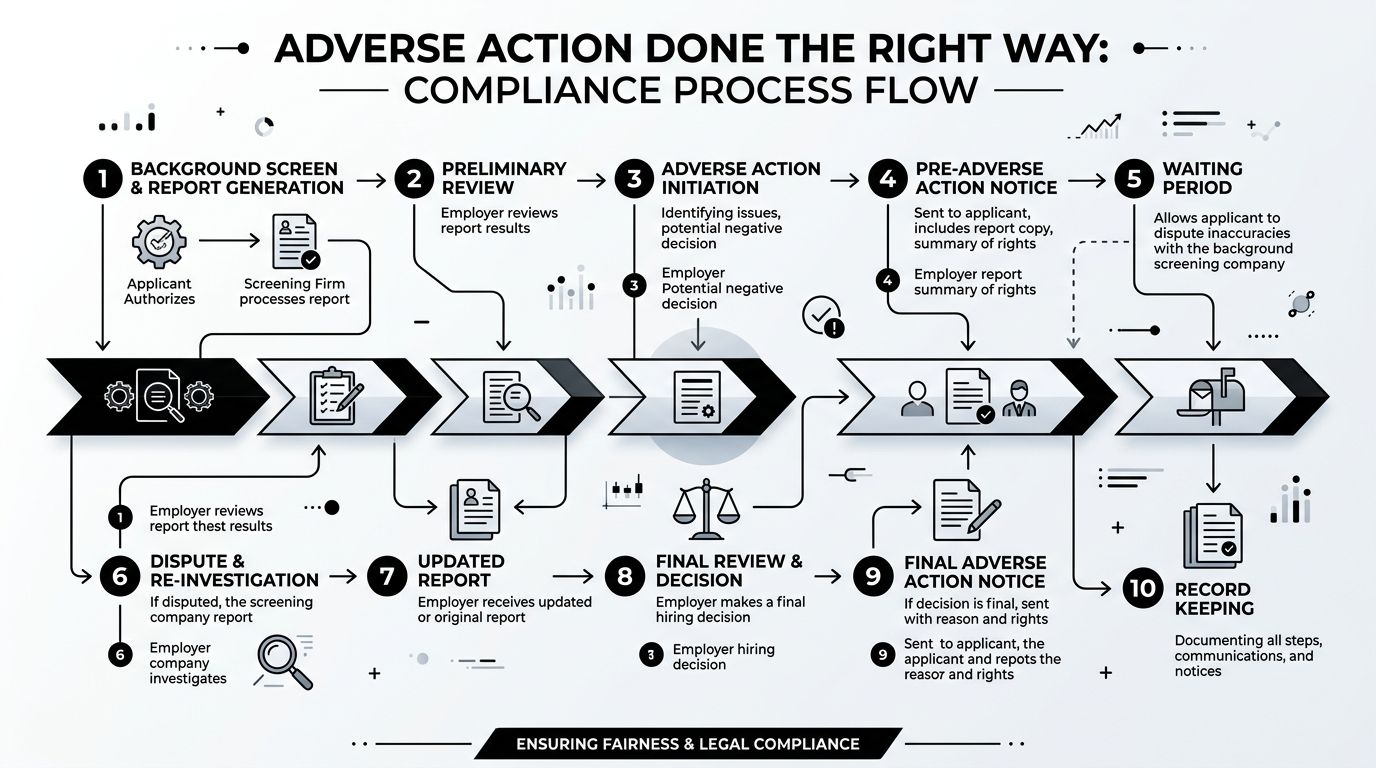
First, employers bury the disclosure in a packet and call it “close enough.” It isn't. The disclosure has to stand on its own. Second, they move to final rejection before the candidate's dispute has been processed. That's how you end up with a clean-looking workflow that still creates a mess in discovery.
Practical rule: don't improvise the adverse-action timeline because someone on the hiring team wants closure. The paperwork is the process.
If you're managing a law firm pipeline, treat this like case management. Someone owns the notice. Someone tracks the wait. Someone checks whether the candidate disputed the report. And someone confirms the final notice went out.
Recordkeeping matters too, because if you can't prove what happened, you didn't really manage the process. You just hoped for the best, which is not a compliance strategy, no matter how shiny the spreadsheet looks.
The best way to understand screening risk is to look at the documents that surfaced after the fact. That's where the story usually gets painfully ordinary.
In the 2022 HireRight class action, the headline issue was misreported criminal data. The paper trail mattered because the dispute wasn't about whether screening was allowed, it was about whether the report was accurate and whether the consumer had the chance to challenge it properly. When background data is wrong, the legal argument starts with the missing or defective paperwork, not the candidate's résumé. Audit-trail discipline in vetting
Another recurring trap shows up in the franchise context. In the Domino's FCRA settlement, the problem centered on a consolidated disclosure, which is exactly the kind of thing teams think is harmless until it isn't. If your disclosure shares space with extra acknowledgments, you've handed the other side a simple argument: the applicant didn't get the standalone notice the law requires.
Then there's the EEOC's finding against a logistics employer that revoked a CDL offer based on a sealed juvenile record. That's the kind of case that reminds employers criminal screening is not a vibes-based exercise. The document that hurt them wasn't a speech from HR, it was the audit log showing the report was never re-pulled before the withdrawal. Paper cuts become legal cuts very quickly.
The lesson is not “never screen.” The lesson is “screen with a trail.” If you can't show the authorization, the report, the notice, the timing, and the rationale, you're making it too easy for someone else to write your story for you.
Start before the report order. Review the job posting for prohibited questions, especially criminal-history questions that appear too early. Prepare a standalone disclosure and a separate authorization form. Combining them creates avoidable paperwork risk and makes it harder to show exactly what the candidate agreed to sign.
Set the screening scope by role. Vet the consumer reporting agency, record the permissible purpose, and provide the FCRA Summary of Rights before relying on the report. A remote paralegal role may justify a different inquiry than another legal-support position. Define the job-related reason for each search before ordering it, rather than expanding the check after receiving an unfavorable result.
For firms that need an operating model, the background verification process provides a useful structure for internal controls. Build one workflow covering intake, authorization, screening, review, notices, and retention. The goal is a file another person can audit without reconstructing the process from scattered emails.
Cross-border hiring adds a separate work-authorization track. Background screening addresses a different compliance need than employment authorization workflows. Use right to work checks with HR Management as a companion reference, then assign ownership for each process so the files do not blur together.
Assign a named owner to every checklist item. Intake, screening, evaluation, and adverse action each need a responsible person, a deadline, and a retained record. Without that structure, accountability disappears when the report reaches an inbox.
If you are building or cleaning up a law-firm screening workflow, audit the last five background checks against this checklist today. Tighten the forms, timing, scope, and owner assignments before the next candidate reaches the offer stage.