 15 minutes read
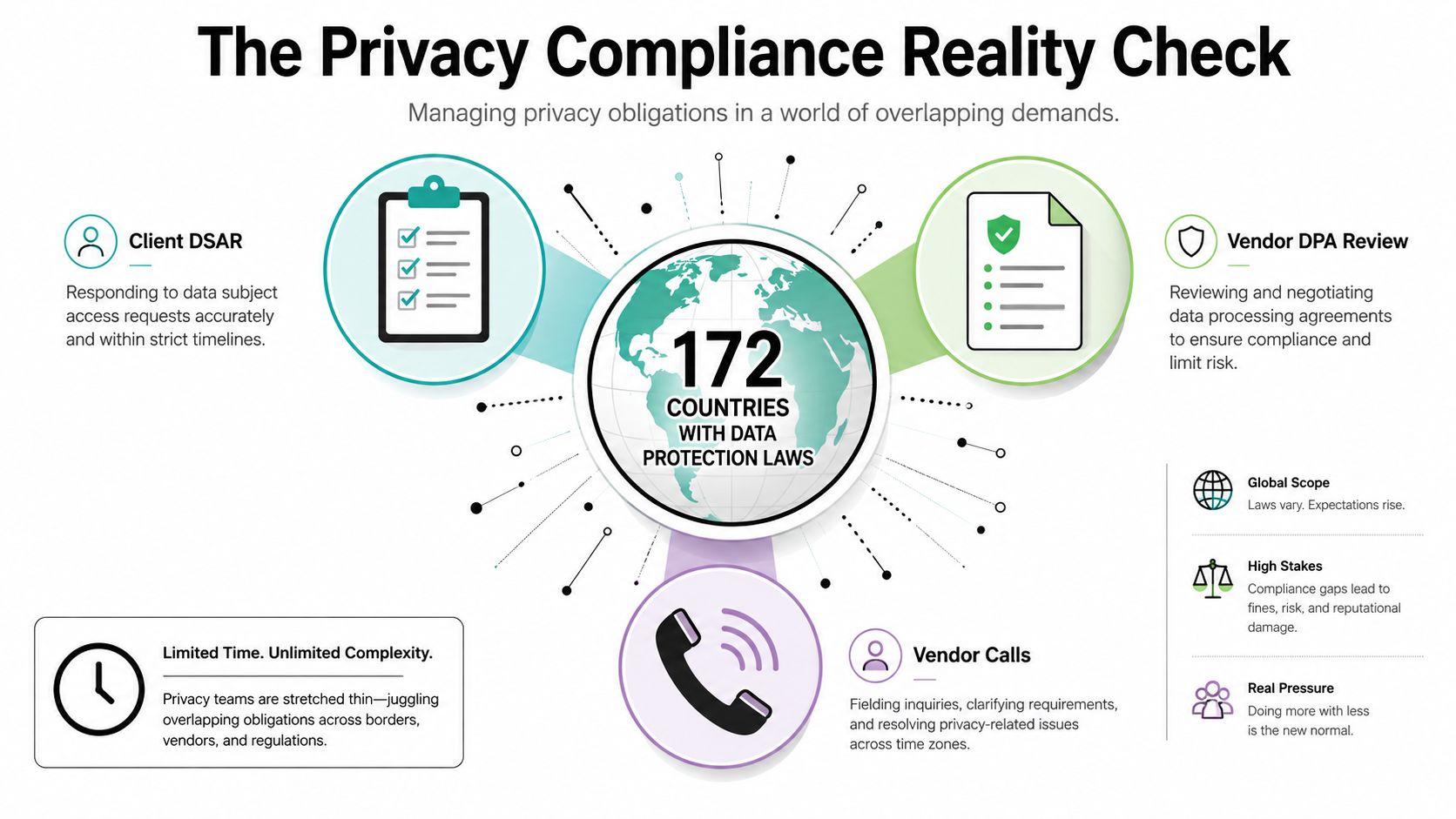
172 countries now enforce data protection laws, and privacy compliance is an operational program, not a one-time legal review. The firms that treat it like recurring legal operations will stay ahead, while firms waiting for a perfect policy binder will keep discovering the same problems under pressure.
A managing partner gets a client data subject access request before breakfast. A vendor is waiting for a data processing agreement. The firm's IT provider wants an answer about a suspicious login, and somebody still needs to return a call about a matter file. None of this arrives in a tidy legal checklist. It lands as work.
That's the central reality of data privacy regulations. The law creates obligations, but people, systems, vendors, and documentation determine whether the firm can meet them. The practical question isn't only, “Which rule applies?” It's, “Who will map the data, verify the requester, search the right systems, update the record, and prove the firm did all of that?”
By 2025, 172 countries enforced data protection laws, representing about 79% of nations worldwide, compared with roughly 100 countries in 2015, according to global privacy regulation research. The GDPR's application on 25 May 2018 accelerated that expansion, with ideas such as data protection by design, the right to erasure, and stronger breach-notification duties influencing laws across multiple regions.
For a law firm, the global count matters less as trivia than as a warning. A firm can advise a US client, use a cloud document platform, send work to a foreign support provider, and process information connected to another jurisdiction in the same matter. The compliance footprint follows the data.
Responsibility stays with the legal team. Outside privacy counsel can interpret requirements, but counsel usually won't maintain every data map, chase every vendor questionnaire, or monitor every request mailbox.
Regulator activity remains persistent. European supervisory authorities issued about EUR1.2 billion in GDPR fines in 2025, closely matching 2024's total, as reported in 2025 international privacy developments. That isn't a temporary blip. It's operating pressure.
Consent and rights requests create volume. A privacy notice doesn't process a deletion request. Someone must authenticate the requester, locate responsive records, apply legal holds, coordinate with vendors, and document the result.
Documentation determines defensibility. If the firm can't show what data it holds, why it holds it, who can access it, and what happened after a request or incident, a sensible compliance position becomes hard to defend.
A practical privacy program therefore runs as a cycle: intake, mapping, vendor review, rights response, incident handling, and audit maintenance. Firms handling confidential information should also reinforce the basics through confidential information handling guidance. The work never becomes glamorous. It does become manageable when somebody owns the queue.
Privacy laws use different terminology, but the operating principles are familiar. Think of them as four questions a firm should be able to answer for every important data flow.
A firm needs a defensible reason to process personal data. Common bases include consent, contract, and legitimate interest. Consent must be meaningful, contract processing must be connected to the service, and legitimate interest requires an actual balancing analysis, not a convenient label.
Review client intake forms, website forms, cookie settings, and engagement communications. If a form collects information for marketing, conflict checks, client service, and analytics without distinguishing those purposes, the firm has created an avoidable ambiguity. For cross-border matters, specialist support such as EU GDPR representation services can help firms assess local representation and compliance needs.
People may have rights to access, correction, deletion, portability, restriction, or opting out, depending on the applicable law and the data involved. The firm should give those requests one monitored entry point, such as a privacy mailbox or intake form, rather than forcing requesters to guess which lawyer to contact.
Build a request record with the date received, identity-verification method, systems searched, custodians consulted, exclusions applied, response, and completion date. A request is a legal workflow, not an email thread.
Collect what the matter requires and no more. Scrub unnecessary CRM fields, remove duplicate exports, restrict free-text notes that invite sensitive information, and set retention rules for temporary working files.

Practical rule: If nobody can explain why a field exists, treat that field as a compliance question.
Information gathered for one purpose shouldn't become a resource for another. An engagement letter may support representation, but that doesn't automatically justify marketing, automated profiling, or unrelated product development.
Audit privacy notices and engagement letters against actual use. The test is simple: what did the firm tell the person, what did it promise, and what is it doing now? Those three answers should align.
GDPR's penalty architecture makes privacy failures a revenue problem, not merely a paperwork problem. Serious infringements can reach €20 million or 4% of prior fiscal-year global turnover, whichever is higher. Less severe violations can reach €10 million or 2% of global turnover, as explained in the GDPR penalty framework.
The top tier applies to the plumbing firms often underestimate: core processing principles, consent conditions, data subject rights, and transfers to third countries or international organisations. That means a broken consent mechanism, ignored access request, or unsupported international transfer can create serious exposure even when no dramatic breach occurred.
| Penalty Tier | Maximum Amount | Common Triggers |
|---|---|---|
| Lower tier | €10 million or 2% of global turnover, whichever is higher | Certain administrative and operational violations |
| Upper tier | €20 million or 4% of global turnover, whichever is higher | Core processing principles, consent, rights, and international transfer failures |
A US-headquartered firm doesn't get a local-only risk profile just because its offices sit outside Europe. If it processes personal data covered by GDPR, exposure can scale against worldwide revenue rather than the revenue of one office or matter. The firm should map cross-border processing, vendor access, storage locations, transfer mechanisms, and supplementary safeguards before a regulator asks for the map.
Modern Standard Contractual Clauses also aren't a magic signature page. The European Commission's SCC framework, updated on 4 June 2021, works alongside a transfer impact assessment that evaluates destination-country law and the safeguards used, as described in the European Commission SCC guidance.
A useful control is technical testing paired with legal review. Firms evaluating provider security can use resources on GDPR testing for service providers, then document what the testing covered and what remediation followed.
The conclusion is blunt. Privacy failures are workflow failures. Prevention costs staff time and disciplined documentation. Defense costs staff time, urgency, outside counsel, executive attention, and potentially much more.
US privacy analysis starts with the data, the business activity, and the people affected. Don't begin with a giant spreadsheet of statutes. Begin by sorting the obligation into three buckets.
HIPAA governs covered health information and brings Security Rule and breach obligations into the analysis. GLBA imposes safeguards expectations on covered financial institutions. COPPA addresses information collected from children under 13. A law firm handling health, financial, or children's information may need a sector-specific review even when a broad consumer privacy statute doesn't apply.
California's CCPA and CPRA remain the reference point for access, deletion, correction, opt-out, sensitive information, and contractual controls. The state model has influenced Virginia's VCDPA, Colorado's CPA, Connecticut's CTDPA, Utah's UCPA, Tennessee, Indiana, Kentucky, and other statutes.
The important operational difference is not just the rights list. It's the scope threshold, definition of sale, treatment of sensitive data, universal opt-out expectations, cure period, and enforcement model. California also includes a private right of action in specified circumstances, which changes litigation risk.
| State | Effective Date | Scope Threshold | Right of Action | Key Distinction |
|---|---|---|---|---|
| California | Existing CCPA and CPRA framework | Covered-business analysis under California law | Limited private right of action in specified circumstances | Broad rights and sensitive-information controls |
| Virginia | Existing VCDPA framework | Statutory consumer and revenue tests | No general private right of action | Opt-out model with controller and processor duties |
| Colorado | Existing CPA framework | Statutory consumer and revenue tests | No general private right of action | Profiling and universal opt-out considerations |
| Connecticut | Existing CTDPA framework | Statutory consumer and sensitive-data tests | No general private right of action | Consumer-friendly rights and cure history |
| Indiana | 1 January 2026 | Statutory consumer-processing tests | No general private right of action | New compliance obligations for covered businesses |
| Kentucky | 1 January 2026 | Statutory consumer and revenue tests | No general private right of action | Closely tracks Virginia-style concepts |
| Rhode Island | 1 January 2026 | Statutory consumer and revenue tests | No general private right of action | No cure period identified in the reviewed source |
The 2025 US state patchwork and the laws effective on 1 January 2026, including Indiana, Kentucky, and Rhode Island, make one-size-fits-all guidance increasingly incomplete, as detailed in privacy developments for 2026 compliance.
GDPR and UK GDPR shape European processing. Canada's PIPEDA uses a real-risk-of-significant-harm threshold for breach reporting and requires breach records. Brazil's LGPD, India's DPDPA, and China's PIPL add further jurisdictional analysis.
Treat international transfers as a separate workstream. A contract alone won't answer where the data goes, who can access it, what destination-country law permits, or which technical safeguards close the gap.
Small and mid-sized firms shouldn't start by buying a massive platform or rewriting every policy. Start with the operational sequence that exposes risk fastest.
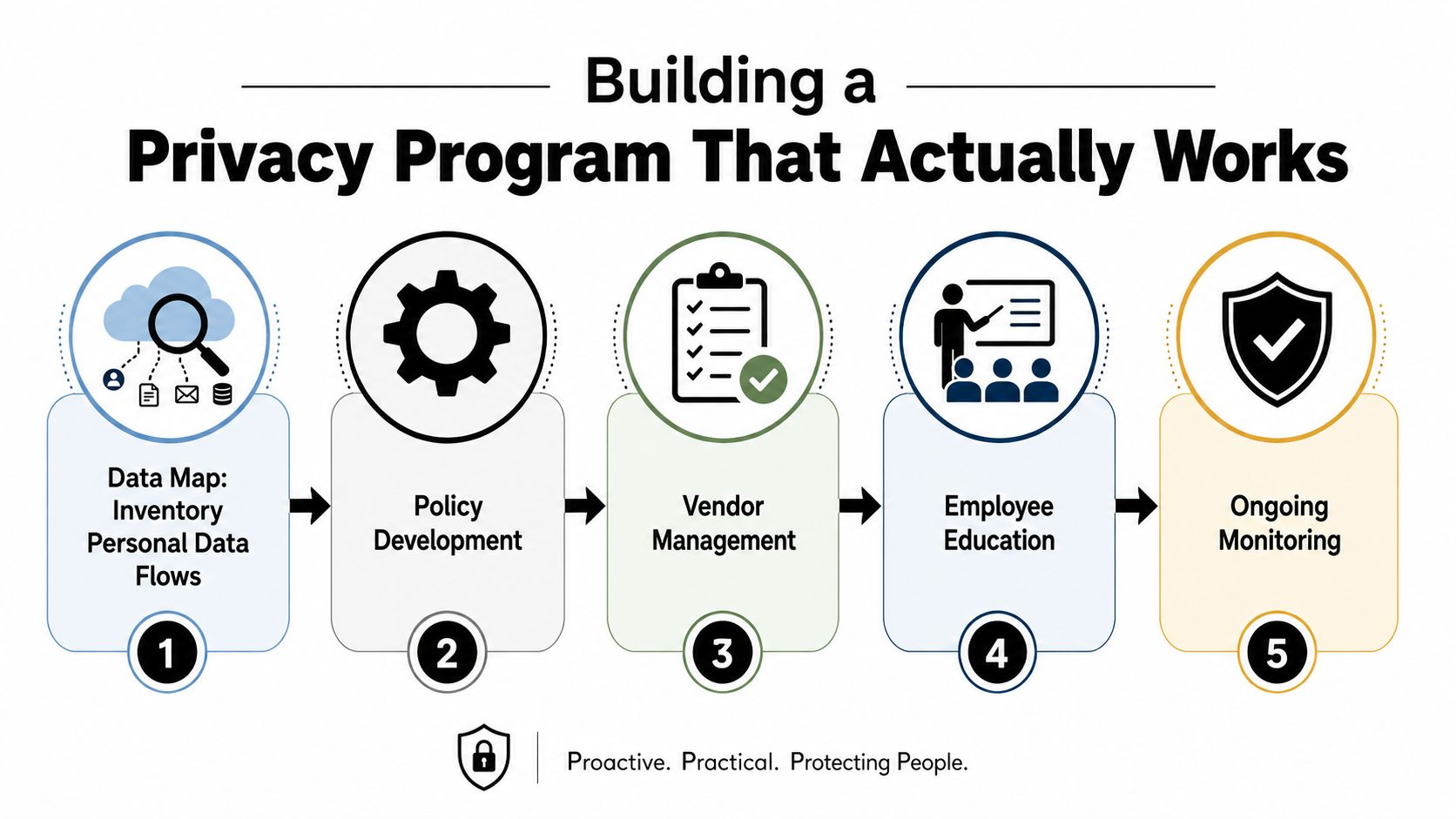
Inventory personal data entering, moving through, and leaving each matter. Include email, cloud storage, the document management system, case-management software, spreadsheets, local downloads, external discovery platforms, and exports sent to vendors.
Record the data category, purpose, owner, location, access group, retention rule, transfer route, and vendor involvement. A data map that excludes “temporary” spreadsheets is not a data map. It's a politely formatted omission.
Create an intake form, verification procedure, search protocol, exception review, approval path, and response template. Assign one owner and one backup. State deadlines vary, so the workflow should calculate the applicable clock from the request type and jurisdiction rather than rely on memory.
For California, access obligations can extend beyond the original 12-month lookback for information collected on or after 1 January 2022, unless providing it is impossible or involves disproportionate effort, as explained in California privacy request guidance. That makes historical data mapping especially important.
Maintain a vendor register with the service, data categories, processing purpose, hosting location, subprocessors, security commitments, deletion terms, incident duties, audit rights, and transfer mechanism. Require a DPA where appropriate, but don't stop there. A signed agreement cannot fix an unknown data flow.
Use a security questionnaire proportionate to the information involved. High-risk vendors deserve deeper review, evidence, and documented approval.
For practical controls covering access, vendors, and client information, use the firm's data security protocols as an operating reference. The program should leave evidence behind every time somebody touches the workflow.
A phishing compromise exposes client matter files. The first person who notices isn't sure whether the attacker downloaded anything. The IT provider wants a decision, the insurer wants a report, and the partner wants to know whether a client must be called.
That is when a rehearsed sequence earns its keep.
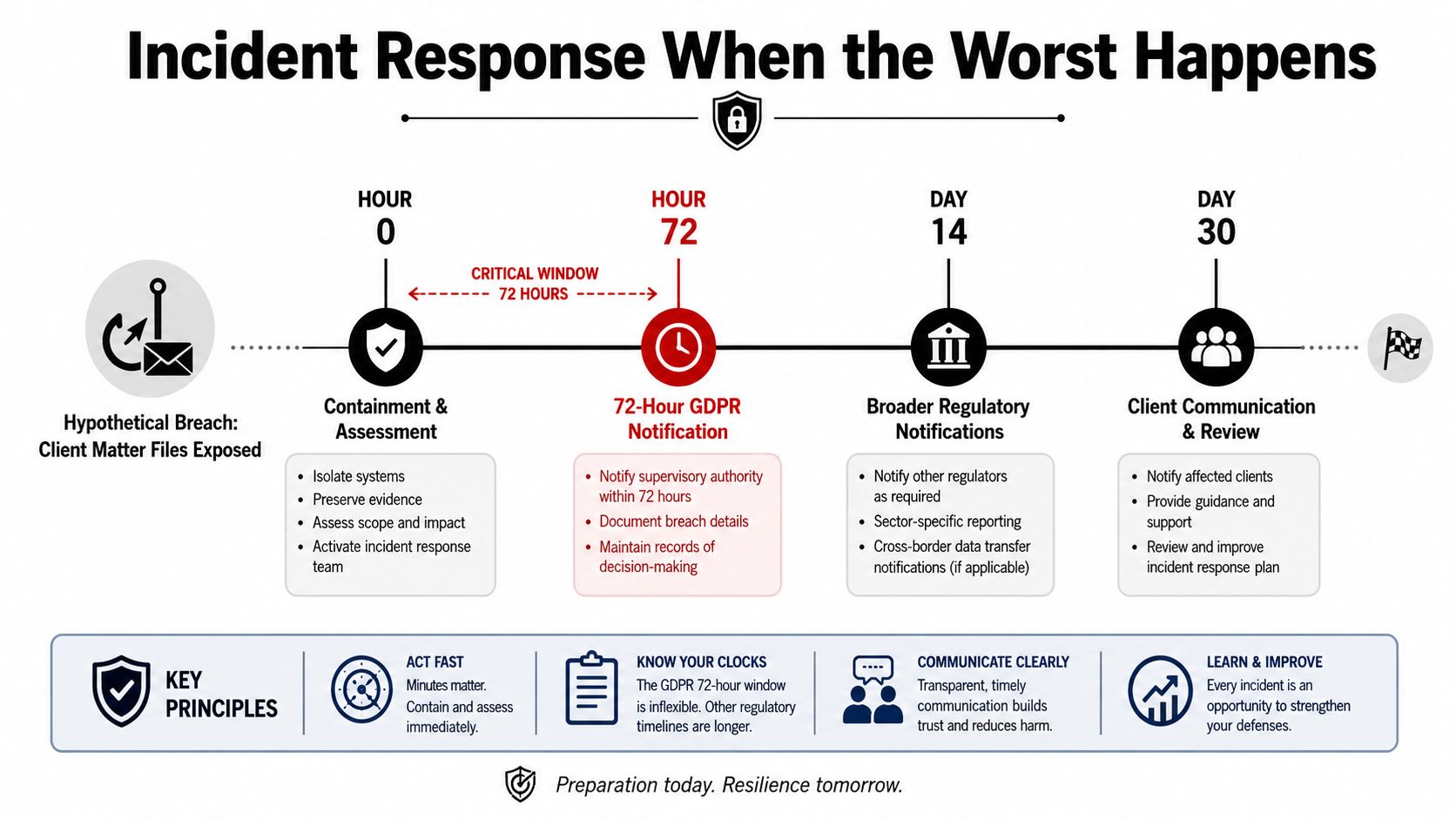
GDPR's supervisory-authority notification obligation is commonly managed against a 72-hour clock. PIPEDA works differently. It requires reporting to the Office of the Privacy Commissioner and notifying affected individuals when there is a real risk of significant harm, while also requiring breach records. The source reviewed does not identify a fixed hourly deadline under PIPEDA, so the operational trigger is harm assessment and action as soon as feasible, not a universal stopwatch, as explained in PIPEDA breach notification guidance.
Paralegals can maintain the incident log, assemble affected-record inventories, track notification decisions, prepare regulator filings, coordinate client letters, and compile insurance carrier reports. Counsel should control legal judgments and the investigation structure. Use a privilege-conscious investigation wrapper from the start, with clear instructions about who is conducting the legal analysis and why.
A disciplined audit trail management process makes the difference between “we handled it” and “here is what we did, when, and on whose authority.”
AI systems don't replace privacy obligations. They make old privacy questions harder to ignore.
California's Privacy Protection Agency approved new rules in mid-2025 concerning automated decision-making technology, risk assessments, and cybersecurity audits, while the UK's Data (Use and Access) Act 2025 introduced phased changes and new DSAR search standards, according to the June 2025 data protection update. Firms using screening, triage, recommendation, review, or drafting tools need to understand what data the system receives and what output it produces.
Start with the same questions used for ordinary processing:
A DPIA can become useful AI governance scaffolding, but it shouldn't be copied and renamed. Add model purpose, training or retrieval data, performance limitations, bias testing, human oversight, output retention, vendor dependencies, and change control.
Create an inventory of AI tools and models beside the existing vendor and processing registers. Link each tool to its owner, approved use, prohibited use, data categories, supplier terms, review date, and incident route. Firms preparing for broader AI oversight can also review AI audit readiness with digna as they formalize governance evidence.
The best program is continuous because the systems change continuously. A new feature, vendor update, model, jurisdiction, or client instruction can alter the risk without changing the firm's branding or policy language.
Privacy counsel can set direction. They shouldn't spend the whole week chasing missing vendor questionnaires and renaming spreadsheet tabs.
The work is operational, repetitive, and relentless. That makes vetted on-demand paralegal support a sensible staffing model for firms that need execution without adding a permanent headcount line. A trained paralegal can manage DSAR intake, maintain records of processing activities, update vendor registers, coordinate questionnaires, preserve breach logs, and prepare first-draft documentation for attorney review.
A firm can source support through platforms that match law firms with remote legal professionals. HireParalegals is one example, offering on-demand legal support and a stated focus on data privacy law professionals and tech-law talent. The firm should still define the scope, confidentiality requirements, supervision model, access limits, and attorney-approval checkpoints before work begins.
Download a privacy checklist and a paralegal scope-of-work template, then turn them into assigned tasks with owners and due dates. Compliance isn't a policy sitting in a folder. It's a sequence of completed actions.
Start Monday morning with the data inventory, the request mailbox, and the vendor register. If your team can't absorb the workload, bring in qualified on-demand support for the repeatable tasks, keep legal judgment with counsel, and review progress at the end of each 30-day phase.