 17 minutes read
Monday morning. A partner opens last week's timesheet and finds a familiar mess: three remote paralegals working under the same staffing umbrella, several entries with no matter assigned, and one lawyer who “fixed” Friday before anyone could ask questions. The billing team now has to decode the work, chase the missing context, and hope the invoice survives client review.
That isn't a software problem. It's an operating-system problem.
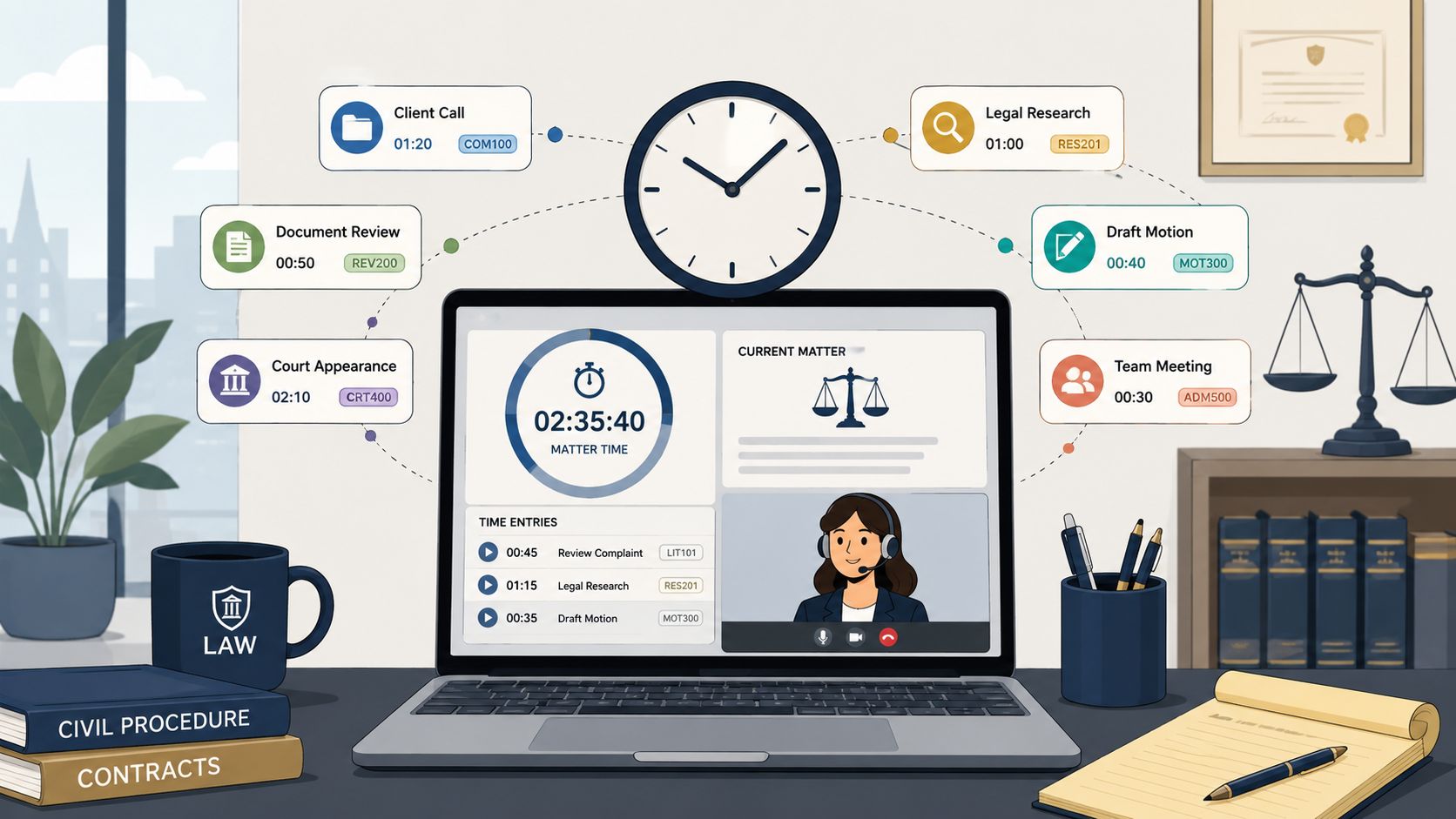
Legal time tracking is the disciplined capture of task-level work against the correct matter, client, billing code, duration, and narrative. Done properly, it gives a firm usable invoice entries, realization data, and operational visibility. Done badly, it produces vague descriptions, delayed billing, and a weekly scavenger hunt across email, calendars, documents, and Slack.
Remote teams make the weak points obvious. A paralegal in one time zone hands off a filing task to someone in another, the attorney reviews it hours later, and the firm has two billing systems with slightly different codes. Everyone worked. Nobody has a clean record.
The Monday problem above usually starts with a category mistake. A firm treats time tracking as a stopwatch, when it needs a matter-based record of work.
A stopwatch answers one question, how long did someone work? Legal time tracking answers several more:
Those inputs become billable entries, internal productivity signals, and realization data. The output isn't merely a timesheet. It's the evidence connecting work performed to revenue collected and client expectations.
Payroll records answer a different question. The U.S. Department of Labor says employers must record the start of the workweek, hours worked each day, and total hours worked during the workweek. It also says work must be counted and paid when an employer knows or has reason to believe it was performed, as explained in the Department of Labor's hours and recordkeeping guidance.
That record doesn't tell a client whether a paralegal drafted discovery responses, coordinated a deposition, reviewed medical records, or attended an internal meeting. PTO clocks and payroll systems protect wage compliance. Practice-management time entries protect billing accuracy and matter accountability.
Project-management burn charts have another job. They show whether a project is consuming planned effort. They don't necessarily produce a client-ready narrative or comply with outside-counsel billing rules.
In an office, someone can lean over and ask, “Which matter was that filing for?” In a distributed team, that question may arrive after the worker has signed off and the attorney is beginning the day. A remote-compatible system therefore needs clear matter ownership, code definitions, handoff notes, and a same-day review habit.

Practical rule: If a supervisor can't understand an entry without opening three systems and sending two messages, the entry isn't finished.
The system should make the right action easier than reconstruction. Otherwise, Friday gets “fixed,” small tasks disappear, and the firm confuses activity with recoverable work.
Firms track time because billing, compliance, and management decisions depend on the record. For distributed teams, that record must survive different time zones, delayed handoffs, and work completed outside a shared office.
A time entry becomes part of the invoice. If a remote paralegal organizes exhibits, sends matter-related emails, and prepares a filing package but records only the main drafting block, the firm has described less work than it performed. The missing tasks do not appear as a visible accounting loss. They never become revenue.
Weak capture is especially costly when a matter generates substantial effort but produces poor realization. Clio data summarized by Billnotch found that the average lawyer records 2.9 billable hours in an 8-hour day, a 37% utilization rate. The same reporting places realization at about 88%, with firms collecting roughly $910 for every $1,000 of billable work performed. These figures do not define every firm's performance. They do show why partners need to manage both captured work and collected fees.
For distributed staff, billing protection begins with matter context. A paralegal should not have to guess whether document review belongs to a general litigation matter, a related arbitration file, or a firm administrative code. Set those rules before the work starts.
Outside-counsel guidelines may reject block billing, vague narratives, duplicate entries, administrative work, or incorrect task codes. A client audit asks whether the invoice shows what happened, for whom, and under which billing rule. It does not give credit for effort that the entry fails to explain.
Contemporaneous entries give the firm evidence it can review. Reconstructed entries leave the firm defending memory. That difference matters during an audit, a fee dispute, or an ethics review, particularly when the lawyer and paralegal work in different time zones.
Time data shows which matters consume effort without producing a healthy return. A partner may assume a paralegal is slow because tasks arrive late. The entries may show repeated rework caused by incomplete attorney instructions. Another matter may appear profitable until internal coordination and write-downs reveal that the team is subsidizing it.
Remote teams gain a clearer view because managers cannot observe hallway interruptions, informal handoffs, or invisible rework. Consistent entries expose those patterns across locations and working hours.
Bad inputs still produce confident nonsense. A polished dashboard built on vague entries is an expensive way to make the wrong decision. Require specific narratives, consistent codes, and prompt review before trusting the numbers.
Tracking time doesn't mean recording all the time that was worked. That difference is where many firms lose money.
The billable hour is widely traced to Reginald Heber Smith at Hale and Dorr, where a 1913 accounting and recordkeeping system tracked the hours each lawyer spent on each matter. The approach became the de facto standard for legal pricing in the early 1970s, marking the move from flat-fee and informal billing toward systematic time tracking in major law markets, as documented in this history of the billable hour.
The modern issue isn't whether the billable hour exists. It's whether the firm captures the work before memory edits it.
A paralegal finishes a research task, answers a quick client email, updates a case chronology, and joins a handoff call. The large task survives. The small tasks become “miscellaneous admin,” then vanish. On Monday morning, the paralegal remembers the outcome but not every transition.
Industry guidance recommends capturing work as it happens or within the same business day, using standardized matter and task codes, and reviewing entries in short cycles. That advice is especially important where firms use six-minute billing increments, or 0.1 hour, because small delays and rounding decisions can accumulate across a matter, according to legal time-tracking best practices.
The usual excuses don't survive contact with a billing report:
No, the attorney probably doesn't. The client certainly shouldn't have to guess.
The false economy is spending less time entering work and then losing the work entirely.
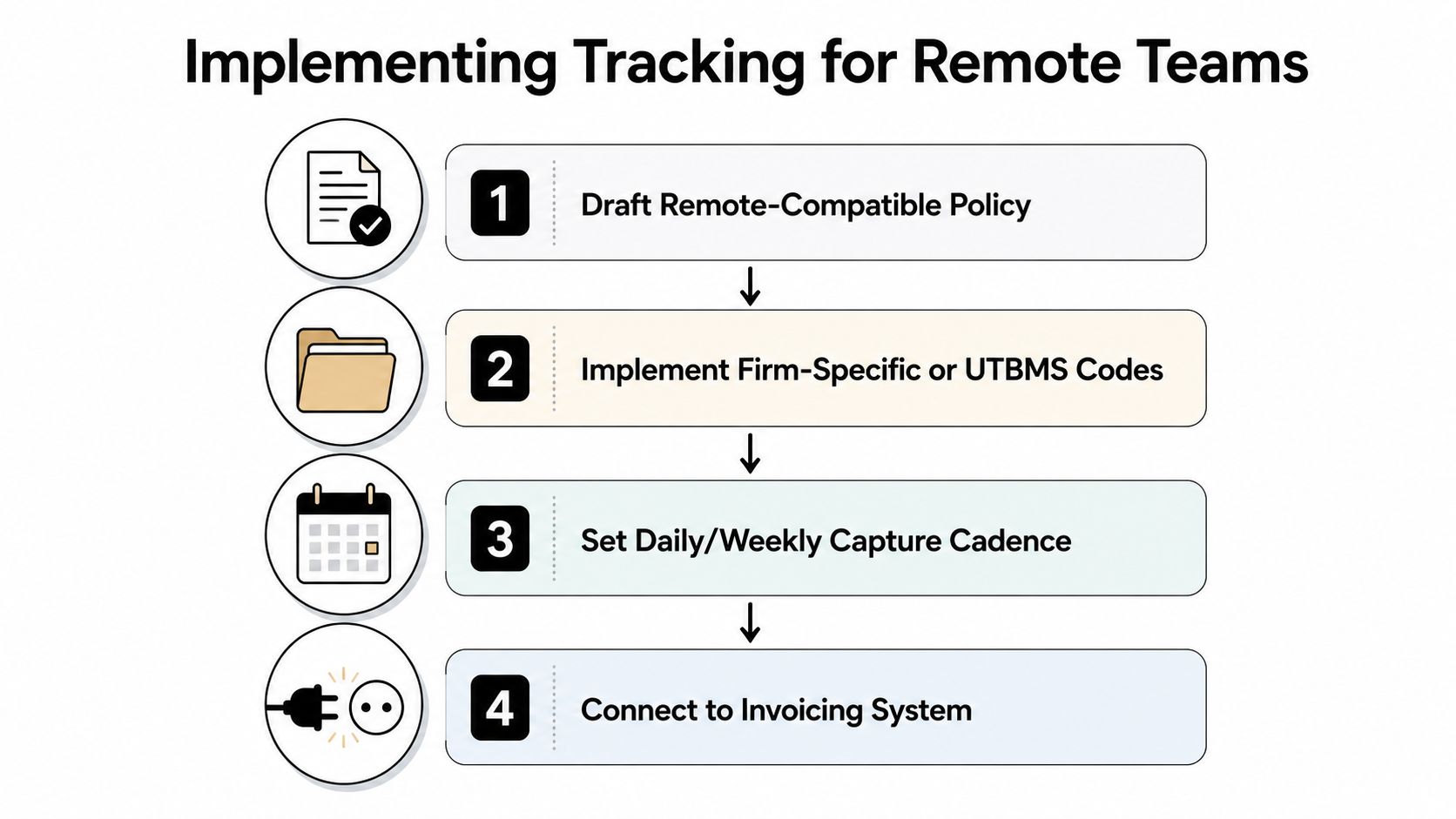
Better capture is primarily a discipline problem. Software can surface a calendar event or draft a suggested entry, but it can't decide whether a task was billable, whether the narrative is defensible, or whether the client permits the charge. Firms need a policy, a cadence, and a reviewer who treats time records as operational data rather than an afterthought.
Start with policy. Don't buy a shiny timer and hope culture catches up.
A remote policy should state when time gets recorded, who reviews it, how workers handle interruptions, and what happens when a matter or code is unclear. It should also recognize timezone reality. “End of day” must identify whose day, and a handoff between a Pacific-time paralegal and an Eastern-time attorney needs a documented review window.
Use UTBMS codes where client requirements call for them, or create a firm-specific list that people can use. A code list with overlapping labels guarantees inconsistent entries. “Document work,” “case preparation,” and “file review” may sound different to three people and identical to the billing department.
Keep the first version narrow. Map common tasks such as drafting, correspondence, research, filing, discovery, scheduling, and internal administration. Add an escalation rule for exceptions instead of creating a new code every time someone encounters an unusual task.
The standard should be hours, not days. A practical policy might require an active timer for discrete tasks, same-day entry review, and a daily summary for work performed away from the primary system. A remote paralegal who finishes before the supervising attorney's local morning shouldn't wait several days for approval. The entry can remain pending, but the worker's memory shouldn't be the storage system.
Supervisors should review for specificity and correct matter assignment, not monitor mouse movement. That's the difference between management and surveillance. Ask whether the entry explains the work and meets the billing rule. Don't punish a worker for taking a short break between tasks or for working across a timezone boundary.
Remote-work rule: A handoff is complete only when the next person can identify the matter, task, current status, and time entry without a private conversation.
Use a shared channel for time-entry questions and a predictable escalation path. For broader calendar and handoff discipline, firms can also review this guide to paralegal calendar management.
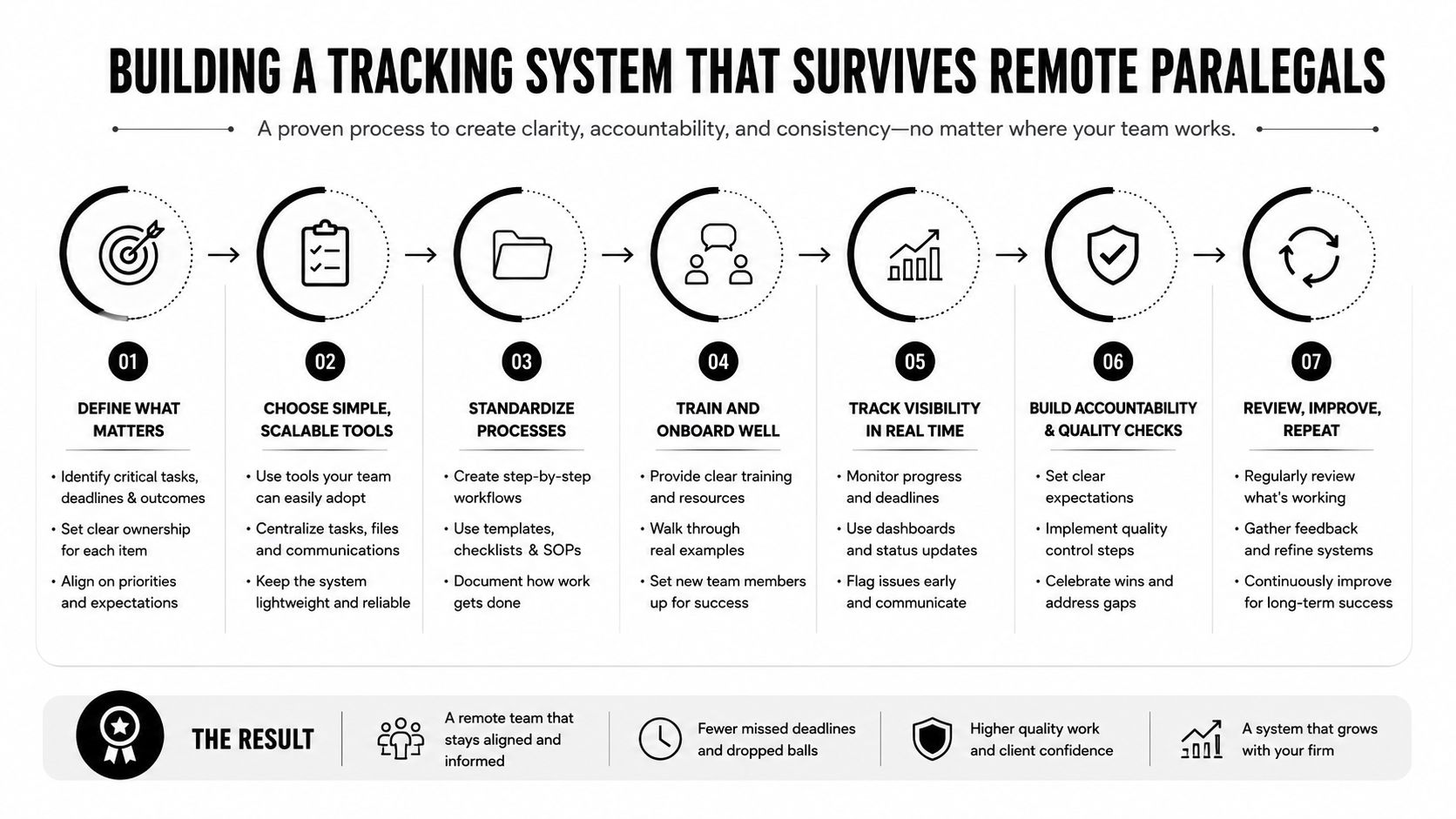
Make these decisions this week: the approved codes, the entry deadline, the reviewer, and the escalation channel. Get firm-wide buy-in before changing client billing rules, outside-counsel mappings, or compensation metrics. A policy nobody understands is just office décor with legal vocabulary.
The right tool depends on how much matter context your firm already has. A free consumer timer may track minutes, but if it doesn't know the matter, task, client rule, or accounting destination, it creates clerical work instead of removing it.
| Category | Best Fit | Watch Out For | Integration Depth |
|---|---|---|---|
| Manual timers inside practice-management suites | Small teams that can enforce same-day use | Forgotten timers, weak narratives, per-seat pricing | Strong for matters, billing, and accounting |
| Dedicated legal time-tracking apps | Firms wanting focused entry workflows across systems | Duplicate data entry and disconnected matter context | Moderate, depending on exports and connectors |
| AI-assisted capture tools | High-volume teams losing small tasks and context switches | Invented descriptions, privacy concerns, and review burden | Potentially broad, but governance is essential |
Clio, MyCase, PracticePanther, and TimeSolv sit in the practical middle. They generally make more sense than a separate timer when the firm wants time, matters, invoices, and accounting in one environment. Their weakness is behavioral. A timer still fails when someone forgets to start it, leaves it running, or selects the wrong matter.
Per-seat pricing can also punish growth. A firm scaling remote paralegals should model the cost of every additional user, administrator, integration, and billing workflow before committing. The cheapest subscription isn't cheap if billing staff must repair every export.
Dedicated apps earn their keep when the firm's practice-management suite doesn't capture activity across email, calendars, document systems, and research tools. The valuable integrations are specific:
AI-assisted capture can reduce manual administration and recover work that would otherwise go unentered. One legal-technology source estimates firms may lose 10% to 20% of billable time annually through inaccurate end-of-day tracking, as discussed by the American Bar Association's legal technology coverage of AI time tracking. That is a reason to test the category, not a reason to hand an algorithm the keys.
For firms with 2 to 10 remote paralegals, I'd start with a practice-management suite, enforced codes, calendar integration, and a simple daily review. Past 25 remote paralegals, add dedicated billing operations and evaluate AI capture for high-volume workflows. If the broader workflow needs automation, this overview of legal workflow automation is a useful adjacent resource.
A distributed team can follow the same policy and still produce unreliable billing data. The difference comes from review discipline, clear ownership, and deadlines that account for timezone gaps. Measure whether work enters the system promptly, whether approved time becomes invoiceable revenue, and whether matter economics match expectations. Use these metrics to find process failures, training gaps, and matter-level problems, not to rank every worker.
Track five signals:
These signals need operational context. A delayed entry may reflect an approval window across time zones rather than poor discipline. A low realization rate may reflect a client rule that rejects certain codes, not a paralegal's performance. Review trends by matter, task, reviewer, and location before assigning blame.
Run a quarterly sample of entries. Check code selection, narrative clarity, matter assignment, prohibited tasks, duplicate work, and unexplained write-downs. Reconcile approved time with billing output, then record the reason for each correction. Point-of-entry validation can flag missing context, prohibited descriptions, and inconsistent non-chargeable coding before an entry reaches the invoice. For broader controls, use this guide to audit trail management.
Assign audit work to the people who can act on it. Accounting owns invoice reconciliation. The paralegal lead reviews coaching patterns. Attorneys resolve matter-specific judgment calls. Document management supplies context, calendars corroborate scheduled events, and staffing-platform reports help compare utilization across distributed staff.
Good audit practice: Review the record, not the person. Correct the workflow before blaming the worker.
A durable system connects billing, documents, calendars, and staffing reports. Without those connections, managers ask remote paralegals to recreate context the firm failed to preserve. Configure the integrations, define exception ownership, and test the full audit trail across time zones before relying on the dashboard.
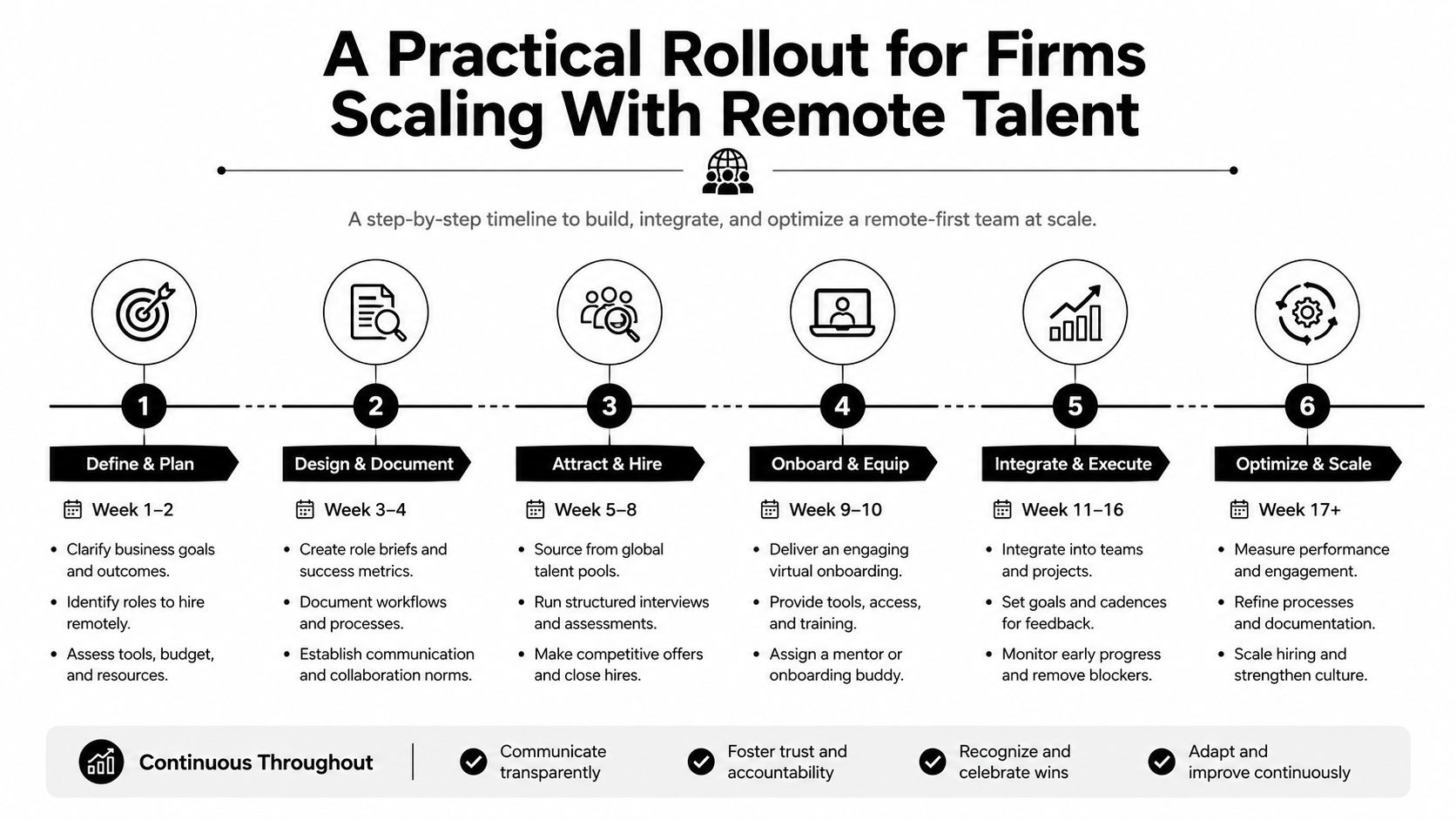
Don't launch this as a grand transformation. Launch it as a controlled operating change with named owners and visible artifacts.
The firm owner approves a one-page timekeeping policy. The remote paralegal lead converts it into examples, including active timers, daily summary entries, code selection, handoffs, and exception handling. The attorney cohort reviews the policy for client-specific billing rules and agrees to answer matter questions promptly.
Every new remote paralegal gets desk-side onboarding over Zoom before the first billable day. “Desk-side” means the trainer watches the actual workflow, opens a test matter, selects a code, writes a narrative, and submits an entry. A PDF nobody opens isn't training.
Lock the code list inside the practice-management system. Connect the accounting export, confirm calendar and document-management links, and test the workflow with real matter patterns. Create a shared Slack channel for time-entry questions so answers become searchable instead of trapped in private messages.
Pair each remote paralegal with a senior reviewer. The reviewer spot-checks entries weekly, focusing on matter assignment, narrative quality, and client-rule compliance. This is coaching, not a digital ankle bracelet.
Publish a weekly capture-rate report for managers and a monthly time-entry reconciliation meeting for billing, staffing, and practice leadership. Review exceptions by cause. A missed entry caused by an unclear code needs policy repair. A recurring delay caused by an overloaded reviewer needs capacity planning.
Firms that want to connect this rollout to broader workflow design can explore automation for legal practices as a separate operational resource. Automation should remove repetitive administration, not replace professional judgment.
The rollout is done when staff enter time without chasing, reviewers resolve exceptions quickly, and realization improves by three points in one quarter without anyone hunting down timesheets. Until then, you're still piloting, even if the software vendor has already declared victory.
Should we use six-minute increments or another format?
Most firms use six-minute increments, also called tenths of an hour, or 0.1 hour, while some use 10-minute or 15-minute increments, as explained in this guide to legal billing increments. The ABA doesn't mandate one increment, but billing still needs to be fair, reasonable, and transparent, as outlined in this explanation of attorney billing increment rules.
My recommendation is simple. Pick one default, document it, and map every remote worker and billing system to it. Mixing increments across teams creates inconsistent rounding and makes matter comparisons harder.
Can AI capture time accurately?
AI can surface activity from calendars, documents, and email, draft suggestions, and reduce manual reconstruction. It can also invent a description, assign the wrong matter, expose sensitive context, or turn an ambiguous activity into a confident-looking entry.
The human who performed or supervised the work must approve billable time. In a 2026 legal-admin survey, 35% of legal professionals said they don't trust AI, 25% cited privacy or confidentiality concerns, and time tracking was the top stress source for 44% of respondents, according to legal administration trend reporting. Passive capture needs disclosure, access controls, retention rules, and a clear explanation of what data the system sees.
What accuracy target should leadership use?
Use 95% of working hours recorded within 48 hours as a defensible operational benchmark, with a 98% target for senior staff. Measure it through a weekly report comparing expected working windows, matter activity, approved entries, and exception notes. Don't ask managers to inspect every line manually. Sample the exceptions and coach the people or workflows creating them.
What proves compliance during an audit?
A defensible record includes contemporaneous entries, specific narratives, correct matter and task codes, conflict checks, and an exportable audit trail from the timekeeping software. Point-of-entry validation should catch prohibited descriptions, missing context, block billing, and inconsistent non-chargeable coding before release.
Where does a staffing platform fit?
HireParalegals is a staffing layer, not a time tracker. Its remote legal support model can include people who understand time-entry deadlines and billing workflows, which makes onboarding easier when the firm has already defined its capture cadence. The firm still owns the policy, software, supervision, and final approval.
The practical move is to stop asking which tool will save time and start asking which behavior the tool will make unavoidable. Choose the policy first, train the people, connect the systems, and audit the exceptions. That's how firms stop mortgaging their billing department to a spreadsheet.
This quarter, appoint one owner for legal time tracking, publish the one-page policy, lock the code list, and run a controlled pilot with your remote paralegal team. Then review the weekly capture report and monthly reconciliation together, fix the workflow failures you find, and make billing accuracy part of normal operations rather than a Friday afternoon emergency.