 19 minutes read
Most legal compliance advice starts with the wrong prescription: write better policies, update the spreadsheet, schedule an annual review, and hope nobody asks difficult questions. That approach confuses documentation with control. A policy sitting in a shared drive doesn't stop a trust-account error, catch a conflict before engagement, or prove who approved a cross-border payroll arrangement.
The core issue within many US law firms is simpler and more uncomfortable. The person responsible for compliance often doesn't have enough time, authority, or operational support to run it. The SRA found that compliance officers spent only 26% of their time on compliance tasks, while nearly half reported insufficient time and resources, according to the legal compliance benchmarking reference. A law firm can own every necessary policy and still fail because nobody runs the controls consistently.
Legal compliance management works when it becomes an operating discipline. That means named owners, repeatable workflows, evidence trails, escalation rules, and people who can execute the work when partners are busy practicing law. The sections below take the practical route, including governance, remote paralegal staffing, cross-border payroll, and the trade-offs small and mid-sized firms usually discover the hard way.
A checklist tells you what should happen. It doesn't make the thing happen.
That distinction matters because law firms often mistake a completed policy review for a functioning compliance program. The managing partner signs the manual, someone circulates a training deck, and the operations team files the evidence. Everyone feels productive. Then a lateral hire arrives with a hidden conflict, a remote worker accesses the wrong client folder, or a sanctions-related filing deadline lands during trial preparation.
The checklist isn't the control. The workflow is.
Compliance fails less often because firms don't know the rules than because nobody has enough capacity to translate those rules into daily behavior. A partner may technically own the risk, while an office manager manages the calendar, an IT vendor controls access, and a paralegal handles the underlying records. That arrangement creates responsibility without operational ownership.
The pressure is rising. Thomson Reuters reported that its Regulatory Intelligence service tracked an average of 257 daily alerts across 190 countries in 2020, a scale described in the ACC legal department management report. A firm handling multi-state or international matters can't monitor that environment through occasional partner emails and a spreadsheet with a cheerful green status column.
The practical consequence is a shift from retrospective review to continuous surveillance. Someone must identify the obligation, decide whether it applies, assign the action, record the decision, and verify completion. If the firm can't name that person, the control is decorative.

Operating rule: If a compliance task has no owner, deadline, evidence requirement, and escalation path, it isn't managed. It's merely hoped for.
Most programs collapse after launch because the firm funds the visible work, policy drafting, but not the invisible work, maintenance. Regulatory mapping gets stale. New vendors bypass review. Training records sit in email. A remote paralegal starts work before anyone confirms data-access boundaries or worker classification.
This is why I don't recommend starting with a giant compliance binder. Start with a short list of high-risk obligations and build the operating rhythm around them. A candid program with imperfect coverage and active ownership is safer than a beautiful manual nobody follows.
Managing partners and legal-ops leads need a system that fits the firm's actual capacity. That may mean central ownership, distributed execution, or outside support paired with an internal coordinator. The right answer depends on risk, matter mix, jurisdictional reach, and whether the firm has people who can do the work every week, not just during audit season.
In plain English, legal compliance management is the ongoing process of identifying obligations, translating them into policies and controls, operating those controls, and producing evidence that the firm followed them.
That definition has four connected pillars. Remove one, and the program develops a weak spot that eventually becomes somebody's emergency.
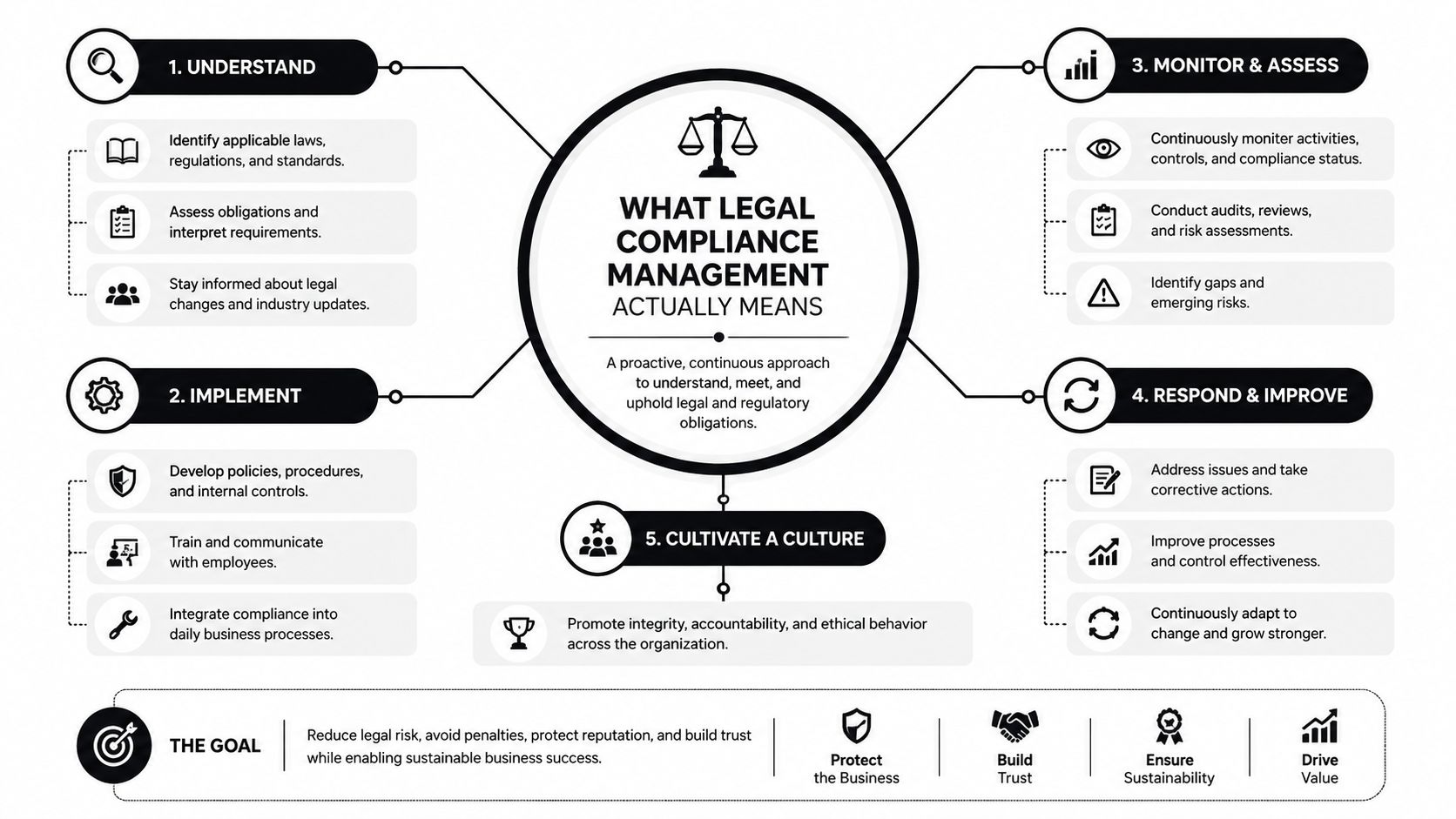
First, identify which obligations apply to the firm, each practice group, each client matter, and each worker or vendor. A litigation boutique may prioritize confidentiality, discovery handling, conflicts, and trust accounting. A firm handling international transactions may also need sanctions screening, privacy controls, jurisdictional reporting, and third-party oversight.
Mapping isn't a one-time inventory. Regulatory alerts, client requirements, court rules, state bar expectations, and contractual duties can change the control set. The map should show the obligation, affected process, owner, review date, and evidence needed to demonstrate completion.
A policy states the standard. A procedure tells someone what to do on Tuesday afternoon.
For example, an ABA Model Rule 1.6 confidentiality obligation should connect to access permissions, secure file transfer, personal-device restrictions, incident reporting, and training. A trust-account policy should connect to authorized signers, segregation, reconciliation, review, and exception handling. Client onboarding KYC should specify when screening occurs, who reviews the result, what happens when information is incomplete, and who can approve an exception.
Monitoring asks whether the control ran. Testing asks whether it worked.
A firm might monitor whether conflict checks occurred before engagement letters were issued, then test a sample to confirm the search covered relevant names and that unresolved hits received documented review. For trust accounting, monitoring could track reconciliation completion, while testing examines supporting records and unexplained differences.
Every serious program needs a response path for missed controls, suspected breaches, conflicts, filing failures, and vendor problems. The response should preserve evidence, assign an investigator, contain the issue, assess reporting duties, document the decision, and track remediation to closure.
A policy without incident handling teaches staff to hide problems until they become expensive. A control system makes escalation safer than silence.
Compliance is no longer a back-office task that partners can assign around the edges of someone's workload. It consumes money, coordination, judgment, and staff capacity. Smaller and mid-sized firms feel that pressure first because the same people often manage matters, client service, technology, payroll, and compliance.
Thomson Reuters reported that the average compliance cost across organizations was about US$5.47 million in 2020, while US businesses averaged about US$10,000 per employee in regulatory costs, as summarized by Secureframe's compliance statistics overview. These figures are not a law-firm penalty schedule. They show the operating burden behind monitoring, controls, audits, training, and reporting.
PwC's 2025 Global Compliance Survey found that 85% of executives said compliance requirements had become more complex over the previous three years. Complexity creates work. Someone must interpret the rule, update the process, train the team, monitor execution, and preserve evidence.
A comparison of average law-firm compliance costs or penalties would be misleading without verified firm-level data. The practical answer is to separate known evidence from measurements each firm must build internally.
| Firm Size | Avg. Annual Compliance Cost | Avg. Non-Compliance Penalty | Cost-of-Risk Ratio |
|---|---|---|---|
| Solo and small firm | Not established by the verified data | Not established by the verified data | Calculate from internal spend and documented exposure |
| Mid-sized firm | Not established by the verified data | Not established by the verified data | Calculate by practice, jurisdiction, and control |
| Larger or multi-jurisdiction firm | Not established by the verified data | Not established by the verified data | Calculate across regulatory, client, and vendor risks |
A fabricated benchmark may look persuasive in a partner presentation. It will not allocate capacity correctly. Track internal hours, outside counsel spend, technology costs, audit findings, remediation time, missed deadlines, and actual financial exposure. Review those measures by practice and jurisdiction, then decide whether the gap requires a process change, better technology, or another person.
That person may be an internal coordinator, a remote paralegal, or a carefully managed offshore team. Remote staffing can close the human-capacity gap, but it also adds controls around access, confidentiality, task ownership, supervision, and cross-border payroll. Payroll administration is part of the control picture when workers operate across jurisdictions. A lower labor cost does not justify weaker records or unclear accountability.
The SRA review found that 94% of firms had a formal office manual and internal compliance policy, 83% conducted file reviews, and 69% used external third-party audits. Compliance officers spent only 26% of their time on compliance tasks, and nearly half reported insufficient resources, as documented in the legal compliance benchmarking reference.
The lesson is operational. A firm can maintain policies, reviews, and audits while execution remains thin. The missing investment may not be another platform. It may be the coordinator who owns the evidence log, follows up on exceptions, checks remote staff access, confirms payroll records, and keeps the partner accountable without making that partner perform every administrative task.
There are three workable governance patterns. None is magical, and each fails in a predictable way.
| Model | Best Fit | Reporting Line | Failure Mode |
|---|---|---|---|
| Centralized compliance officer | Firms with enough scale for a dedicated owner | Direct access to managing partner or executive committee | The officer becomes a bottleneck and lacks practice-level cooperation |
| Distributed responsibility | Small firms with simple operations and tightly involved partners | Practice leaders report through management | Everyone owns compliance, so no one owns the follow-through |
| Outsourced director with internal coordinator | Firms managing multiple jurisdictions, vendors, or cross-border work | Outsourced lead reports to firm leadership, coordinator runs daily workflows | The firm treats the outside advisor as a substitute for internal accountability |
A centralized compliance officer gives the firm a clear point of accountability. That person maintains the obligation register, coordinates testing, manages incidents, and reports exceptions to leadership. It works when the officer has authority, access to records, and a direct reporting line.
It breaks when the officer becomes an inbox. If every practice group waits for the compliance lead to chase documents, approve ordinary decisions, and interpret every small issue, the program slows down and the officer gets blamed for delays the firm created.
Distributed ownership looks efficient on paper. The corporate partner handles client onboarding, the litigation leader handles conflicts, IT handles access, and finance handles trust accounting. Each person knows the subject matter.
The failure is structural. Cross-functional risks don't respect practice-group boundaries, and busy leaders prioritize client work. “The finance team has it” isn't a control description. It doesn't identify the reviewer, cadence, evidence, or escalation standard.
For firms handling multi-state or cross-border matters, an outsourced compliance director paired with an internal coordinator is often the most practical arrangement. The outside lead supplies specialized judgment and program design. The internal coordinator keeps the machinery moving, gathers evidence, schedules reviews, and knows when an issue needs escalation.
The decision test is straightforward:
Don't outsource accountability. Outsource capacity and specialist judgment, then keep the final risk decision with firm leadership.
Law firms face a distinctive mix of client, professional, financial, information-security, and employment risks. The control should match the failure, not the software vendor's favorite feature.
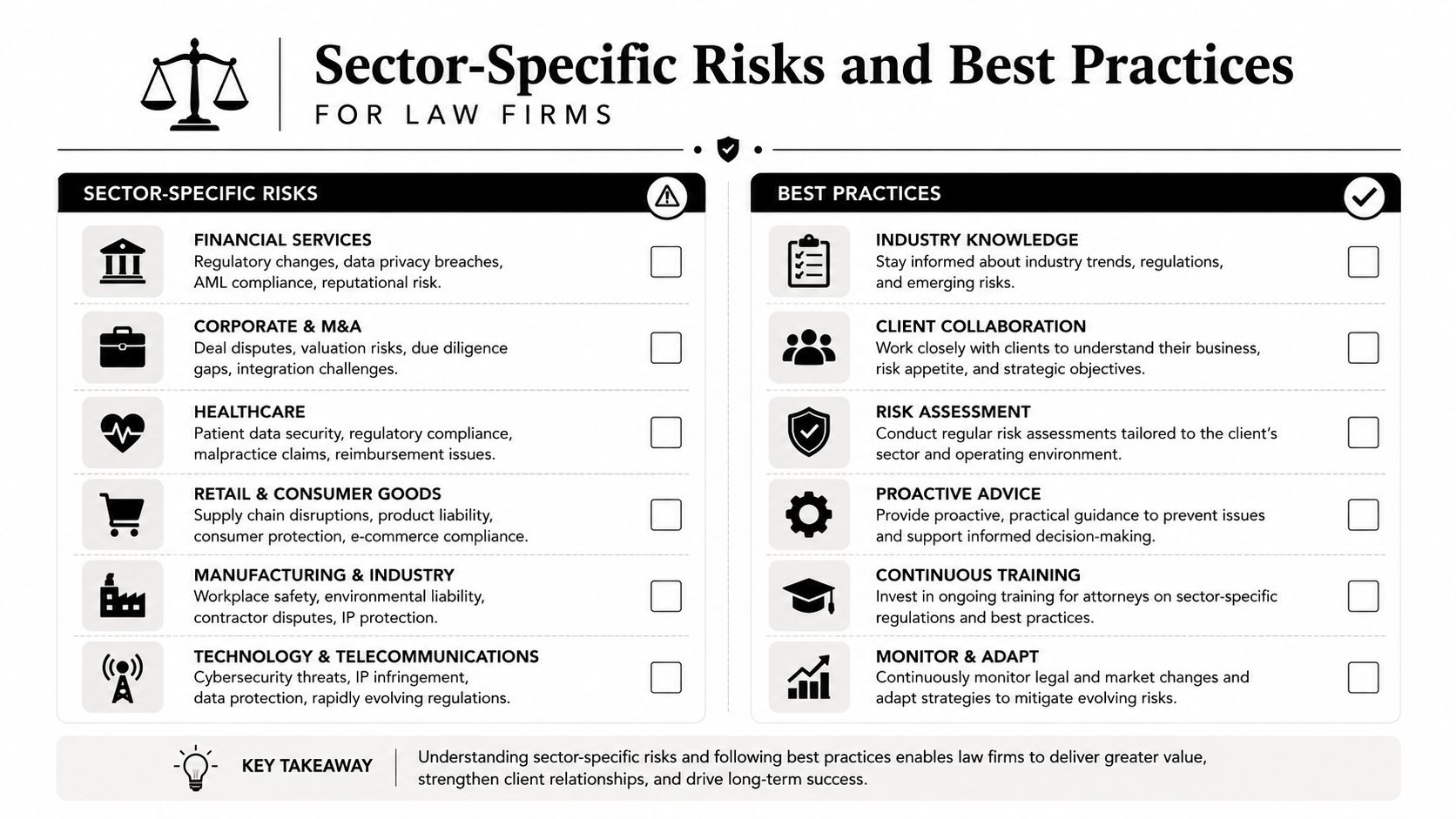
Trust accounting needs segregation, authorization, and reconciliation. Use separate trust accounts, restrict signing authority, and require a documented monthly three-way reconciliation between the ledger, client subledgers, and bank statement. An unexplained difference is an exception, not an accounting curiosity.
The reviewer should be independent from the person entering transactions where practical. Every exception needs an owner, explanation, correction, and approval record.
Run conflict checks before engagement letters, not after a lateral attorney has already started contacting clients. The search should cover the attorney's current and former matters, parties, affiliates, adverse entities, and relevant personnel.
A positive match isn't automatically a conflict, but an unresolved match is a stop sign. Record the search terms, reviewer, result, and decision. That evidence protects the firm when memories become unreliable.
Classify information at the matter level, then apply access rules based on role and need. Confidential client data shouldn't become broadly available because a new paralegal needs one folder or because a vendor's default permissions were convenient.
Remote work makes this operational. Review devices, account access, file-transfer methods, retention, and offboarding. Train workers on the actual workflow they use, not an abstract security lecture nobody remembers after lunch.
Hiring a remote paralegal across borders adds employment, tax, contract, data-handling, intellectual-property, and supervision questions. The firm should document worker classification, payroll registration, payment flow, confidentiality terms, IP ownership, access controls, timekeeping, and termination procedures for every jurisdiction involved.
Don't confuse a contractor label with compliance. The contract is one control. The working relationship, supervision, payment structure, and records must support it.
For a practical review of the firm-side obligations, use this guide to law firm compliance requirements. A staffing shortcut can create an employment or tax liability faster than a small firm can absorb it, especially when nobody knows who was supposed to validate the arrangement.
A usable framework produces artifacts people can inspect. If the output is only “greater awareness,” the firm has purchased a mood, not a control system.
List obligations by practice area, jurisdiction, client requirement, vendor relationship, and workforce arrangement. Create an obligation register with the rule, affected process, risk level, owner, evidence requirement, and next review date.
For client onboarding, the register might connect KYC and sanctions screening to intake. Firms that need a plain-language reference can consult OneSafe's AML KYC guide while designing their own procedures. Use it as background, not as a substitute for jurisdiction-specific legal advice.
Create a RACI map for each material control. One person should be accountable for the result, even when several people execute pieces of it. Remote paralegal staffing and payroll controls belong here too. Name who approves the engagement, who validates classification, who reviews access, and who maintains the records.
A shared mailbox isn't an owner. Neither is “operations.”
Write a one-page runbook for each control. It should state the trigger, inputs, steps, decision points, exceptions, evidence, and escalation route. Keep it short enough that a competent employee can use it during a busy week.
For regulatory and client-facing work, firms can also evaluate regulatory compliance support when internal capacity isn't enough. The support arrangement still needs a defined scope and reviewer.
Build evidence collection into the workflow. Store approvals, screening results, reconciliation records, training logs, access reviews, payroll confirmations, and remediation notes where the responsible reviewer can find them.
The evidence log should answer five questions: what happened, who performed it, when it happened, what decision was made, and what happened to exceptions. If the firm has to reconstruct the answer from email, the process is already too fragile.
Set a fixed review cadence and define escalation thresholds. A quarterly review memo should summarize completed controls, exceptions, overdue actions, incidents, trend observations, and decisions required from partners.
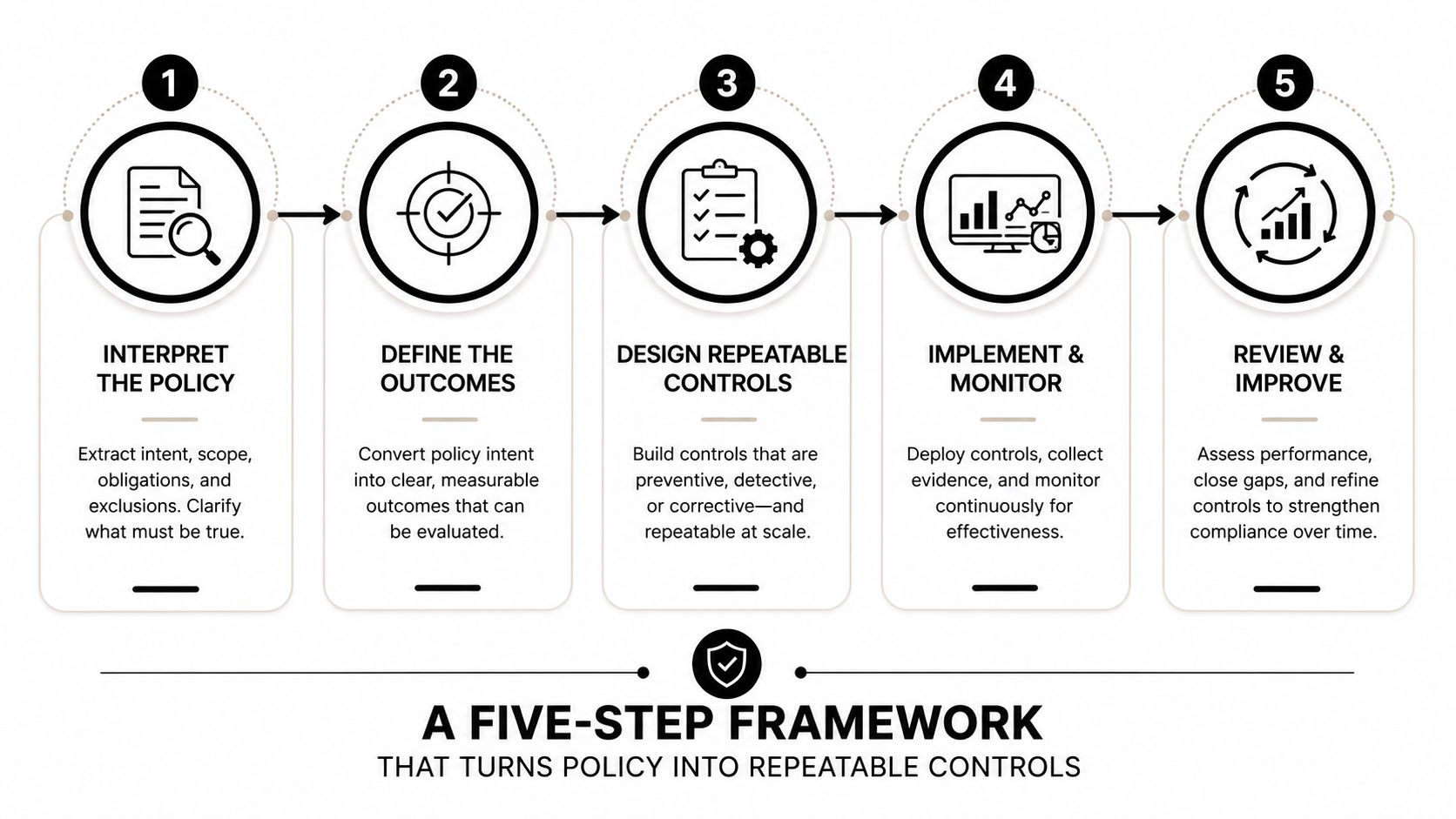
A five-step loop works because it closes the gap between policy and proof:
A rollout should be boring in the best possible way. Give an operations lead a dated sequence, a required output, and a person to chase. Don't launch a transformation program that depends on everyone feeling inspired.
Complete the obligation register by practice area and jurisdiction. Inventory policies, contracts, vendors, trust-account procedures, conflict workflows, data-access rules, remote-worker arrangements, and payroll processes.
The required outputs are a signed risk register and a policy gap audit. Escalate immediately when the review identifies a possible client-data exposure, unresolved trust-account difference, suspected conflict, sanctions concern, or worker arrangement that lacks documented classification and payment controls.
Approve the control matrix and assign one accountable owner per control. Draft runbooks for high-risk workflows, then select any required staffing, payroll, compliance, or technology vendors.
For remote paralegal support, evaluate supervision, confidentiality, access, timekeeping, contract terms, IP protection, payroll administration, and offboarding. A provider such as HireParalegals can be considered as one staffing option, with remote legal support, payroll management, and compliance guidance for Latin American hires. The firm still owns its approval and oversight decisions.
Use compliance documentation resources to organize the evidence standard before rollout. If the firm can't decide what proof it needs, it won't know whether the control worked.
Publish the approved procedures, train affected employees and contractors, and collect completion records. Run the workflows in practice rather than merely asking people to acknowledge them.
The output should include an approved control matrix, runbook library, training completion log, and documented exceptions. Add headcount when owners consistently miss control deadlines because of workload, not because the process is unclear. Engage outside counsel when an issue involves potential privilege, reporting duties, professional responsibility, sanctions, employment classification, or material client harm.
Turn on the evidence log, conduct the first internal audit, and deliver a partner-level dashboard. Report overdue controls, unresolved exceptions, incidents, remediation status, and decisions requiring leadership approval.
Partner test: A dashboard should make it obvious what needs a decision this week. If it only displays activity, it isn't reporting risk.
If the rollout falls behind, don't reset the entire program. Freeze scope, finish the highest-risk controls, document the missed milestone, assign a recovery owner, and move the lower-risk work to a revised date. A transparent delay is manageable. An undocumented gap is how a small operational miss becomes a professional-responsibility problem.
Retention rules expose whether a firm's compliance system is real. People tend to remember the policy and forget the clock, the custodian, and the retrieval test.
The SEC requires accounting firms to retain certain records relevant to audits and reviews of issuers' financial statements for seven years, including workpapers and documents containing conclusions, opinions, analyses, or financial data related to the audit or review, according to the SEC records retention rule. That requirement belongs in a retention schedule with an owner, storage location, legal-hold process, and retrieval test.
HIPAA creates a separate documentation obligation. Covered entities and business associates must retain required policies, procedures, actions, and assessments for six years from creation or the date they last were in effect under 45 CFR 164.530(j), as described in the HIPAA audit-log retention guidance.
OFAC-related work combines reporting deadlines with long-term recordkeeping. Initial blocked-property reports must be filed within 10 business days, annual blocked-property reports are due for property still blocked as of June 30, rejected transaction reports are due within 10 business days of rejection, and sanctions-related records must be retained for 10 years, according to OFAC reporting and recordkeeping guidance.
The correct workflow is not “the sanctions team knows.” It is a trigger, assigned reviewer, deadline tracker, approval record, filing confirmation, and retention location. Yes, sanctions compliance is part paperwork, part stopwatch, and part “please don't mortgage the office ping-pong table over a missed filing.”
Test whether a reviewer can locate a requested record without asking five people where it lives. Record the source system, naming convention, retention period, legal-hold override, deletion authority, and responsible custodian.
For remote workers, include access termination and record transfer in the offboarding checklist. Payroll records, contracts, training confirmations, access approvals, and work product should not disappear when a contractor's account closes. A compliance program proves itself when it can retrieve evidence calmly, not when everyone remembers that evidence probably exists somewhere.
Automation is necessary. Automation alone is reckless.
Thomson Reuters describes compliance as becoming a “technology arms race” while noting that many teams still rely on legacy systems. Its projection for 2026 scrutiny includes AI governance, cybersecurity, data privacy, sanctions, ESG, and third-party oversight, as reported in its global compliance concerns analysis. That doesn't mean every firm needs an expensive platform immediately. It means manual processes should stop pretending they can scale indefinitely.
Regology's 2026 State of Regulatory Compliance survey found that 92.6% of respondents said their role had become more difficult, 32.8% said their organization had already faced fines or penalties, and 73.5% had either experienced or expected enforcement consequences, according to Regology's survey report. The same report states that 59.3% already use AI in some capacity.
Use technology for alert collection, obligation routing, deadline reminders, conflict-search workflows, access reviews, evidence requests, and status reporting. Those tasks benefit from consistency and clear inputs.
Don't automate the final decision where context matters. A sanctions match, privacy incident, conflict, worker-classification question, or AI-use exception may require facts that a rule engine can't interpret reliably.
The strongest model is not “humans do everything” or “AI replaces the compliance team.” It's targeted automation with expert review for high-risk issues. A paralegal or coordinator can gather records, run standard checks, maintain the log, and flag exceptions. A qualified reviewer makes the judgment that carries professional, client, employment, or regulatory consequences.
Contrarian view: The most mature compliance program isn't the one with the most automation. It's the one that knows exactly where automation must stop.
For small and mid-sized firms, this approach controls cost without pretending that judgment is a software feature. Start with the workflows that create recurring administrative drag, then reserve senior attention for exceptions and decisions. That is how legal compliance management becomes scalable without becoming careless.
If your firm still runs compliance through a policy folder, scattered spreadsheets, and partner memory, pick one high-risk workflow this week. Name its owner, write the runbook, define the evidence, and set the review date. Then book a working session with your legal-ops lead or compliance advisor to build the first obligation register and decide where qualified remote support can add capacity without weakening confidentiality, supervision, payroll, or accountability.