 16 minutes read
The most popular advice about regulatory compliance support is also the least useful: read the rules, write the policy, train the team, and move on. That approach works beautifully until someone asks who approved the control, where the evidence lives, whether the obligation changed, or why the spreadsheet has three different owners for the same filing.
Compliance failures rarely begin with nobody knowing the rule. They begin with nobody owning the task, nobody updating the tracker, or nobody having time to assemble proof before an audit. The work is operational, repetitive, jurisdiction-specific, and unglamorous. In other words, exactly the kind of work that gets pushed to Friday afternoon until Friday afternoon becomes an enforcement problem.
Compliance teams rarely fail because nobody can read a rule. They fail because the work sits in spreadsheets, inboxes, and calendars with too little capacity behind it. Smart lawyers, regulatory alerts, and polished policies cannot prove that a control operated, who approved it, or what happened after an exception appeared.
The World Bank's Global Indicators of Regulatory Governance tracks good regulatory practices across 186 countries, including publication of proposed rules, consultation, and regulatory impact assessments. That scale reflects the environment legal teams must monitor. Obligations arrive through formal regulatory systems across jurisdictions, then require local interpretation, assignment, follow-up, and evidence. The World Bank's regulatory governance indicators show why a manual process becomes difficult to maintain.
The operating pressure is substantial. Eighty-five percent of organizations say regulatory compliance is more complex today than three years ago, 92% conduct at least two compliance audits annually, and non-compliance can average $14.82 million in costs for affected organizations, according to the industry data cited in the World Bank resource. Those figures point to a practical conclusion: firms need enough operational capacity to maintain controls and retrieve proof without relying on memory or scattered email threads.
A functioning support model assigns each obligation to a named owner, records the applicable jurisdiction, sets a review cadence, links the control to evidence, and creates an escalation route when something slips. The standard is simple, yet many firms apply it inconsistently.
The gap between a policy binder and an audit-ready operation comes down to workflow design:
A useful primer on control frameworks is Beyond Surplus's compliance guide, especially for teams connecting compliance duties with internal control design. Legal operations teams should also understand how recurring work gets planned, assigned, and measured through legal project management.

Practical rule: If your team cannot show the control, the owner, and the supporting evidence without a scavenger hunt, treat the control as unfinished.
The firms that manage this well separate judgment work from process work, build repeatable handoffs, and assign recurring compliance tasks enough capacity to survive busy periods. That means replacing heroic manual tracking with clear ownership, scheduled reviews, and evidence that remains usable when an auditor, regulator, or executive asks for it.
Regulatory compliance support is no longer a back-office function. It now covers data privacy, financial regulation, employment law, cross-border payroll, AI governance, sustainability reporting, cybersecurity, trade controls, ethics, and workforce safety. These duties intersect across products, hiring decisions, vendors, customer communications, and internal systems. The rulebook is broad. The harder problem is having enough operational capacity to track obligations and prove that controls work.
The market reflects that expansion. ScottMax's compliance industry trends research places the global regulatory compliance market at about $23.08 billion in 2025, up from $21.16 billion in 2024, with roughly 9.5% year-over-year growth. Its projections place the market at $34.62 billion by 2030, while another estimate cited in the same research puts it at $25.38 billion in 2026 and $56.22 billion by 2035. The research also reports that North America held the largest share in 2025 and Asia-Pacific was the fastest-growing region.
The exact estimate depends on methodology. The operating conclusion does not. Compliance now crosses departments, jurisdictions, and risk categories, making spreadsheet ownership and side-of-desk tracking poor substitutes for staffed workflows.
Enforcement activity creates work even when headline penalties fall. Wolters Kluwer's violations index recorded 199 violations in H1 2024, compared with 136 in H2 2023, while total penalties fell from $7.977 billion to $1.876 billion. A lower aggregate penalty figure does not make operations calmer. Frequent, lower-value actions still require investigation, remediation, documentation, and follow-up.
Effective support therefore includes regulatory monitoring, obligation mapping, control testing, filing calendars, evidence management, and exception tracking. It also requires people who can interpret an update, assess its operational effect, assign ownership, and record the decision without leaving the work buried in an inbox.
AI governance adds another workload. Teams handling emerging obligations should treat navigating the EU AI Act as an operating exercise, not a collection of policy summaries. They must identify affected systems, assign control owners, preserve review evidence, and respond when AI requirements overlap with privacy, cybersecurity, or procurement.
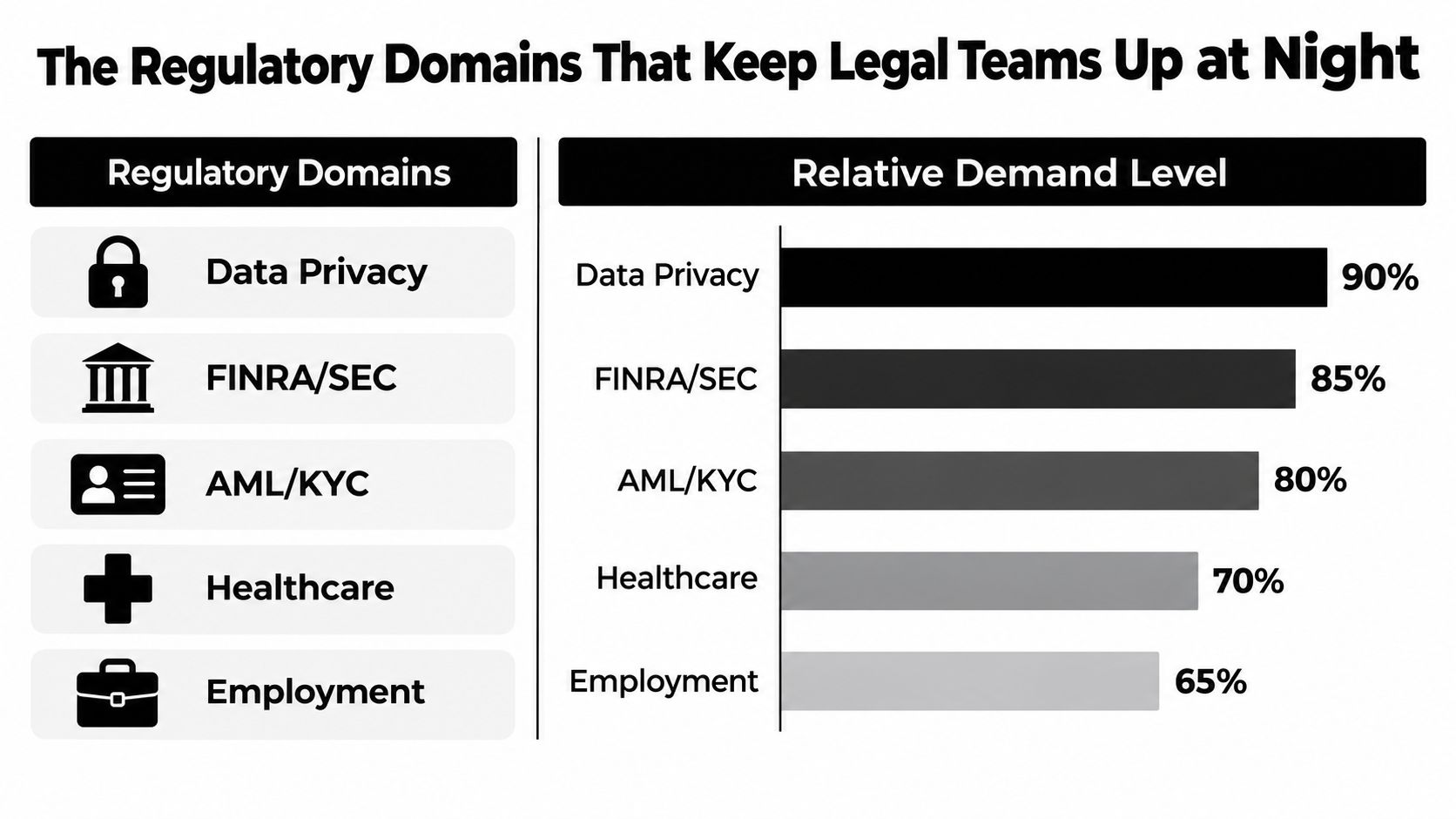
Regulatory risk rarely overwhelms legal teams because the rules are unknowable. It overwhelms them because evidence, ownership, and follow-through live in spreadsheets, inboxes, and under-resourced teams. Financial services, employment, privacy, AI governance, and healthcare each create different execution problems, yet every domain demands controls that work in practice and can be proved later.
U.S. financial regulation deserves early attention. U.S. financial regulators accounted for 95% of the $4.6 billion in global financial penalties in 2024, according to Fenergo coverage cited by Corporate Compliance Insights. Teams responsible for AML, KYC, sanctions, and customer due diligence should give U.S.-focused controls, audit trails, and escalation paths more operating capacity than a generic risk register provides.
| Domain | Where support gets stuck | What the team must prove |
|---|---|---|
| Data privacy | Data inventories, access decisions, vendor handling, and incident response spread across departments | That data handling follows approved controls and decisions are documented |
| FINRA and SEC obligations | Recurring reviews, communications, filings, and supervisory evidence compete with client work | That required reviews occurred, were approved, and can be reconstructed |
| AML and KYC | Identity checks, screening, refreshes, and exception handling generate repetitive queues | That checks were performed, exceptions were escalated, and records were retained |
| Healthcare | Privacy and operational safeguards depend on staff behavior and system access | That sensitive information is handled through defined, monitored procedures |
| Employment and classification | The contract says “contractor,” but the working relationship tells a different story | That classification decisions reflect the applicable legal test and underlying facts |
The employment category exposes the gap between paperwork and operating reality. The U.S. Department of Labor defines misclassification as treating a worker who qualifies as an employee under the FLSA as an independent contractor. Its January 10, 2024 final rule took effect March 11, 2024 and applies six factors, including profit or loss, investments, permanence, control, integral work, and skill or initiative, as explained in the DOL's misclassification guidance.
A signed contractor agreement does not finish the analysis. Someone must collect the working facts, apply the relevant test, document the decision, and revisit it when the relationship changes. That work is easy to lose when the legal team tracks classifications manually.
Cross-border hiring adds local payroll and tax mechanics. Tax rates, social security contributions, and other deductions differ across Latin American countries, so a compliance workflow must assign country-specific ownership instead of treating the region as one payroll jurisdiction, as outlined in guidance on remote work compliance in Latin America.
A single quarter can include a financial review, privacy assessment, AI governance decision, workforce classification check, and sustainability reporting request. The practical requirement is one shared workflow that connects obligations, owners, deadlines, exceptions, and evidence across those domains.
A firm that publishes frequent regulatory updates may use a law firm newsletter service to distribute them. Publication is only the front door. The legal operations team still must convert each development into an obligation, assign an owner, create a task, and preserve proof of completion.
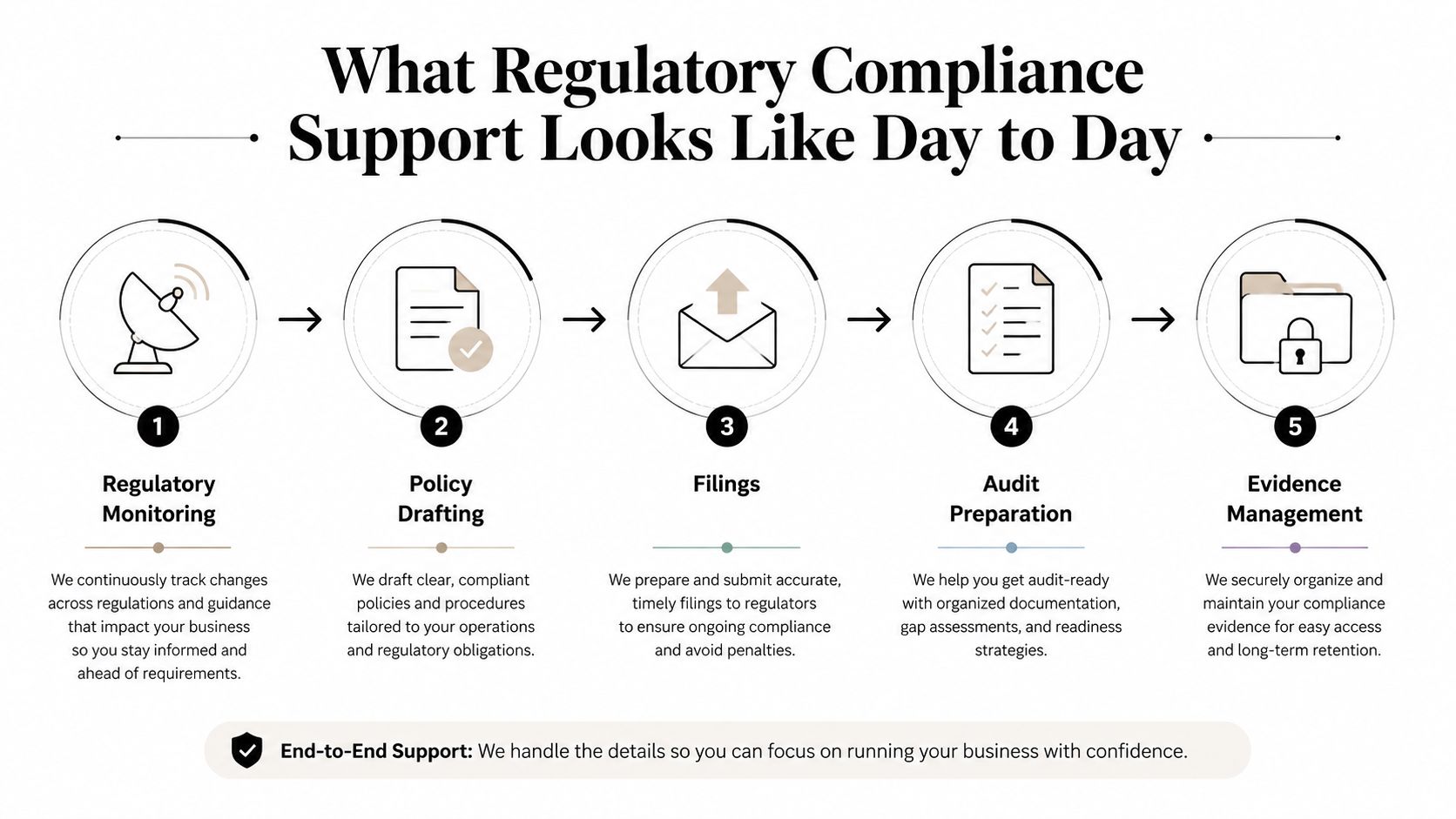
Compliance work is an execution problem before it becomes a software problem. The daily queue includes reviewing regulatory updates, maintaining obligation registers, drafting and revising policies, preparing filings, chasing approvals, assembling audit packages, and recording exceptions. Spreadsheets and manual tracking create the bottleneck when teams must prove that controls operated across jurisdictions, products, and business units.
Regulators and auditors examine the process and supporting evidence, so a finished policy alone does not close the gap.
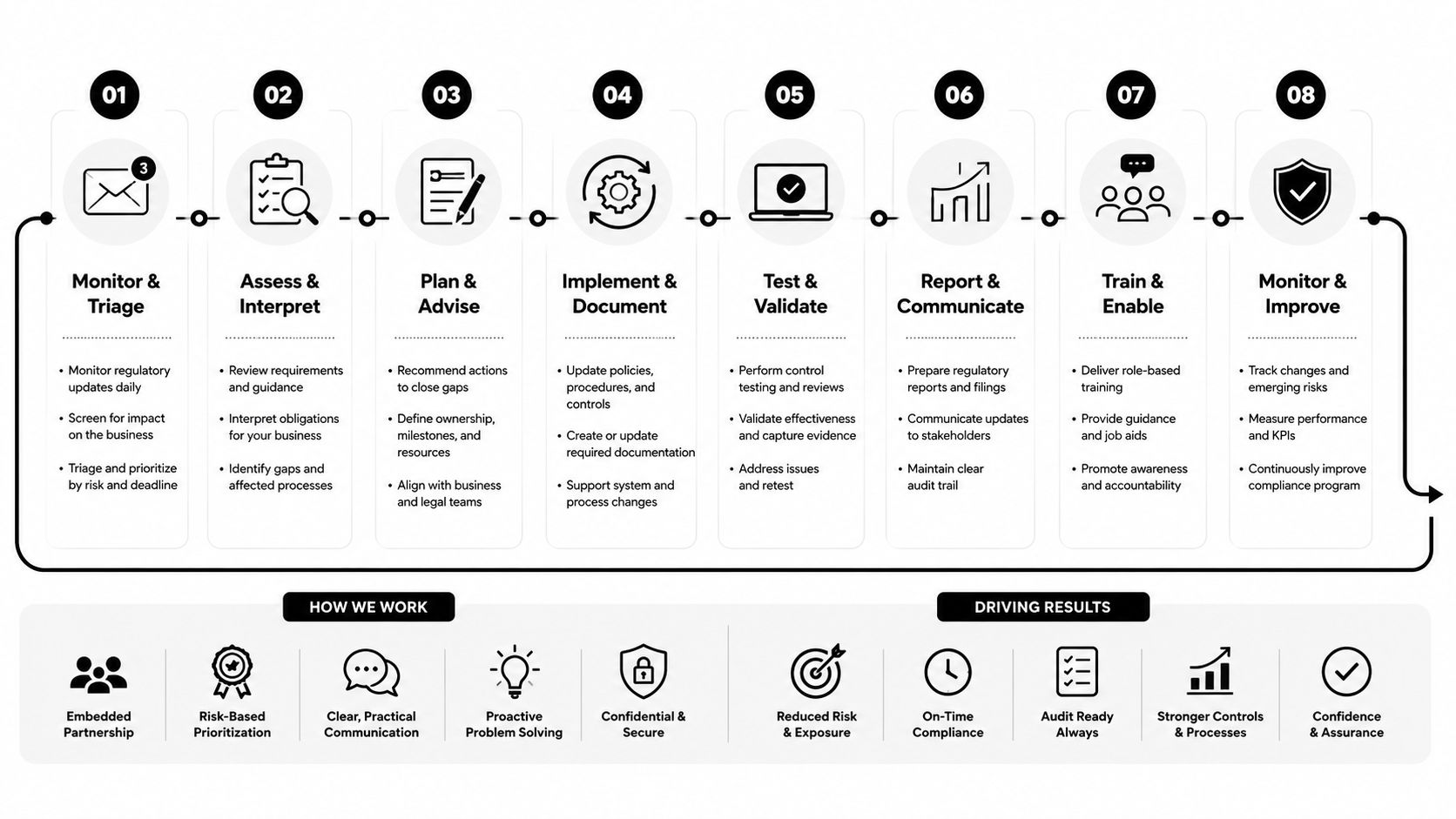
Monitoring comes first. A person or system identifies a change, filters it for relevance, and records the affected jurisdiction, business unit, product, or process. Alerts without triage are digital confetti. The team needs a documented decision on whether the update changes an obligation or control, who owns the response, and what evidence must be retained.
Policy drafting follows impact analysis. Counsel should own interpretation and material judgment. Support staff can prepare redlines, compare versions, build approval packets, and coordinate comments. Automated summaries can speed review, but a qualified person must make the final legal call.
Filings require calendar discipline. Each workflow should show the due date, data owner, reviewer, approver, submission status, and final receipt. “I think finance sent it” is a gap in control, not filing management.
Audit preparation exposes weak programs quickly. Someone must locate requested records, confirm that they cover the correct period, reconcile contradictory versions, and explain gaps. Evidence management keeps the package usable after the audit, preventing the same question from triggering another frantic search next quarter.
A clear division of labor keeps decisions from disappearing inside a shared spreadsheet:
The support model needs a feedback loop. After each audit, incident, or near miss, the team updates the control, ownership, evidence requirement, or escalation rule. Compliance is an operating system for recurring work. Maintain it, test it, and leave a usable record behind.
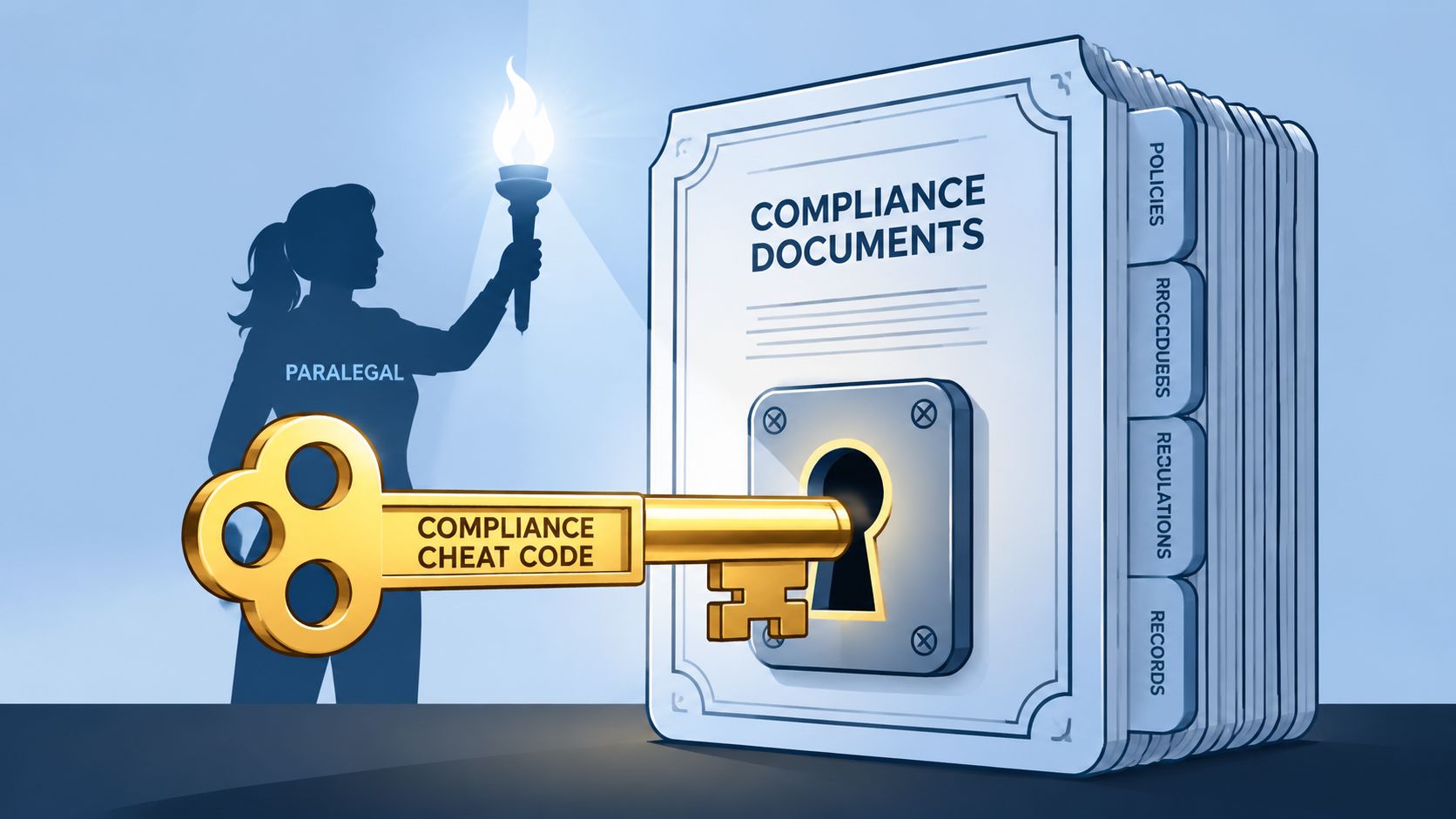
On-demand paralegals solve the part of compliance that software can't solve by itself: someone has to do the work. A platform may identify an update, but a trained professional still needs to review the notice, classify its impact, update the obligation record, contact the business owner, and assemble evidence.
That makes on-demand support especially useful for recurring work that requires legal literacy but not constant senior-attorney judgment. A capable paralegal can maintain a regulatory tracker, prepare audit binders, coordinate policy attestations, compare jurisdictional requirements, organize KYC documentation, and keep remediation items moving while counsel focuses on interpretation and escalation.
Traditional hiring creates a timing problem. You need capacity now, but recruiting, interviewing, onboarding, and payroll setup take attention away from the compliance queue. Pure software creates the opposite problem. You buy a dashboard and discover that your team still has to interpret alerts and populate every field.
A flexible legal support model sits between those extremes:
The model isn't magic. It fails when the firm gives a paralegal an undefined mandate, no escalation path, and a spreadsheet that looks like it was designed during a fire drill.
For teams exploring this approach, on-demand legal services can provide a useful framework for separating recurring execution from legal judgment. HireParalegals is one option that offers remote legal professionals, candidate matching, and payroll management with compliance guidance for Latin American hires.
Don't casually label a support professional an independent contractor and assume the label settles the question. The DOL says an incorrectly classified worker may lose minimum wage, overtime, and other protections, and the employer may be responsible for unpaid wages under the FLSA, as explained in the DOL's small-entity compliance guide.
The DOL offers free employer compliance assistance and lists the worker helpline at 866-4US-WAGE (487-9243) in its misclassification guidance. Use official guidance before turning a staffing shortcut into a wage claim.
Start with the work, not the vendor pitch. List every recurring compliance activity, its jurisdiction, required evidence, current owner, review level, and failure consequence. If you can't describe the work clearly, no platform or staffing partner will rescue the process. They'll just help you create a more expensive version of the fog.
Ask candidates and vendors to show how they would handle a real obligation from intake through evidence storage. Don't accept a tour of colorful dashboards. Request a sample change log, escalation record, audit index, and status report.
Evaluate five things:
The final point matters most. A support provider that can't explain when work stops and counsel takes over is selling labor without governance.
Choose one contained process, such as regulatory update triage, audit evidence collection, or a cross-border contractor review. Define the intake format, naming convention, review threshold, response time, evidence standard, and weekly reporting format before work begins.
Use a centralized workspace, even if the first version is modest. A well-designed tracker beats an expensive tool nobody maintains. The legal outsourcing company you select should reduce coordination overhead, not create another portal that legal operations has to babysit.
At the end of the pilot, inspect the exceptions. Did support staff identify uncertainty early? Did counsel receive clean escalation packets? Can a third party reconstruct what happened? If the answer is no, fix the operating design before expanding the relationship.
Consider a financial services team preparing for an examination. Senior counsel defines the scope and approves the response strategy. A compliance paralegal builds the request matrix, assigns each item to a business owner, checks that records cover the requested period, and logs missing evidence. The system stores versions and deadlines, but a human reconciles conflicting documents and flags anything that needs legal judgment.
That division prevents the classic failure mode: counsel spends valuable time searching for files while operational staff guess which version matters. The final package includes the request, owner, status, source record, reviewer, approval, and unresolved issue. Nobody has to reconstruct the story from memory.
Now take a product team deploying an AI feature while privacy and cybersecurity reviews are already active. Counsel identifies the legal questions. Operations support inventories the system, records data flows, collects vendor materials, maps existing controls, schedules reviews, and tracks open decisions. The business owner confirms how the tool operates in practice.
The key artifact isn't a broad AI policy sitting in a shared drive. It's a decision record showing what the system does, what data it touches, which controls apply, who reviewed the risk, and what evidence supports the conclusion. If a later rule changes, the team has a structure to update instead of starting from a blank page.
For a U.S. company hiring remote support across Latin America, the workflow begins before the contract is signed. Legal and HR identify the country, worker relationship, role, control level, permanence, payment method, payroll treatment, and local deductions. Operations support gathers the facts and routes them for review, while payroll or an appropriate local provider confirms tax and social security handling.
The contractor agreement is only one artifact. The compliance file should also show the classification analysis, country-specific payroll inputs, approvals, changes, and payment records. If the facts change, the team reopens the review. A charming contract can't override the working relationship.
The audit-ready standard: Someone unfamiliar with the matter should be able to understand what the team decided, why it decided it, who approved it, and where the supporting evidence sits.
These workflows work because technology, paralegals, counsel, and business owners each have a defined job. Remove any one of them and the process starts leaning on hope again.
The return on regulatory compliance support isn't limited to avoided penalties. It shows up in fewer senior-attorney hours spent chasing documents, faster responses to audits, cleaner handoffs, fewer duplicate reviews, and earlier escalation of issues that would otherwise mature into expensive problems.
The costliest mistake is treating compliance as a one-time project. Rules change, products change, workers change, vendors change, and evidence goes stale. A polished implementation without ongoing ownership is just deferred failure with better formatting.
Stop doing these things immediately:
Measure whether support reduces unresolved exceptions, improves evidence retrieval, clarifies ownership, and gives counsel better decision packets. Those indicators tell you whether the program is reducing risk or merely generating tasteful busywork.
If your compliance operation still runs on spreadsheets, email chains, and heroic overtime, start with one workflow this quarter. Map the obligations, assign the owners, define the evidence, add trained execution capacity, and test the process before an auditor does it for you. Your ping-pong table can stay un-mortgaged, but only if you stop treating compliance like a side quest.