 14 minutes read
You've got a remote paralegal, a court deadline, and a task board that says “in progress.” The attorney assumes the filing is nearly ready. The paralegal assumes someone else is reviewing the exhibits. At 4:45 p.m., everyone discovers the certificate of service is missing and the client's key document is sitting in an inbox nobody owns.
That isn't a motivation problem. It's a remote team accountability problem, and law firms make it harder than most businesses because the work carries judgment, confidentiality, billing consequences, and deadlines that don't care whether someone's working from home in another time zone.
The answer isn't surveillance. Green dots, keystroke reports, and “just checking in” messages create the appearance of control while burying risks. A properly designed system makes ownership, quality, deadlines, escalation, and client impact visible without requiring an attorney to supervise every mouse movement.
A missed marketing task is annoying. A missed discovery deadline can damage a matter, strain a client relationship, and force a partner into emergency mode. Legal support work also contains a large amount of invisible judgment. A paralegal may spend hours reviewing a record, spotting an inconsistency, organizing exhibits, or deciding that an issue needs attorney input. None of that shows up reliably as “online.”
That's why presence-based supervision fails. You can see whether someone is available, but you can't see whether the draft is accurate, the privilege designation is defensible, or the filing package is complete. Law firm accountability means proving that the right work was completed to the agreed standard, on time, with the right safeguards.
Consider a routine litigation filing. The attorney asks for a draft motion, supporting exhibits, a proposed order, and filing instructions. The paralegal starts the draft, waits for a missing exhibit, sends a message, and moves to another task. The blocker never gets escalated. The attorney sees activity but not risk.
By the time someone asks for an update, the task is late. Then the firm spends its afternoon reconstructing what happened across email, chat, document folders, and someone's personal notes. That's not accountability. That's archaeological fieldwork with worse coffee.
Remote work can support accountability, but it doesn't create it automatically. In an Oregon State University study of remote workers, people who did at least 80% of their work remotely reported a higher sense of responsibility for their work and greater accountability to their company. The analysis found statistically significant positive effects for work accountability, p=0.019, and company accountability, p=0.045.
The practical shift is simple:
Your operating system should answer those questions without forcing employees to narrate every minute. Use asynchronous communication for remote legal teams to preserve focus while documenting decisions, blockers, and next actions.
A strong system gives each role clear outcomes, each task a single owner, each deadline a precise meaning, and each failure an early warning. That's how remote team accountability becomes a management tool instead of a daily anxiety ritual.
“Handle intake.” “Stay on top of discovery.” “Respond promptly.” These instructions sound reasonable until two people interpret them differently and both believe they've done what was asked.
Start with three to five core outcomes per role. The number matters because a paralegal's responsibilities need focus, not a sprawling dashboard that turns every minor action into a performance judgment. An outcome should describe the result the firm needs, not the activity someone performs while trying to produce it.
For each outcome, document five items:
For a litigation paralegal, an outcome might be “maintain the discovery response package.” The standard could include consistent exhibit labels, a complete index, attorney review flags, and a documented record of unresolved issues. The deadline should identify the actual due time, not “by Friday.” The escalation path should state what happens when a requested document is missing or a response needs legal judgment.
A probate paralegal needs a different scorecard. The relevant outcomes might involve petition preparation, document collection, deadline tracking, and client follow-up. Don't force every specialty into the same mold. Uniform accountability rules often produce unfair evaluations because legal roles generate value in different ways.
Responsiveness shouldn't mean “reply immediately.” That standard rewards whoever happens to be staring at chat and punishes focused work. Define response expectations by channel and urgency instead.
A message marked urgent might require acknowledgment during the firm's coverage window. A routine internal request might require a response within an agreed working period. A client-facing request needs an owner, a target turnaround, and a backup route when the primary owner is unavailable.
A 2022 Journal of Applied Psychology paper found that clear expected email response times given at the start of a remote-work transition were positively associated with remote-work functioning, as described in the published manuscript. The lesson is operational, not mystical. “Be responsive” is vague. “Acknowledge urgent requests during the coverage window and record the next action” can be managed.
Use a documented performance standard, not a personality test disguised as a workplace norm. Your paralegal performance evaluation framework should assess deliverables, judgment, quality, and reliability against written expectations. If the standard lives only in the supervising attorney's head, the firm has created a complaint, not a system.
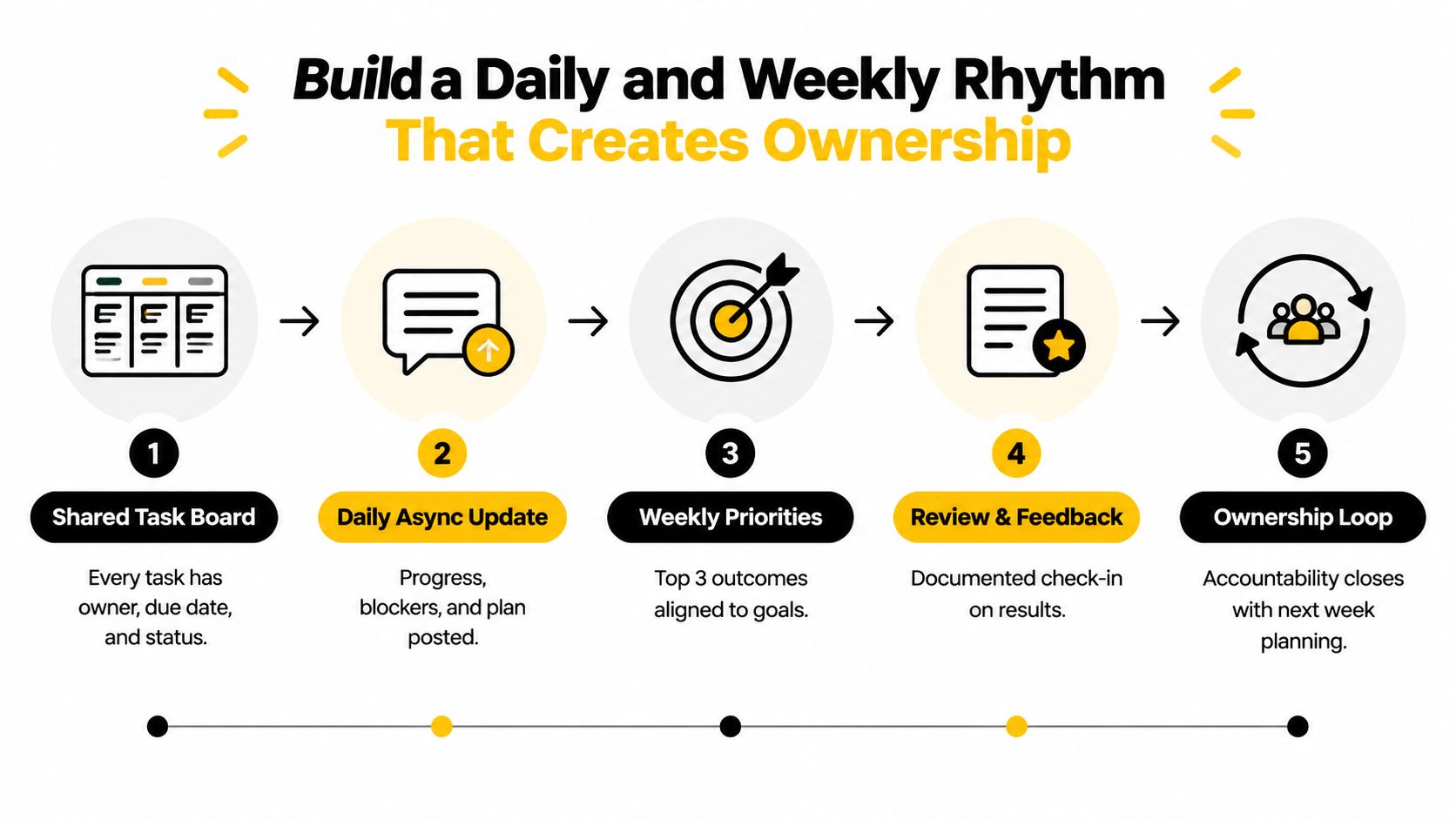
A task board is useful only when the team treats it as the firm's source of truth. If assignments live partly in Clio, partly in email, partly in Slack, and partly in an attorney's memory, the firm doesn't have a workflow. It has several competing versions of reality.
Put every material task in one shared system. Clio, Asana, ClickUp, Trello, or another platform can work. The brand matters less than the discipline. Every item needs an owner, due date, status, matter, priority, and definition of done.
Boring is good here. A short asynchronous update should answer three questions:
For intake triage, the update might identify which new inquiries were categorized, which require conflict review, and which are waiting for attorney direction. For litigation filing preparation, it might identify the draft status, outstanding exhibits, review owner, and next deadline.
The update isn't a diary. It's an early-warning mechanism. If a paralegal says a filing package is blocked because the attorney hasn't approved a factual section, the firm can solve that before the deadline becomes a crisis.
Use a weekly scorecard review to compare what the paralegal committed to with what was delivered. The practical accountability workflow guidance recommends reviewing the prior week's commitments, comparing three to five success metrics against targets, removing blockers, and resetting specific commitments for the next week.
Keep the conversation direct:
A missed deadline shouldn't automatically trigger a lecture. First determine whether the firm supplied the needed file access, review time, authority, and realistic priority. Then address the behavior that remains within the paralegal's control.
“Can you update this file?” creates a one-time errand. “You own the file's status through attorney review” creates responsibility for the outcome. That distinction changes what the person notices, reports, and escalates.
Your paralegal calendar management process should connect court dates, internal review dates, client dependencies, and contingency time. A court deadline is not the only date that matters. The internal dates are what prevent the court deadline from becoming the first moment anyone takes the task seriously.
Remote teams get into trouble when managers confuse evidence of work with work itself. Login time, message volume, application activity, and constant meeting attendance can look reassuring. They can also reward performance theater.
A paralegal who sends frequent status messages may be less effective than one who produces an accurate, review-ready deliverable. That doesn't mean communication is irrelevant. It means communication should support legal outcomes rather than substitute for them.
The remote team KPI guidance identifies outcome-oriented measures including task completion rate, productive-task time, output volume, response time, meeting participation, and employee satisfaction. For law firms, those measures need translation into role-specific legal standards.
| Metric Type | Example Metric | Why It Matters |
|---|---|---|
| Outcome | Deadline hit rate | Shows whether the firm can rely on the paralegal when dates matter |
| Outcome | Deliverable completion | Reveals whether assigned work reaches an agreed finish line |
| Outcome | Attorney quality review | Tests accuracy, completeness, drafting quality, and judgment |
| Outcome | Response time by urgency | Shows whether dependencies and client needs receive timely attention |
| Outcome | Matter or client impact | Connects support work to progress, responsiveness, and service quality |
| Activity | Login duration | Indicates availability, but not legal quality or completed work |
| Activity | Message volume | Shows communication volume, not necessarily useful communication |
| Activity | Keystrokes or app usage | Creates surveillance pressure and weakly represents professional judgment |
Pick the smallest useful set. A litigation support role may need deadline reliability, review quality, discovery-package completion, and blocker escalation. An intake role may need response time, accurate matter classification, conflict-check handoff, and appointment conversion. An estate-planning role may need document completeness, drafting quality, turnaround consistency, and client follow-up.
A visual workspace can help teams see relationships between matters, dependencies, and deliverables. For firms that think spatially, a workspace tool for visual thinkers can complement the formal task system, provided the firm still maintains one authoritative record for deadlines and matter status.
Metrics should trigger useful conversations, not deliver verdicts without context. A low completion rate could reflect excessive workload, missing attorney decisions, or a broken process. A slower turnaround could reflect careful review on a complex matter rather than weak performance.
Document the reason behind material misses. Track patterns across a meaningful review period rather than reacting to the latest visible event. Structured one-to-ones and written feedback reduce recency bias, especially when much of a remote paralegal's work is invisible until a milestone is delivered.
The best dashboard tells the attorney where help, clarification, or correction is needed. It doesn't exist to prove that someone was sitting at a computer.
Trust doesn't eliminate supervision in legal work. It makes supervision more deliberate.
An attorney should know which work requires review, when review occurs, and how feedback gets recorded. A paralegal should know where judgment ends and attorney direction begins. Without those boundaries, remote work creates two bad outcomes: the attorney checks everything, or nobody checks the right thing.
Create checkpoints around risk, not around anxiety. A draft pleading may require attorney review before filing. A client communication involving legal advice should follow the firm's approval rules. A billing entry should identify the matter, work performed, and appropriate time according to the firm's policy.
Keep feedback in the matter record or another approved system. “Please tighten the factual chronology” is useful when attached to the draft and connected to a clear revision. A vague message sent weeks later is just emotional weather.
Use structured one-to-ones to discuss workload, recurring errors, judgment calls, and development. Mentoring shouldn't consist of correcting the same drafting issue forever. Show the paralegal what quality looks like, explain why the change matters, and record the standard so the next assignment starts from a better baseline.
Billing accountability isn't achieved by demanding more hours. It comes from accurate matter allocation and clear descriptions of work. Set expectations for when time should be recorded, how administrative work is treated, and what happens when a task spans multiple matters.
Review entries for clarity and consistency. If a paralegal spends time correcting a document caused by an internal process failure, the supervisor needs to understand that context before treating the entry as poor performance. Otherwise, the firm encourages concealment instead of accurate records.
Remote confidentiality requires practical controls:
Fair accountability also requires realistic conditions. A 2026 academic paper on remote teams found that structured digital accountability systems matter most when teams face infrastructural constraints, and that equity-conscious resource provisioning improves both capability and fairness perceptions, as discussed in the Frontiers paper on remote-team accountability. Don't impose identical live-availability rules on people working across different time zones or with different access constraints, then call the result objective.
For practical guidance on structuring virtual legal support, a SkipCalls legal guide can help firms think through delegation and remote assistance. The firm still needs its own confidentiality policy, matter controls, supervision plan, and billing rules. A guide can inform the system. It can't replace the system.
You don't need a dramatic transformation. You need a clean operating rhythm that people can follow when the inbox gets ugly and the court calendar starts throwing elbows.
Start with a single role. Pick one remote paralegal or one practice area, then build the expectations around the work that creates the most risk. Don't launch a giant firm-wide scorecard before you know whether the definitions are clear enough to survive contact with reality.
You can use an accountability implementation roadmap as a planning aid, but keep the final system grounded in your firm's matters, deadlines, review habits, and client obligations.
When a task slips, ask whether the problem came from unclear ownership, missing access, unrealistic capacity, a hidden dependency, or avoidable execution. Fix the process where the process is broken. Address performance directly where the individual had the information, authority, and resources to deliver.
Remote accountability also fails when firms measure busyness instead of value. A paralegal shouldn't need to perform constant availability to prove commitment. The firm needs reliable deliverables, accurate records, timely escalation, sound judgment, and secure handling of client information.
The system works when everyone can answer five questions without asking a manager:
That's the standard worth building. Start this week by choosing one role, documenting its outcomes, and running the first review. If you need qualified remote legal support to plug into that system, HireParalegals provides curated remote legal professionals for US law firms, with candidate shortlists, interview coordination, and support for remote hiring workflows. Bring in the person, then give them a system capable of letting them succeed.
Stop tracking green dots and start tracking legal work that matters. Build your expectations sheet, move assignments into one shared board, set the first review date, and contact HireParalegals today if you need a remote paralegal matched to your practice area and working requirements.