 14 minutes read
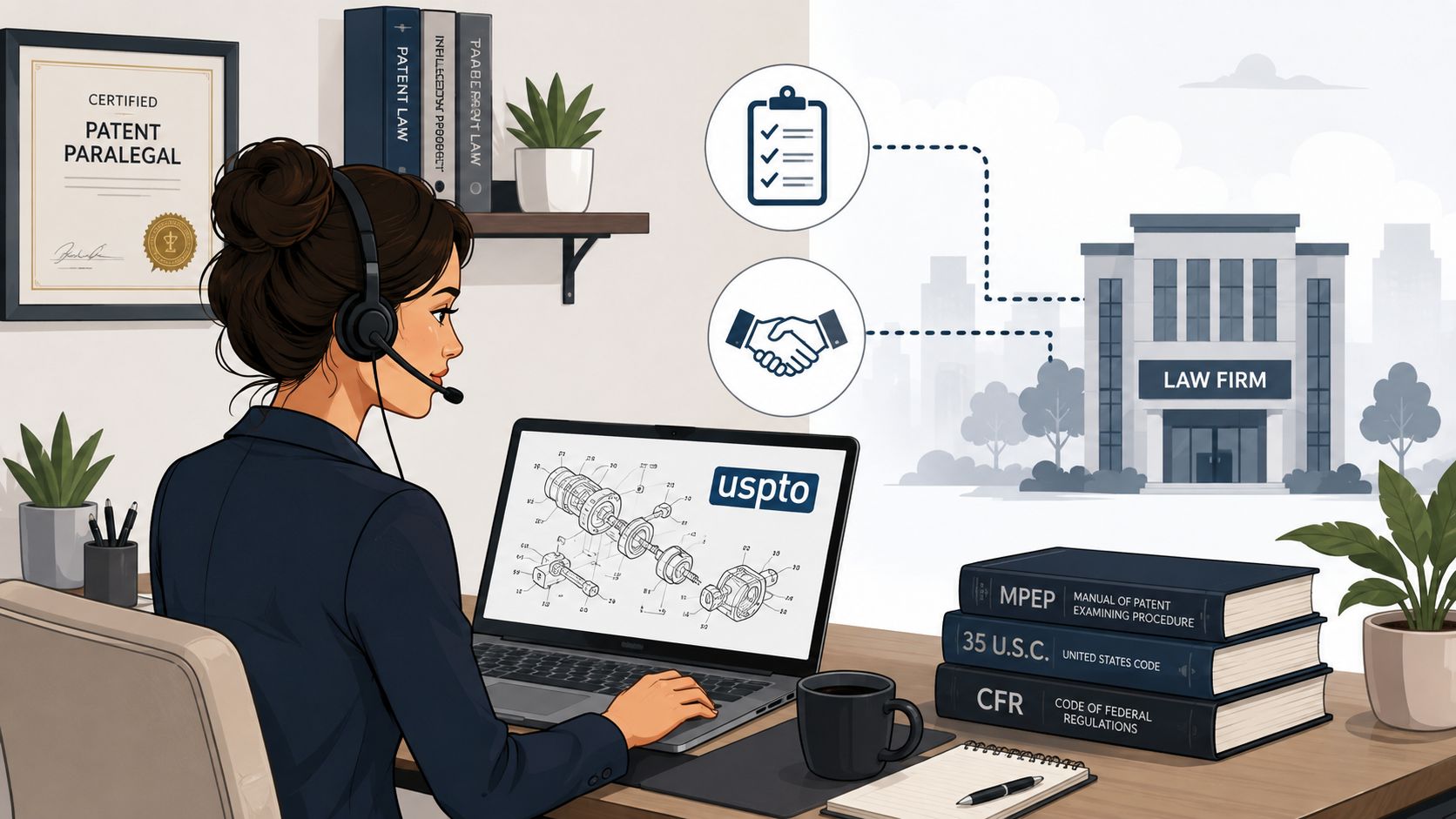
Most advice about patent paralegal remote hiring starts with the wrong question. “Can a patent paralegal work remotely?” Yes. Firms already hire for it at scale. LinkedIn lists more than 1,000 remote patent paralegal jobs in the United States (LinkedIn's remote patent paralegal listings), while other job indexes show 486 remote intellectual-property paralegal openings and 843 remote patent-prosecution legal assistant openings (FlexJobs patent opportunities).
The useful question is tougher: which patent tasks should never leave the building, and which ones are perfectly suited to a distributed team? That distinction is where firms either build a reliable operation or create a malpractice problem.
I've seen remote legal support work beautifully. I've also seen firms treat docketing like ordinary inbox management, then discover that a missed prosecution deadline doesn't care whether the person responsible was sitting three feet away or in another time zone. This playbook uses a task-by-task risk map, not cheerful “remote work is the future” slogans.
The myth is that remote patent support is just ordinary remote paralegal work with a different specialty label. It isn't. Patent prosecution combines USPTO-facing filings, jurisdiction-specific procedures, formal records, and deadlines that can't be negotiated with a friendly Slack message.
Legal services saw a 22.2 percentage-point increase in remote workers from 2019 to 2021, according to the U.S. Bureau of Labor Statistics analysis of remote work productivity. That proves remote legal work became normal. It doesn't prove every legal task carries the same operational risk. A peer-reviewed study of work-from-home lawyers cited in that analysis found productivity fell 8%–19%, which is a useful warning: location alone doesn't create quality.
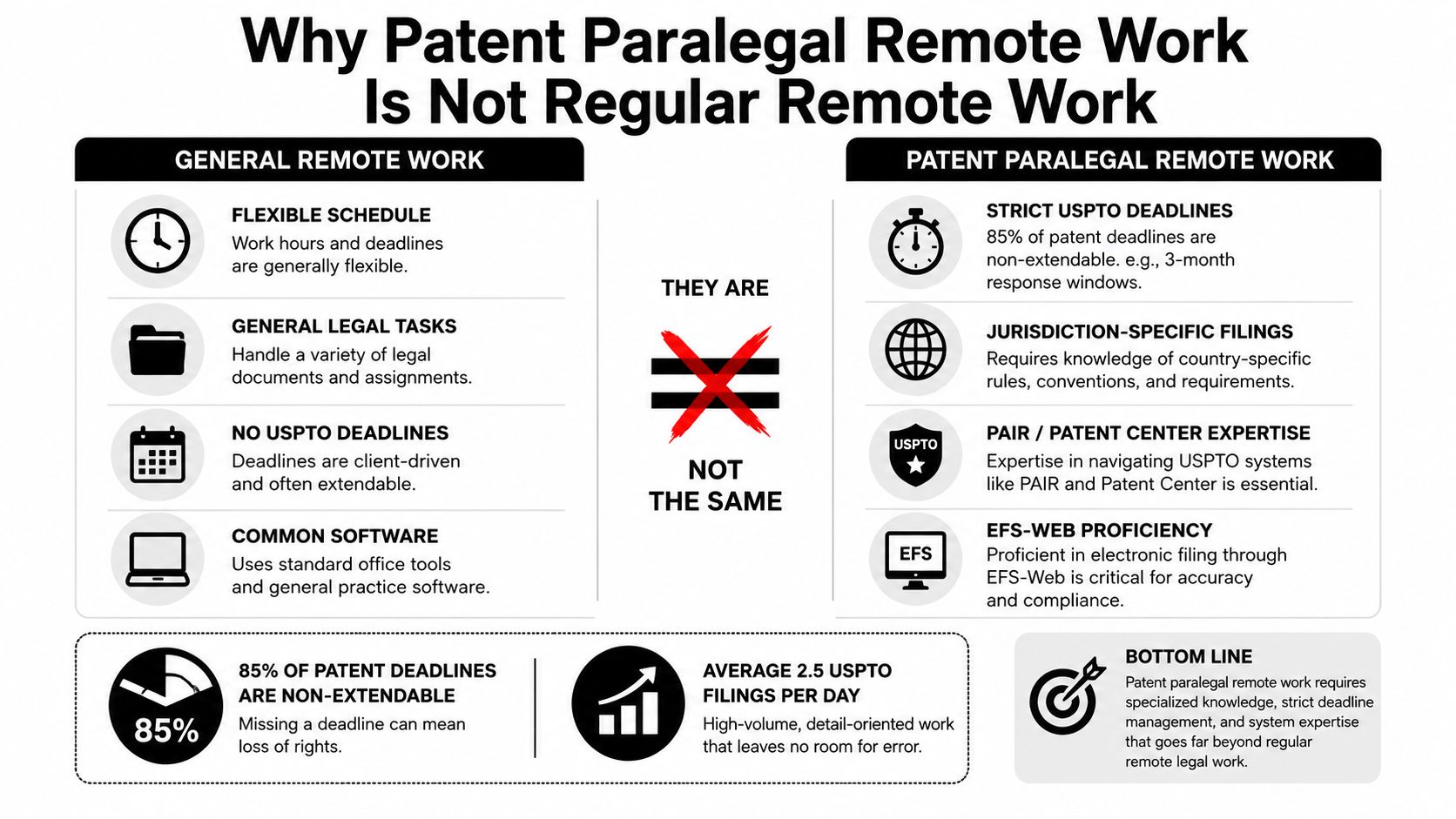
Remote teams handle many patent-support tasks effectively when the work has a clear input, a defined output, and a review path.
Client strategy calls, sensitive inventor interviews, original signature handling, secure specimen custody, and cross-border filing decisions deserve tighter supervision. A remote paralegal can coordinate many of these tasks, but the firm shouldn't confuse coordination with independent legal judgment.
That's the dividing line. Remote is a location. Risk is a task property. A firm with a large filing portfolio shouldn't send every activity into the same remote bucket, especially when a single missed docket event could jeopardize a valuable matter.

Practical rule: If a task changes legal strategy, controls an original record, or triggers a non-negotiable filing event, assign a named reviewer before assigning the task.
A polished résumé doesn't make someone useful in a patent paralegal remote role. The candidate needs to understand how prosecution work moves through the USPTO, how the docket records that movement, and where a small data-entry error can distort the next action.
Start with USPTO procedure fluency. The candidate should know how to use Patent Center, retrieve correspondence, confirm filing receipts, and distinguish an incoming Office action from routine notices. PAIR is a common résumé term, but ask what the person did there. “I had access” is not the same as “I verified continuity, downloaded the right document, and updated the docket on receipt.”
EFS-Web experience still appears in older job descriptions, while current workflows may center on Patent Center. Either way, the candidate must demonstrate filing competence rather than recite software names.
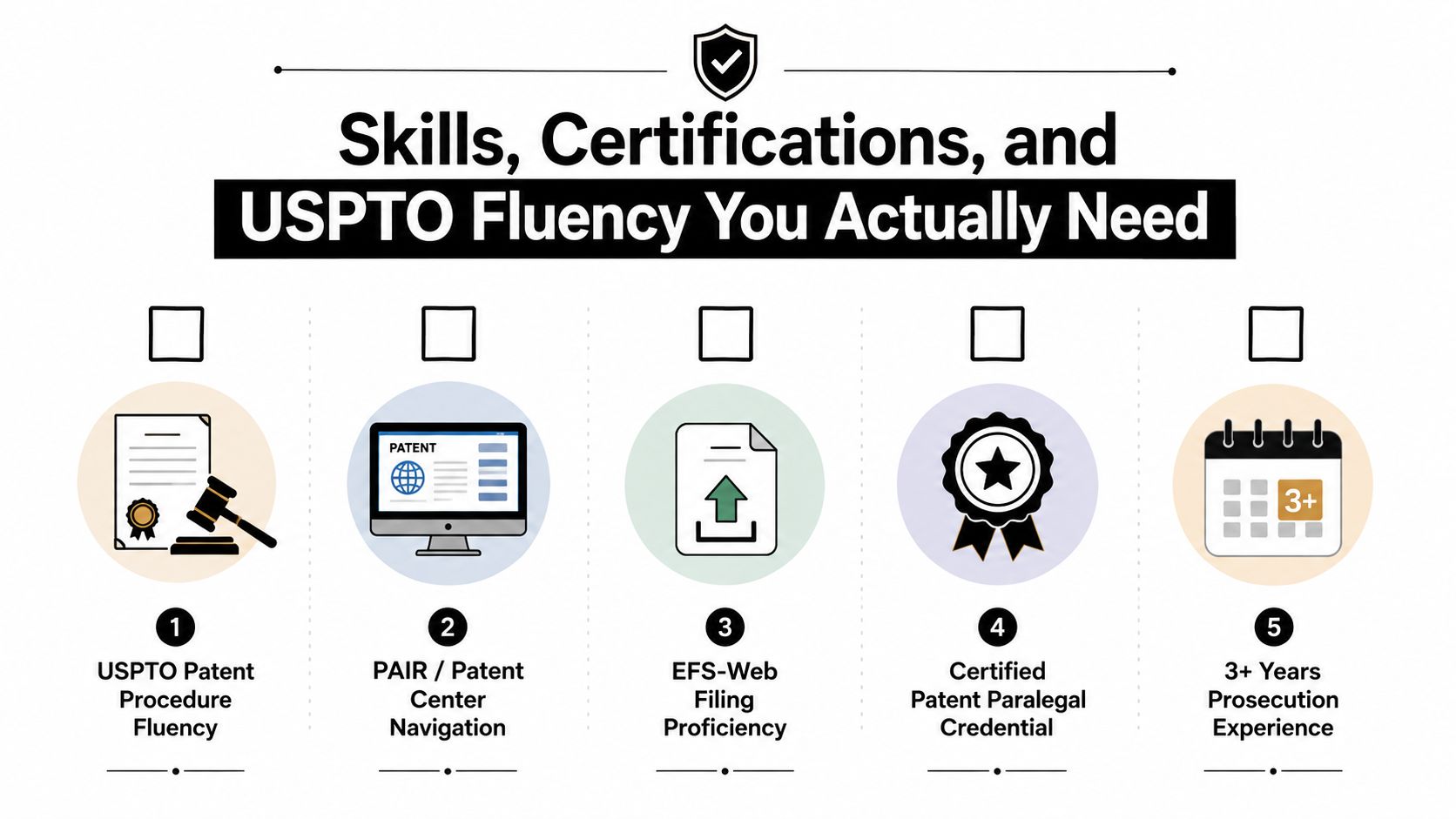
Use a checklist that forces candidates to explain their work:
The market confirms this isn't entry-level busywork. One patent paralegal job description typically asks for 2–5 years of Intellectual Property experience, while another requests 5+ years, a four-year degree, and a paralegal certificate, with ABA approval preferred (patent paralegal job requirements).
Certification helps, but it's not a substitute for prosecution experience. A NALA credential or patent-specific program can strengthen a candidate's foundation. Foreign-language ability and prior-art tools such as PatSnap or Espacenet are useful extras. Firms hiring should spell out the difference, and candidates can review the paralegal certification requirements before treating a certificate as the whole qualification.
If a job posting omits Patent Center or PAIR experience and says nothing about docketing software such as CPI, Anaqua, or Foundation IP, I'd pause. That omission often means the firm hasn't defined the work it needs.
The right model depends on the task, not the worker's location. Keep deadline ownership, USPTO coordination, and sensitive prosecution logistics with people who can respond during your firm's working hours. Assign repeatable, reviewable work elsewhere.
| Model | Hourly Rate | Timezone Overlap | Best For |
|---|---|---|---|
| US-based remote | $35–$65/hr | 0–3 hrs | High-stakes docket control and USPTO coordination |
| US-based hybrid | $35–$65/hr | 0–3 hrs | Work requiring occasional in-person handling |
| Latin American remote | $18–$35/hr | 1–4 hrs with ET | Research, IDS volume, and repeatable support |
These rate bands are operating assumptions for comparison, not universal market prices. Market data shows that specialized compensation can run higher. One salary tracker reports average U.S. remote patent-paralegal pay of $92,823 per year, while individual hybrid or remote listings advertise $72,000 to $120,000 and $85,000 to $125,000 (remote patent paralegal jobs).
Choose US-based remote for core docket control, direct coordination with U.S. attorneys, and sensitive prosecution logistics. The overlap in working hours and familiarity with U.S. practice reduce delays when a missed handoff can threaten a filing.
Choose hybrid when the role includes original signatures, in-person inventor interviews, physical files, or a partner who works better face to face. Require a clear office schedule. Occasional attendance is part of the job, not an informal favor.
Choose Latin American remote for structured volume work, including prior-art organization, IDS preparation, records cleanup, and repeatable research. Aligned hours can support daily collaboration, but the firm must define what the contractor may prepare and what an attorney must approve.
Foreign filing work requires a separate review. Confirm PTO registration requirements and prevent unauthorized legal judgment, regardless of where the worker sits. Cost matters, but risk-adjusted fit matters more than the cheapest hourly rate. Build the assignment around the task's consequence if someone misses, misroutes, or misunderstands it.
Hartwell & Vance, a fictional mid-size IP boutique, stopped hiring from résumé keywords after one too many candidates claimed “full-cycle patent support” but couldn't explain how they tracked an Office action. The partners built a four-step funnel that takes less time than cleaning up a bad hire.
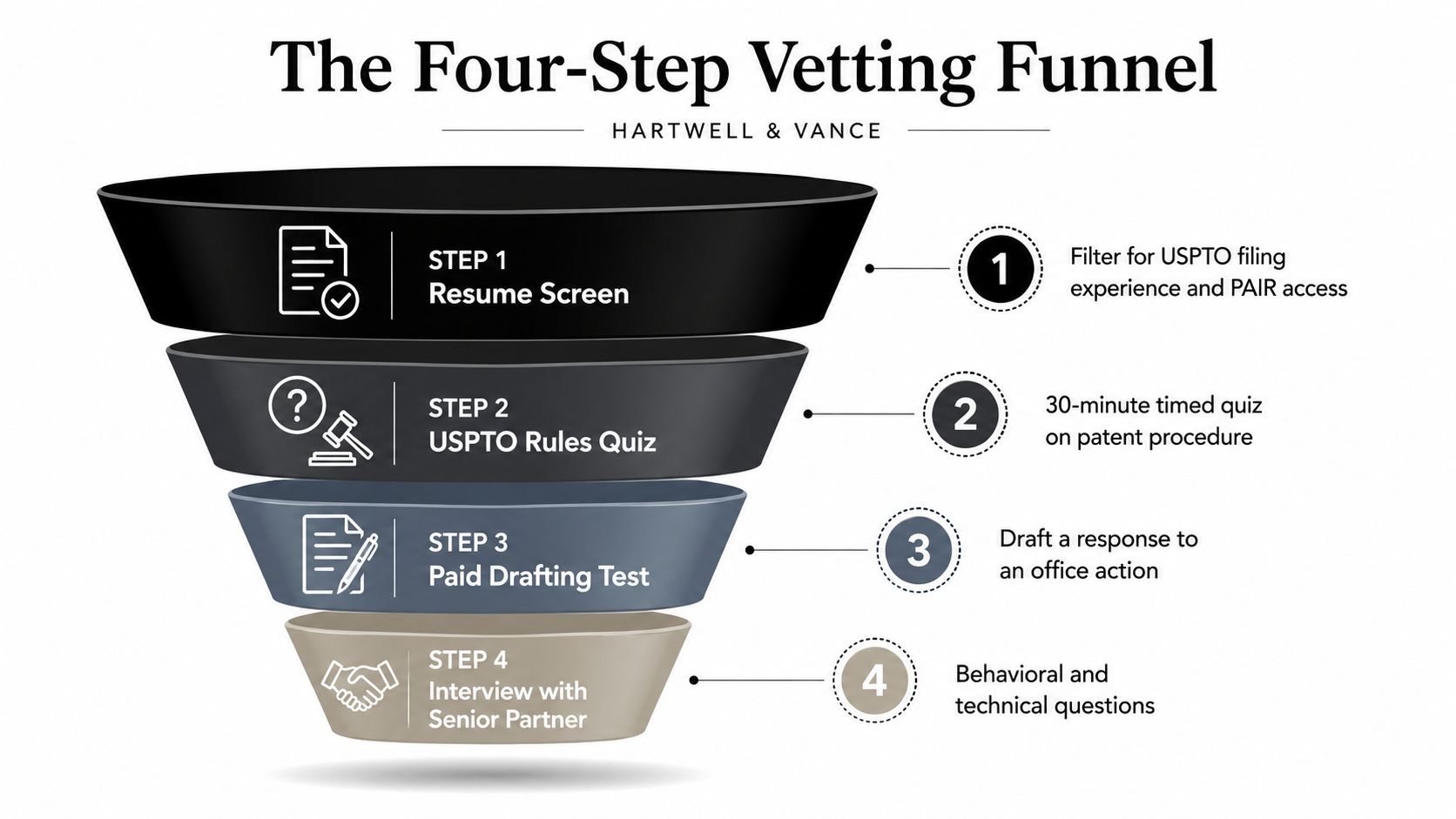
The résumé screen looks for actual USPTO filings, prosecution docket ownership, Patent Center or PAIR use, and named docketing systems. Hartwell & Vance rejects vague phrases such as “supported attorneys” unless the candidate can identify the matter types and personal responsibilities behind them.
Step two is a 30-minute USPTO rules quiz. It tests deadline recognition, document routing, filing receipts, and escalation judgment. The firm doesn't need a trivia champion. It needs someone who knows when to stop, verify, and ask the attorney.
Step three is a paid drafting test. The candidate prepares an IDS package or organizes a response to an Office action using supplied materials. The firm scores document control, completeness, issue spotting, and whether the candidate invents legal conclusions.
The final step is a culture and communication call with a senior partner. Remote work fails when people hide uncertainty until the deadline is breathing down everyone's neck.
Try these:
Weak candidates answer with generalities. Strong candidates describe the sequence, the evidence, the reviewer, and the correction. They don't claim they've never made an error. That answer is résumé perfume.
For a simple scoring sheet, rate each stage from zero to two for technical accuracy, documentation, escalation judgment, and communication. Hartwell & Vance advances candidates who demonstrate evidence at every stage, not candidates who merely sound confident. Firms that want a more formal process can compare this funnel with the candidate screening process.
Remote onboarding should begin with controlled access, not a welcome email and a pile of passwords. The first month determines whether the paralegal learns the firm's actual control system or improvises a private one.
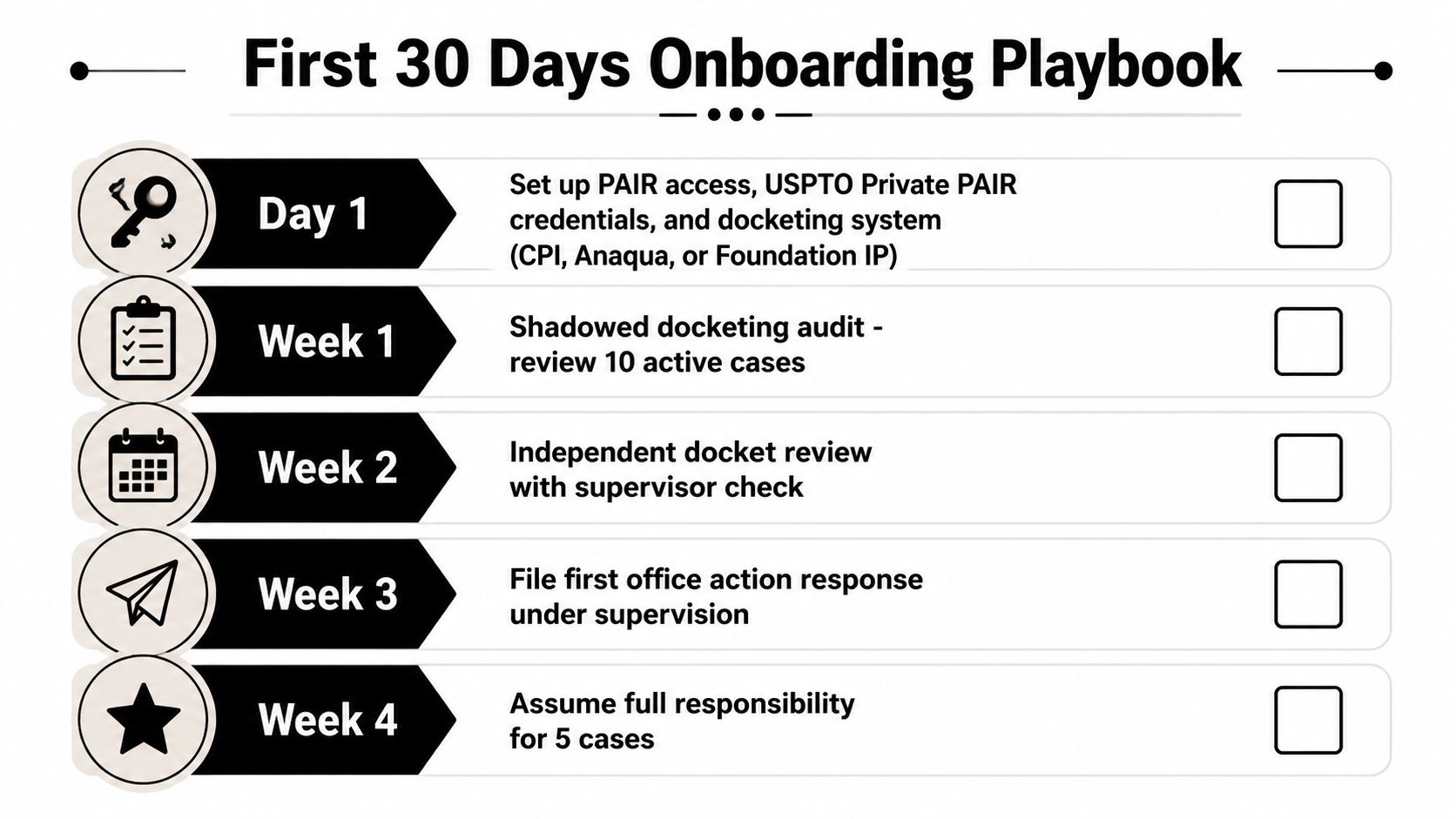
On day one, provide access to Patent Center, the firm's approved USPTO credentials, and the docketing system, whether that's CPI, Anaqua, or Foundation IP. Access should follow least-privilege rules. A contractor shouldn't receive broad matter access because the administrator wants to finish setup before lunch.
During week one, run a shadowed docketing audit against three live matters. Compare incoming correspondence, docket entries, calculated deadlines, reminder levels, and attorney assignments. The supervisor should review every discrepancy with the new hire and document the firm's decision rules.
The strongest docketing guidance recommends same-day intake, duplicate tracking in a second system, reminders at roughly 90/60/30/14/7 days, and periodic audits (docketing best practices). Use those controls as the operating baseline, not as optional process decoration.
In week two, pair the paralegal with an attorney on a real Office action response. Use Word track changes and shared redlines, then complete two rounds of attorney review before the paralegal handles a similar matter independently.
Weeks three and four should bring a graduated caseload. Novel filings receive a 72-hour escalation window before the deadline becomes urgent. The daily standup should cover new USPTO correspondence, deadlines approaching, blocked instructions, and unresolved discrepancies. Keep it short. Nobody needs a remote conference about the remote conference.
Contractor onboarding also needs an exit plan. Revoke system access, transfer docket ownership, export matter notes, confirm open filing instructions, and preserve the audit trail. For broader guidance on building a structured distributed-team transition, use this resource on onboarding remote employees in LATAM.
Payroll mistakes can erase the savings from a remote program faster than a bad candidate can. Firms often focus on whether a paralegal can prepare an IDS, then neglect whether the engagement is classified, insured, and supervised correctly.
Start with worker classification. A W-2 employee and a 1099 contractor don't carry the same obligations, and federal and state tests can differ. California's ABC framework, Massachusetts rules, and New Jersey standards deserve specific review rather than a copy-pasted contractor agreement. The employee versus independent contractor guide can help organize the questions for outside counsel.
An offshore paralegal can support document preparation and research, but the firm must control legal judgment, attorney review, confidentiality, and access to technical information. Claim drafting, prosecution strategy, and foreign filing decisions require carefully defined responsibility. PTO registration requirements also matter when work touches foreign-filing activity.
Technology matters too. Patent matters can involve controlled technical information, export-control concerns, or ITAR touchpoints. Before sharing files, determine what data the worker may access, where it may be stored, and whether the firm's systems support the required restrictions.
Give outside counsel a concise checklist:
If the firm is evaluating a broader employment structure, a practical resource on law firm PEO provider switching can help frame the operational questions. Don't outsource responsibility, though. A provider can administer payroll. It can't decide whether your workflow gives a contractor too much legal authority.
Remote patent work should be priced by risk, not by the lowest hourly quote. A missed filing date, incorrect docket entry, or unchecked correspondence can erase any labor savings. Build the business case around compensation, supervision, review time, and rework before comparing remote and in-office models.
Available market data supports a useful compensation baseline. A salary tracker places average U.S. remote patent-paralegal pay at $92,823 per year. Job listings show ranges of $72,000 to $120,000 and $85,000 to $125,000 for comparable roles. Other listings report roughly $75,000–$95,000 and $88,000–$133,000 for remote patent and IP support, as discussed by the American Bar Association discussion of remote paralegals. These figures describe specialized labor, not low-cost administrative capacity.
| Metric | US In-Office | US Remote | LATAM Remote |
|---|---|---|---|
| Compensation evidence | Specialized professional salary bands | Average reported at $92,823 annually, with listings from $72,000 to $125,000 | Active market demand, but no verified rate benchmark provided |
| Productivity | Depends on supervision and workflow | Mixed evidence, with legal-services remote adoption documented | Depends on training, timezone overlap, and review controls |
| Docketing target | Set by firm policy | Use same-day intake, redundant tracking, reminders, and audits | Use the same controls, with defined escalation |
| ROI test | Include salary, benefits, office, and software | Include compensation, equipment, supervision, and rework | Include contractor fees, compliance, review, and data controls |
A 10-attorney boutique should model twelve months of actual costs. Count compensation, benefits, workspace, software seats, recruiting time, onboarding drag, attorney review, rework, payroll administration, and compliance. Test utilization against the firm's real matter mix. A remote hire who waits for attorney instructions most of the week will not produce a positive return, regardless of the rate.
The strongest savings usually come from repeatable work with clear review points. Intake, formalities checks, docket updates, filing preparation, and status reporting can support remote capacity when the firm assigns ownership and escalation rules. Tasks involving final legal judgment, ambiguous deadline interpretation, or sensitive technical access should remain with the people the firm can supervise closely.
Before approving the hire, answer:
Remote hiring pays when standardized work, active supervision, and sufficient volume exist together. It loses money when the firm buys availability without designing the workflow. HireParalegals offers specialized matching for remote patent-law support, including timezone matching and legal staffing options. Use it as a sourcing channel, then apply your own technical vetting and compliance review.
Map each task by risk, place the review point beside it, and test candidates on real USPTO workflow. Build the first-month audit before the new hire touches a live docket. That approach adds distributed capacity without exposing the prosecution portfolio to preventable failures.