
 15 minutes read
Stop interviewing for vibes. A polished résumé, confident eye contact, and a camera-ready smile can make a weak candidate look capable, while a quieter applicant with sharper judgment gets overlooked. That's résumé theater, not hiring.
Strong paralegal interview tips should help firms test what the role demands: legal research, drafting, document accuracy, confidentiality, client communication, prioritization, and reliable remote execution. Candidates need the same discipline. Rehearsed enthusiasm won't replace specific evidence of how they handled a filing deadline, protected sensitive information, or caught an error before it reached an attorney.
This guide treats the interview as a work sample and risk-detection process. You'll get seven practical checks covering case ownership, systems thinking, competency scoring, turnover patterns, asynchronous communication, legal reasoning, and remote-work readiness. If you're comparing structured hiring methods across legal and operational roles, even interview questions for nurse managers can illustrate why consistent, evidence-based questioning beats conversational improvisation. HireParalegals can also support firms seeking pre-vetted remote legal talent, but no platform excuses a sloppy interview.
Résumé language is cheap. “Detail-oriented,” “highly organized,” and “experienced in complex litigation” appear on countless applications, including those from candidates who cannot explain their work beyond polished labels.
Ask the candidate to walk through a real matter they supported. Skip the highlight reel and examine the messy middle: the discovery dispute, missing exhibit, rushed filing, or client who changed instructions late in the day. Someone who owned the work can explain the matter's context, their responsibilities, the tools they used, and the decisions they made.
Use follow-up questions that require evidence:
Listen for concrete details, but do not treat confidential information as proof of experience. Candidates should protect client identities and privileged facts while describing workflows, document categories, deadlines, and outcomes in useful terms. A person who casually discloses protected material is showing poor judgment, not expertise.
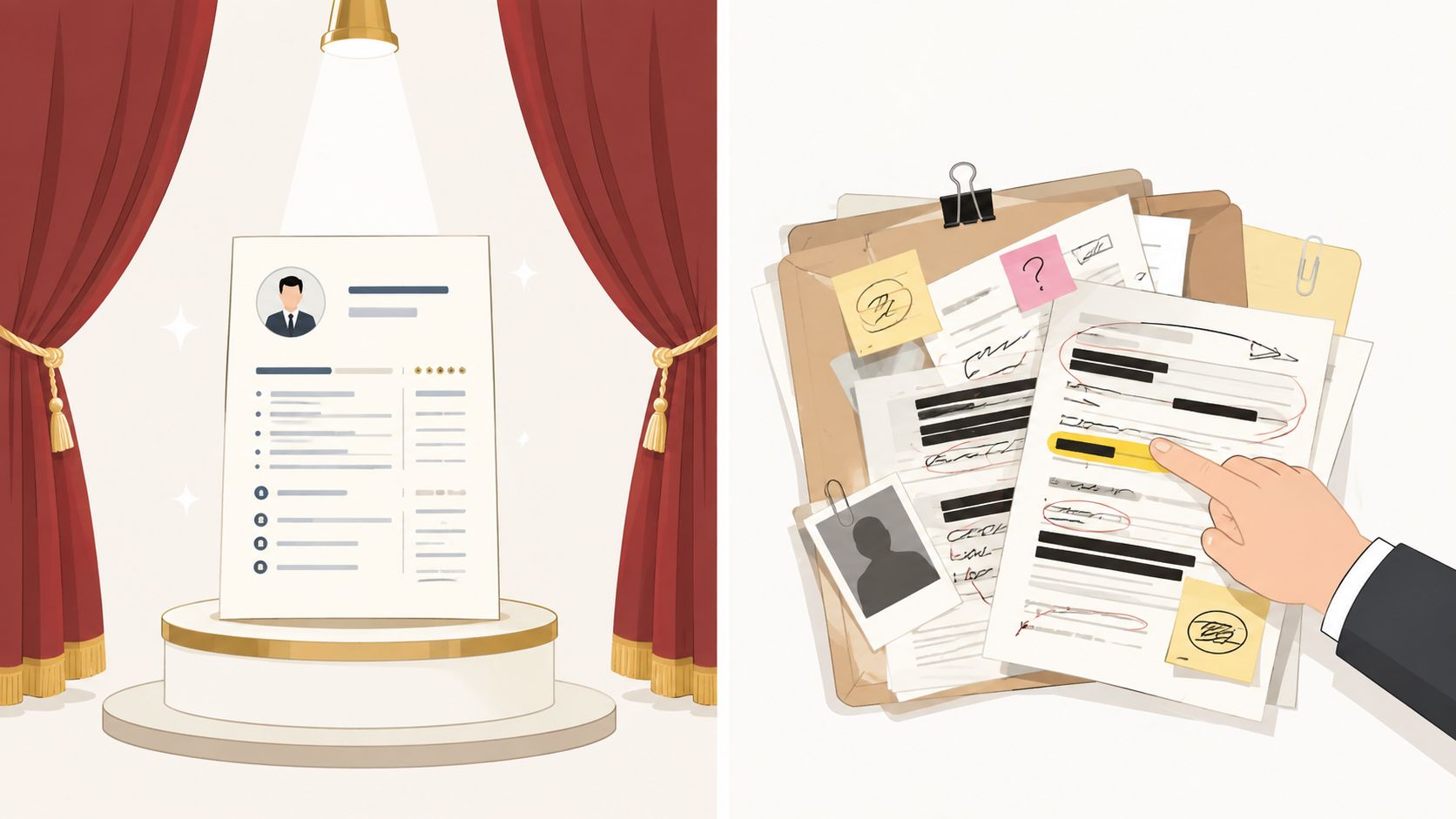
Remote hiring raises the value of this work-sample test because casual desk-side observation disappears. Candidates must communicate their contribution clearly across distance, whether the matter involves litigation, immigration, corporate work, or family law experience. That clarity also helps hiring managers detect inflated résumé claims before they become operational risk.

Practical rule: Don't ask whether a candidate is “detail-oriented.” Ask them to prove where detail changed the work.
A paralegal who completes assigned tasks can be useful. A paralegal who builds a system that prevents the next fire is far more valuable.
Give the candidate a realistic pressure scenario. Three attorneys send competing requests. A partner needs a brief-support package within two hours. A long contract is waiting for review. Ask, “Walk me through your process.” You're not looking for the magic phrase “I stay organized.” You're listening for triage, dependencies, escalation, documentation, and communication.
A strong answer might include:
Ask about a time the candidate prevented a crisis by thinking ahead. Then ask them to “walk me through your tools.” Candidates don't need to use your exact software, but they should be able to explain how they manage tasks, notes, deadlines, and handoffs. Experience with legal project management can be useful, but the key test is whether the person has a repeatable operating method.
Remote work exposes weak systems quickly. Ask how they document asynchronous decisions, manage time zone differences, and keep attorneys from discovering a blocker five minutes before a deadline. A person who relies on memory and heroic effort is not organized. They're one busy afternoon away from a preventable crisis.
Likeability can improve a conversation. It cannot prove competence.
Interviewers often reward candidates who seem familiar, warm, polished, or socially effortless. That bias is risky in a role built on accuracy, confidentiality, legal reasoning, and deadline control. The quiet candidate who asks precise questions may outperform the charming candidate who guesses with confidence. Hire evidence, not chemistry.
Keep technical answers, judgment, written communication, organization, and reliability separate from your personal reaction. Use consistent questions and an anchored scoring rubric, then pair the interview with a work sample. Legal hiring guidance on candidate evaluation recommends defining core competencies, asking candidates consistent questions, and scoring work samples for accuracy, completeness, organization, judgment, written clarity, and instruction-following.
Use questions that expose judgment rather than reward performance:
A strong answer sounds like this: “I don't know yet, but I would check the applicable authority, confirm the procedural requirement, and escalate if the issue affects strategy.” That beats polished nonsense. Candidates should prepare confident interview answers, but confidence must support evidence, not replace it.
For remote applicants, give written work serious weight. Review an anonymized email, case summary, or research explanation. Friendly conversation is pleasant. Clear writing, careful reasoning, and reliable follow-through protect the matter when no one is sitting nearby.
A work history only becomes useful when you ask what happened between the dates.
Don't treat a short tenure as automatic disqualification. People leave for legitimate reasons, including changes in practice area, management problems, relocation, layoffs, or a role that wasn't what the employer promised. The issue is the pattern and the candidate's ownership of it.
Ask the same question for every transition: “Why did you leave, and what would have made you stay?” Vague answers such as “I wanted to grow” or “the commute was difficult” need follow-up. Ask what the candidate expected, what changed, and what they learned. You're looking for accuracy and self-awareness, not a perfectly flattering story.
Compare the shape of the answer:
Remote roles deserve direct questions. Has the candidate worked remotely before? Did they like the independence? What do they need from a manager? How long do they see themselves in this position? You're not demanding a legally binding promise. You're checking whether the role matches the person's actual expectations.
References should focus on reliability, communication, follow-through, and response to supervision. A candidate who made a mistake isn't automatically risky. A candidate who refuses to discuss any mistake is harder to trust.
Remote legal support fails when people confuse silence with progress.
Give the candidate a scenario: they find a document that could affect legal strategy, but the supervising attorney is offline for four hours. What happens next? A thoughtful answer may include a detailed Slack message or email, a concise explanation of why the document matters, preliminary research, a clear urgency flag, and a phone call if the issue requires immediate attention.
There isn't one mandatory communication channel. There is a mandatory standard: the candidate must preserve context and avoid both panic and inaction.
Ask for examples of cross-time-zone work. Strong candidates can explain how they batch routine questions, record decisions, prepare handoffs, and reserve interruptions for urgent matters. They may mention tools such as Slack, Asana, email, Loom, or Notion, but tool names alone prove very little. Ask what they put in the message and how they confirm that the recipient understands the next step.

Set expectations during the interview, not after the offer. Explain working hours, meeting cadence, expected response windows, escalation rules, and the difference between urgent and merely inconvenient. If your team includes Latin American-based professionals, clarify the preferred overlap window and how the candidate handles US business hours. HireParalegals' guidance on asynchronous communication is relevant here because remote reliability depends on documented handoffs, not constant availability.
“I'll wait until you're online” can be responsible in some situations. It can also be an elegant description of inaction. Ask what the candidate would document, research, and escalate while waiting.
Legal vocabulary can conceal weak judgment. Asking a candidate to define discovery tests memory. Presenting an anonymized, realistic scenario tests how they work.
Use a matter from the relevant practice area. In immigration, present pending forms, an approaching visa expiration, and unclear procedural status. In litigation, ask whether an old email exchange should be collected or produced. Do not reward speed. Ask the candidate to identify risks, applicable rules, privilege concerns, relevance, metadata, procedural consequences, and missing facts.
Look for a clear sequence:
Ask “Why does that matter?” more than once. Candidates who connect facts to consequences show judgment. Candidates who repeat buzzwords without analysis are performing vocabulary, not demonstrating job readiness.
Add a written work sample when the role requires it, including a critical thinking assessment for hiring. Keep the exercise tied to actual duties, and never request confidential work from another employer.
Strong paralegals know when to research, when to ask, and when to stop guessing. That boundary protects the matter and gives the supervising attorney useful information before a small assumption becomes a larger problem.
Remote work exposes operating habits that an office can conceal. A capable in-office paralegal may lose focus without visible accountability, immediate feedback, and a reliable daily rhythm. That is a work-sample risk, not a personality verdict.
Ask, “Have you worked remotely before, and how did it go?” Then require specifics. “During COVID, it was fine” proves nothing. Ask how the candidate planned the day, protected confidential files, handled interruptions, reported progress, and separated work from personal obligations. You are testing controls, judgment, and communication, not inspecting someone's household.
A candidate without fully remote experience can still qualify with a disciplined hybrid routine and a credible plan. Remote experience alone earns no pass. Someone who depends on office reminders, tolerates constant distraction, or has weak boundaries may need more supervision than the role allows.

Ask about:
Keep every question tied to the job. Do not probe protected personal circumstances. Assess availability, secure work practices, communication, and the ability to meet role requirements. For virtual interviews, use the University of Texas legal interview resource to check the platform, plugins, permissions, connection, camera, and audio in advance. A quiet setting and disabled notifications also help. Your microphone should not become the interview's most memorable participant.
| Approach | Implementation complexity | Resource requirements | Expected outcomes | Ideal use cases | Key advantages | Key limitations |
|---|---|---|---|---|---|---|
| Skip the Resume Theater, Ask About Real Cases They've Actually Owned | Moderate, needs tailored prompts and deep follow-ups | More interview time; prep to avoid confidentiality breaches | Clear evidence of hands‑on experience and problem‑solving | Document‑heavy litigation; validating remote experience | Exposes real skills, uncovers gaps, shows communication under pressure | Time‑intensive; confidentiality constraints; supervised roles may limit examples |
| Test Their Systems Thinking, What's Their Chaos Management Strategy? | Moderate‑high, scenario design and process evaluation | Interview time; familiarity with workflow tools and process criteria | Assessment of workflow design, prioritization, and scalability | High‑volume practices; multi‑attorney teams; remote operations | Identifies candidates who reduce supervision and create repeatable workflows | Theoretical answers may not reflect execution; some lacked autonomy previously |
| Pull Back on Personality, Hire Competence, Not Likeability | Low‑moderate, adopt structured rubric and objective scoring | Scoring rubric, competency questions, sample work | More objective hiring decisions focused on capability and reliability | Remote hires where output and reliability trump culture fit | Reduces halo bias; surfaces competent, coachable candidates | Can feel transactional; requires cultural/process change to implement |
| Dig Into Why They Left (And Why They're Here), Turnover Patterns Matter | Moderate, probing questions plus reference checks | Additional interview time; follow‑up reference verification | Insight into retention risk and candidate motivations | Roles needing long‑term commitment; minimizing turnover cost | Identifies red flags and clarifies what keeps candidates engaged | Sensitive topic; requires nuance; legitimate external reasons may explain moves |
| Ask About Communication Defaults, How Do They Handle Async and Time Zones? | Moderate, scenario questions and tool checks | Time to probe examples; assess tool familiarity (Slack, Loom, Asana) | Measure of async maturity, initiative, and timezone fluency | Distributed teams; US firms hiring across LATAM/time‑zone differences | Prevents communication breakdowns; shows autonomy and boundary respect | Some candidates lack remote experience; communication preferences vary |
| Verify Their Legal Knowledge Isn't Just Jargon, Test Critical Thinking | High, craft practice‑area scenarios and evaluate reasoning | Interview prep; subject‑matter expertise or written test to assess answers | Evidence of analytical judgment and correct escalation choices | Substantive tasks, high‑risk matters, semi‑independent paralegal work | Reveals true comprehension, reduces costly mistakes and supervision burden | Requires interviewer expertise; candidates may lack niche experience |
| Check Their Fit for Remote Work Specifically, Not Everyone Can Do It | Low‑moderate, direct questions about routine and setup | Questions about workspace, routines, distractions; possible trial period | Determination of remote compatibility and likely reliability | Fully remote roles or limited overlap schedules | Prevents remote‑incompatible hires; reduces onboarding/re‑hire costs | Some strong candidates lack prior remote experience but could adapt |
A good conversation is not a hiring system. After each interview, score the candidate against the same competency rubric. Separate evidence from preference, because “I liked them” belongs in the feelings column, not the final hiring rationale.
Use categories tied to the actual role: case ownership, legal research, drafting, document accuracy, confidentiality, prioritization, software fluency, client communication, judgment, and remote execution. Define what weak, acceptable, and excellent evidence looks like before reviewing candidates. Pair the interview with a practical work sample when appropriate, and score accuracy, completeness, organization, written clarity, judgment, and instruction-following rather than speed or presentation polish.
Document specialty-specific strengths and risks. A candidate may be strong in family law but need training in litigation software. Another may reason well through legal issues but require clear guidance on your filing procedures. Record those distinctions while they're fresh. Otherwise, every candidate becomes “pretty good,” and the loudest interviewer wins by accident.
Use a short follow-up template with candidates:
Thank you for speaking with us. We appreciated your examples involving [specific matter or workflow]. Before we make a decision, please confirm your availability, preferred working hours, experience with [practice-area task], and comfort with the communication expectations we discussed.
Hiring managers need a template too:
Based on the interview and work sample, the candidate demonstrated [evidence]. Risks include [specific concern]. Before an offer, we need to verify [reference, confidentiality practice, software experience, schedule, or role-scope point].
Confirm the role's boundaries before making an offer. Clarify supervision, permitted work, client contact, deadlines, tools, confidentiality obligations, and escalation expectations. Remote hiring also requires secure interview practices. SHRM's guidance on remote hiring legal issues recommends attention to nondisclosure agreements, restrictions on recording or publishing interviews, appropriate interviewer training, secure applications, and private-network participation.
HireParalegals is one relevant option for US law firms that need qualified remote legal support, curated candidate shortlists, and a more structured path through screening. Whether you use a platform, an internal recruiter, or your own network, apply the same standard: inspect the work, test the judgment, protect confidential information, and hire the person whose evidence matches the job.