 17 minutes read
You've got a motion due, a partner asking for a clean research memo, and a remote paralegal candidate who looks excellent on paper. Then the candidate reviews a fifty-page contract and misses the indemnity problem sitting in plain sight. Suddenly, the “savings” from a quick hire look rather less impressive.
I've vetted enough legal support professionals to know the problem usually isn't effort. It's legal analysis skills. A paralegal can search quickly, format beautifully, and sound confident while still failing to identify the issue that changes the matter. That gap creates rework, missed deadlines, weak drafts, and the sort of partner supervision nobody has time to provide.
Remote hiring makes the gap harder to spot because you can't rely on hallway questions or casual observation. You need turnkey exercises, a consistent scoring rubric, and interview scripts that test judgment rather than résumé polish. AI raises the bar further. A candidate who can generate a polished answer but can't verify its authorities is a risk with excellent typing speed.
A managing partner rarely feels the cost of weak legal analysis in one dramatic moment. It arrives as a chain of small failures: a research assignment returns without the controlling authority, a factual timeline omits an inconvenient event, and a draft motion applies a rule without connecting it to the record. Someone senior then has to rebuild the work under deadline pressure.
That's why I treat analytical ability as a hiring gate, not a pleasant extra. Strong paralegals don't merely collect cases or summarize documents. They identify the legal question, separate material facts from background noise, locate relevant authority, test competing interpretations, and explain what the facts mean under the rule.
The American Bar Association's accreditation framework requires law schools to teach legal analysis and reasoning, legal research, problem-solving, and written and oral communication as minimum learning outcomes. The same framework also requires understanding substantive and procedural law, along with the professional and ethical responsibilities of legal practice. The ABA's accreditation standards therefore place analysis at the center of professional competence, not in the optional “nice academic skill” bucket.

Practical rule: If a candidate can't explain why a fact matters, you haven't tested legal analysis. You've tested document handling.
For remote teams, the payoff is operational. A capable paralegal can turn an unclear assignment into a focused work plan, flag uncertainty before it reaches a client, and produce a draft that helps the attorney decide rather than creating another research project. That translates into fewer correction cycles and more dependable delegation.
The hiring mistake is assuming a legal research task automatically measures analysis. It doesn't. Searching is an activity. Analysis is the judgment applied before, during, and after the search.
“Research and analysis” is one of those labels that sounds impressive while telling you almost nothing. It can describe a careful authority map, a case summary copied from a database, or ten pages of prose that never answers the legal question. Partners need a definition tied to observable work.
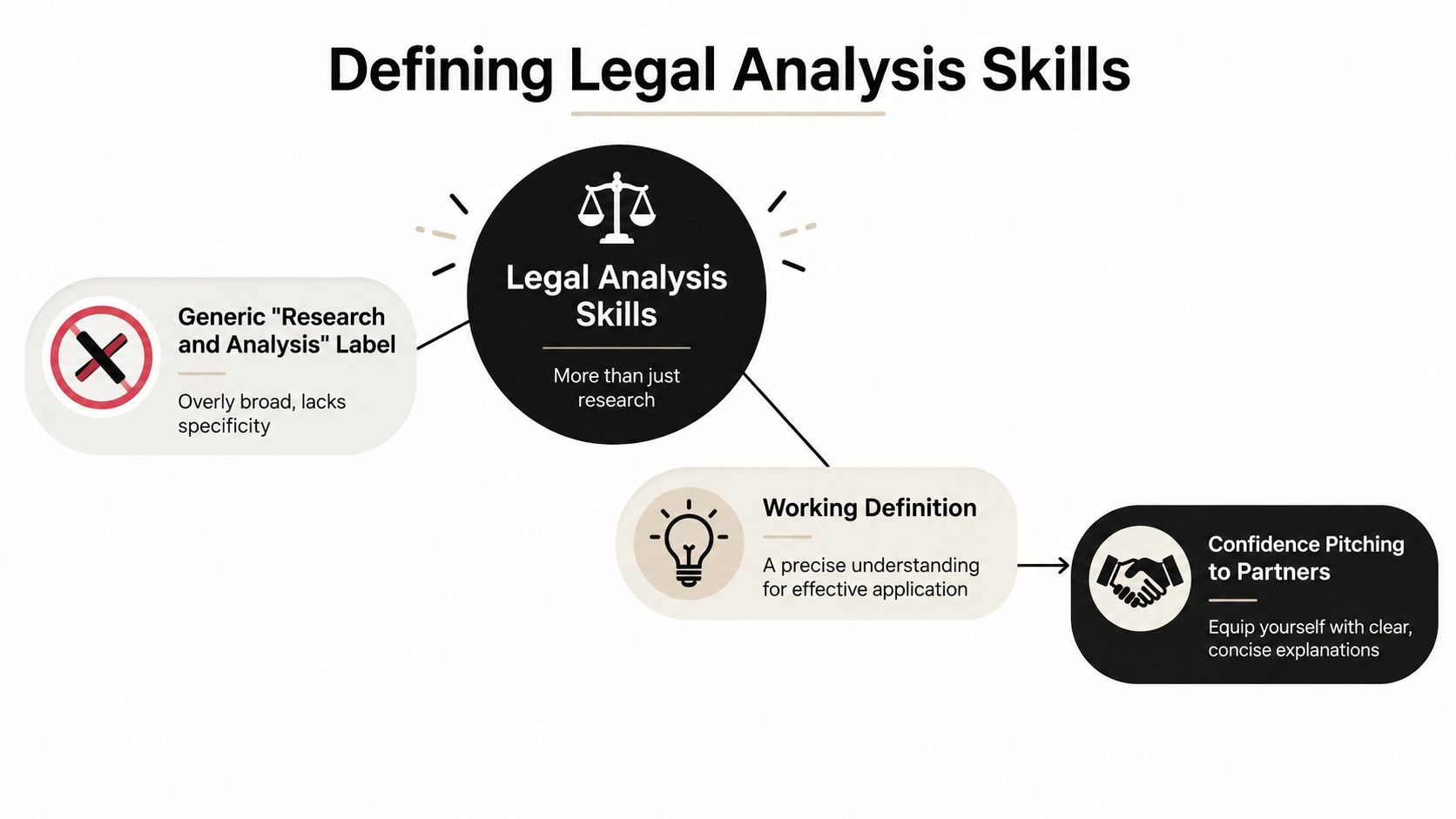
A useful definition is this: legal analysis skills are the ability to identify a legal problem, select and apply governing authority, organize relevant facts, construct a defensible argument, and communicate a supported conclusion while recognizing uncertainty and professional risk.
That definition connects classroom competency to paralegal performance. The ABA framework formalized legal analysis and reasoning, research, problem-solving, and communication as core learning outcomes, while also tying those abilities to substantive law, procedure, and professional responsibility. The ABA standards explain that foundation, and a hiring rubric should translate it into work samples.
Most legal analysis becomes easier to inspect when it follows IRAC, Issue, Rule, Application, Conclusion. Columbia Law's legal writing guide describes the pattern as the basic structure lawyers use in memos and briefs, with each discrete legal topic receiving its own IRAC block. Columbia Law's guide to organizing legal discussion is worth giving candidates before a writing exercise because it clarifies what a usable answer looks like.
IRAC isn't a magic spell. It's a quality-control device. If the issue is vague, the answer wanders. If the rule lacks authority, the conclusion floats. If the application skips the facts, the memo becomes decorative law-school prose.
Remote paralegals must distinguish evidentiary facts from controlling facts, identify omissions and inconsistencies, and map relationships among cases, statutes, regulations, and other authorities. Those competencies appear in paralegal-oriented frameworks such as AAFPE's core competency guidance.
A fact can be true without being legally important. The candidate who lists every contract date but misses the notice provision hasn't demonstrated analysis. The candidate who says, “The notice may be defective because the agreement requires written delivery and the record only shows a phone call,” has started doing the job.
Research on law students similarly frames legal reasoning as a combination of legal knowledge, legal skill, and legal mindset, with practical sub-skills including identifying a legal problem, using legal knowledge, argumentation, and seeking information. The 2022 study on legal reasoning supports the point that analysis isn't abstract logic. It's structured technique applied to messy material.
A remote paralegal doesn't need to perform every task like a lawyer. They do need a reliable analytical process that helps the attorney make decisions. I use six components to evaluate that process.
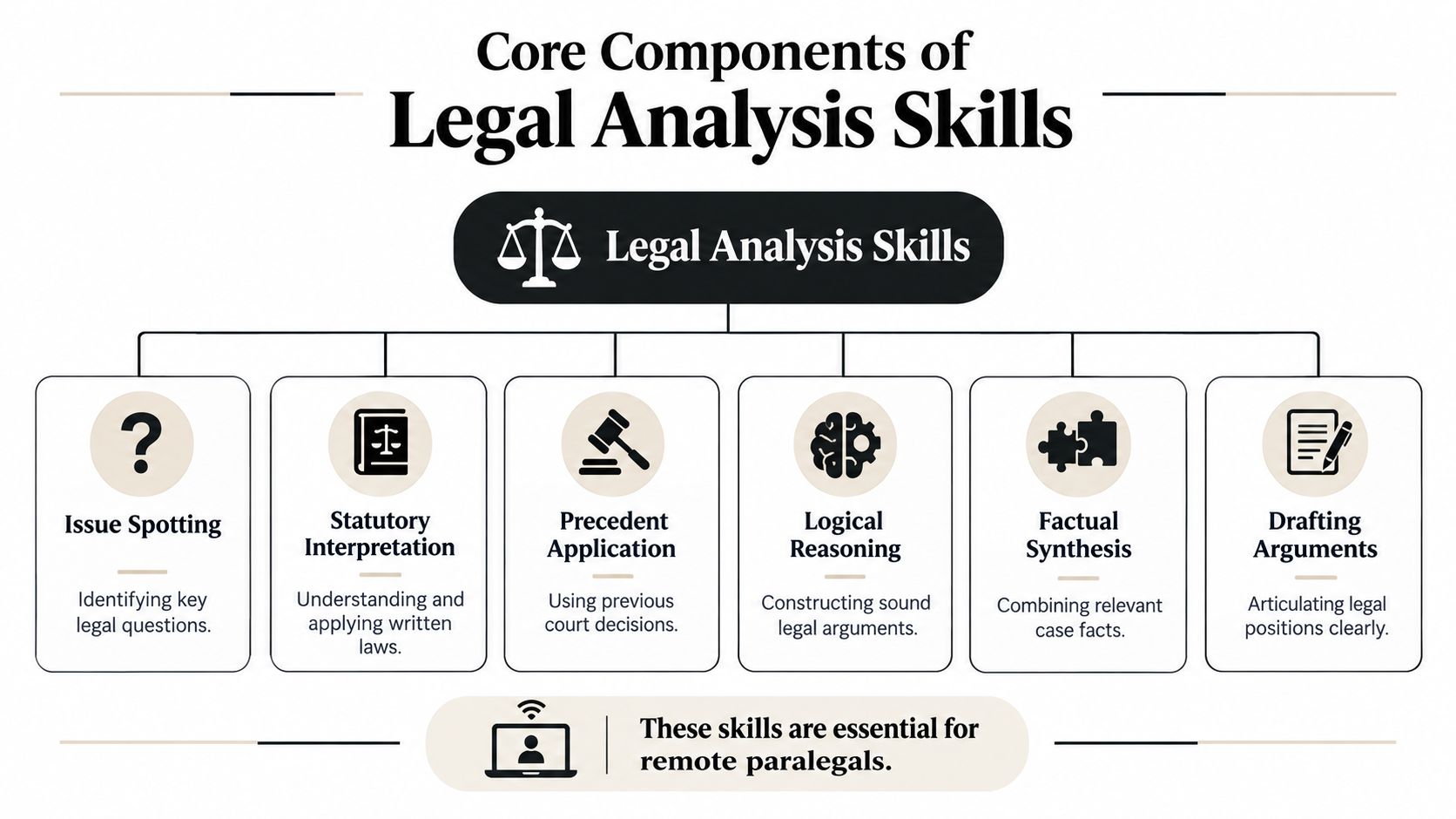
Issue spotting starts before the database search. Give a candidate a fact pattern, complaint, or contract and ask them to identify the questions that could affect the outcome. A strong response separates primary issues from secondary concerns and explains why each matters.
In daily work, this appears in intake review, discovery organization, deadline tracking, and motion support. A paralegal who spots a missing signature, an unusual venue clause, or a possible privilege issue early protects the team from expensive surprises.
Reading a statute means more than finding a keyword and pasting the first result. The candidate should identify the operative language, definitions, exceptions, cross-references, and jurisdictional limits. They should also explain where the text is clear and where reasonable arguments could diverge.
Test this with a short statutory question. Ask the candidate to mark the language doing the essential work, then explain how it applies to the facts. If the response ignores definitions or exceptions, the problem isn't formatting. It's incomplete analysis.
Case law becomes useful when the candidate can compare it to the current matter. Look for attention to procedural posture, material facts, governing rule, court level, and the reasoning that connects the facts to the holding.
A weak candidate says, “This case is similar.” A stronger one says, “The cases share the same notice issue, but the earlier decision turned on actual receipt, while our record only shows attempted delivery.” That distinction helps an attorney decide whether precedent supports, limits, or threatens the position.
Logical reasoning is the bridge between authority and recommendation. The candidate should be able to state assumptions, identify missing information, test an opposing interpretation, and avoid jumping from “possible” to “proven.”
You'll see this in privilege reviews, discovery summaries, and risk assessments. Good reasoning doesn't pretend uncertainty is absent. It labels the uncertainty and tells the team what evidence would resolve it.
Factual synthesis turns scattered records into a usable narrative. Ask the candidate to reconcile an email, a timeline, and a witness statement that don't line up neatly. The answer should distinguish confirmed facts, disputed facts, and facts that still require verification.
Many polished candidates stumble by summarizing each document separately but never explaining how the documents interact. Attorneys don't need three mini-summaries. They need a coherent account of what happened and why it matters.
Drafting arguments means presenting a position clearly, supporting it with authority, and addressing the obvious counterpoint. It doesn't mean making a paralegal impersonate counsel. It means producing organized work that an attorney can revise without excavating the logic.
A useful way to structure the underlying research workflow is to use Fluidwave's decision guide when a matter contains competing options, unknowns, and deadlines. For a deeper distinction between gathering authority and applying it, review this guide to legal research methodology. Both are more useful when treated as process aids, not substitutes for professional judgment.
The fastest way to test legal analysis is to stop asking candidates whether they're analytical. Nobody answers that question with “no.” Give them a controlled problem and inspect the work.
Give the candidate this prompt:
A tenant emails the landlord about a leaking roof. The lease requires written notice by certified mail for maintenance disputes. The landlord sends a contractor two weeks later, but the tenant has already moved valuable equipment into a storage unit and claims business losses. The lease also contains a notice-and-cure provision.
Ask the candidate to identify the legal issues without researching.
A sound answer should flag the notice method, whether the email satisfied the lease, the operation of the notice-and-cure provision, causation for the equipment losses, and any questions about mitigation or proof of damages. The candidate doesn't need to reach a final legal conclusion. They need to identify the questions that control the next research step.
The common mistake is treating “leaking roof” as the issue. That's a fact. The issue is whether the tenant complied with the contractual notice process and what consequences follow.
Use a short statutory question and require one discrete IRAC block. The candidate should state the issue narrowly, identify the governing statutory language, apply that language to the supplied facts, and reach a qualified conclusion.
For example, ask whether a filing was timely where the statute uses a defined trigger date and the record contains two possible dates. The model answer should quote or accurately paraphrase the relevant rule, explain which event fits the statutory trigger, identify the factual uncertainty, and state what document would resolve it.
IRAC works because it forces the writer to keep each legal topic answerable. Touro Law's IRAC guide likewise emphasizes organizing an essay around an issue, rule, application, and conclusion for every issue and sub-issue. For candidates who need drafting practice, pair the exercise with this guide to writing a legal memorandum.
Provide three short records:
Ask for a factual summary that separates what the record establishes from what it merely suggests.
A strong answer might say the approval date is disputed, the meeting occurred on or around the stated dates, and the execution date remains unconfirmed. It should recommend checking metadata, correspondence, or testimony rather than uncritically selecting the most convenient date.
The red flag: A candidate who resolves a conflict by preference instead of evidence will do the same thing with a case record.
Keep each exercise short enough to complete during a structured interview or take-home assessment. You're testing the candidate's process, not their ability to write a treatise before lunch.
A useful assessment has three parts: a written exercise, a live reasoning drill, and a review conversation. The written task shows how the candidate works independently. The live drill reveals whether they can think aloud, ask sensible questions, and revise an answer when new facts appear. The review conversation tests whether they can accept correction without defending every sentence like it's a constitutional amendment.
Use a scoring rubric that separates components. A candidate may be excellent at factual synthesis and weak at authority selection. One blended score hides that difference and gives you a false sense of precision.
| Component | Excellent (3) | Good (2) | Needs Improvement (1) |
|---|---|---|---|
| Issue identification | Spots the central issue, sub-issues, and missing facts | Identifies the main issue but misses a material sub-issue | Restates facts without identifying legal questions |
| Authority use | Selects relevant authority and explains its weight and limits | Finds generally relevant authority with limited comparison | Relies on unsupported statements or poor authority |
| Factual analysis | Separates controlling and evidentiary facts, conflicts, and gaps | Summarizes relevant facts with some omissions | Treats all facts as equally important |
| Argument construction | Applies the rule directly, addresses counterarguments, and calibrates uncertainty | Reaches a plausible conclusion but leaves reasoning thin | Jumps from rule to conclusion |
| Source verification | Checks citations, quotations, jurisdiction, currency, and fit | Checks obvious sources but misses a verification step | Accepts generated or supplied material without checking |
This structure reflects competency frameworks that emphasize identifying legal problems, using legal knowledge, constructing arguments, seeking information, distinguishing fact types, and mapping relationships among authorities. AAFPE's core competencies provide a useful reference point for building the categories.
Give remote candidates the same instructions, materials, time window, and permitted resources. Then ask them to explain one decision live. A take-home assignment alone can't tell you whether the candidate made the judgment or merely polished someone else's work.
For AI-era hiring, require a source log. If the candidate uses an approved AI tool, they should identify what it produced, which authorities they checked, and what they rejected. The exercise should reward verification, not clever prompting.
Use this legal skills assessment resource as a model for testing jurisdiction-specific drafting, source selection, and authority explanation. Don't confuse speed with competence. A fast unsupported answer is a faster problem.
Interview questions should force candidates to reveal their reasoning. Ask for an example, then follow up until you understand the sequence of decisions. I score each answer on a 1 to 5 scale, where 1 means the candidate gives a vague or unsupported response and 5 means they explain the issue, method, judgment, verification, and result clearly.
“Tell me about a time you found a legal issue that wasn't obvious from the assignment.”
A strong answer identifies the overlooked fact and explains how it changed the work. “I always double-check everything” earns a 2 at best.
“How do you decide which authority controls?”
Look for jurisdiction, court hierarchy, statutory text, procedural posture, and currency. A candidate who chooses the first result from a respected database is not demonstrating source judgment.
“Walk me through how you read an unfamiliar statute.”
Good answers mention definitions, exceptions, cross-references, and the factual question the statute must answer.
“How do you compare two cases that appear to conflict?”
Listen for facts, issue framing, holding, reasoning, and court level. “I'd summarize both” is not enough.
“What makes a fact legally material?”
The candidate should connect the fact to an element, defense, procedural requirement, or remedy.
“Describe a time the record contained inconsistent facts.”
Strong candidates explain how they preserved the conflict, tested the sources, and escalated the uncertainty.
“How do you structure a legal research memo?”
Look for a focused question, governing rule, application, conclusion, and clear authority support.
“What do you do when research produces no clean answer?”
The right response identifies competing interpretations, explains risk, and states what additional information would help.
“How would you verify an AI-generated case citation?”
A serious candidate goes to the underlying authority, checks the citation, confirms the quoted language, reviews later treatment, and verifies jurisdiction and relevance.
“Tell me about a time you changed your conclusion after checking a source.”
This question separates careful professionals from people who think confidence means never revising.
After every answer, use the same follow-ups: “What did you check?” “What did you rule out?” “What would you do next?” Those prompts expose memorized interview language quickly. Score independently before discussing the candidate with the rest of the panel, or the most senior voice will become the de facto rubric.
Hiring a capable paralegal is only the opening move. Small firms and legal departments often lack a formal development function, and practical guidance for building research and analysis capability outside large-firm environments remains limited. Robert Half's discussion of evolving legal department talent needs identifies legal research and analysis among the shortages teams are trying to address.
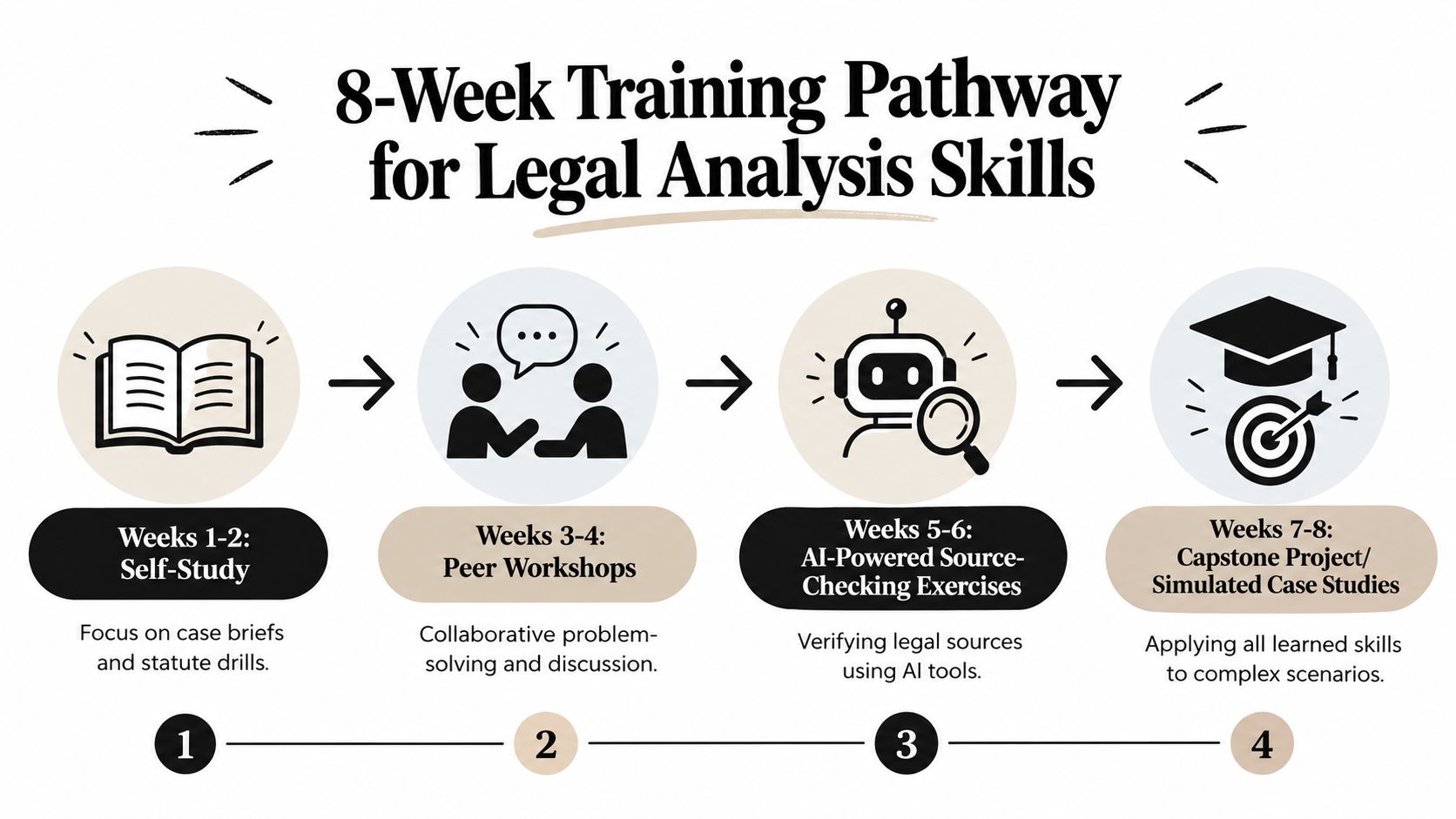
I recommend an eight-week internal program built around actual matter types, not generic webinars.
Assign case briefs, statute drills, citation checks, and short issue-spotting exercises. Require the paralegal to identify the question before opening a research platform. The advantage is control and low cost. The drawback is that self-study can become passive unless someone reviews the work.
Pair the paralegal with an attorney or experienced legal support professional. Use a shared fact pattern and ask each person to identify issues independently before comparing answers. Workshops surface assumptions that solitary study hides, but they need a facilitator who can keep discussion tied to authority rather than personal preference.
Use an approved AI tool to generate a preliminary issue list or research path. Then require the trainee to verify every authority against the underlying source and document what changed. AI can accelerate exploration, but it can also produce confident errors. Treat the output as a hypothesis, never as the final answer.
Give the trainee a realistic matter packet with a deadline, contradictory facts, and multiple authorities. Require an issue map, source log, factual chronology, short memorandum, and verbal briefing. Score the capstone using the same rubric used for hiring.
Small firms should prefer repeatable internal exercises over expensive courses that never touch the firm's files. Vendor training can help with platform mechanics and AI governance, while peer review develops judgment in context. The combination works better than either route alone.
Don't build a training calendar that ends with attendance. Build one that ends with a work product you'd trust.
Legal analysis skills aren't a résumé adjective. They're the operating system behind reliable remote legal support. A paralegal who can identify the core issue, locate the right authority, organize the facts, draft a defensible analysis, and verify AI-assisted work provides significant value to the attorney. A paralegal who can't do those things gives the attorney another inbox.
Before your next hire, make five commitments:
AI makes this discipline more important, not less. Drafting can be accelerated. Accountability can't. The professional who reviews, verifies, and explains the work remains responsible for what reaches the partner, client, opposing counsel, or court.
Start this week. Choose one real practice-area fact pattern, create the five-column rubric, and run it with your next remote paralegal candidate. If you want a faster way to compare vetted remote legal professionals, review how HireParalegals connects firms with remote paralegals and legal researchers, then apply your own exercise and scoring standards before making an offer.
Send your next candidate the exercise, set the clock, and score the reasoning, not the résumé.