 17 minutes read
The most popular advice about communication skills evaluation is also the least reliable: put a candidate on Zoom, ask whether they're a “good communicator,” and trust the person who sounds polished.
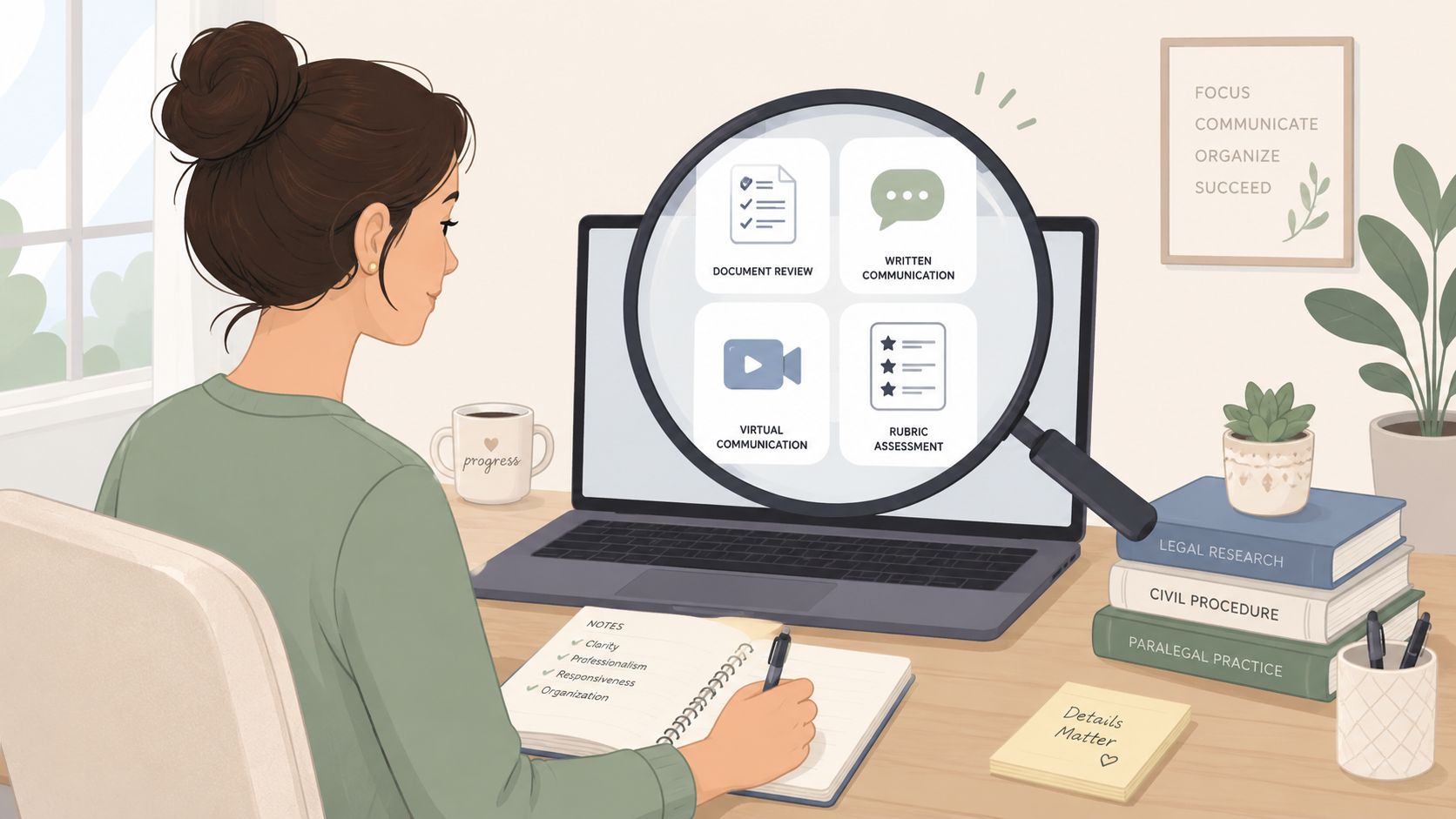
That's interview theater. Remote paralegals communicate through case notes, deadline alerts, client emails, document summaries, Slack updates, and carefully worded messages sent when nobody else is online. A warm smile on camera helps, but it doesn't tell you whether someone can turn a messy discovery batch into a useful summary without burying the attorney in vague prose.
I've hired remote legal support, made expensive mistakes, and learned that async writing and structured work samples reveal more than conversational sparkle. This guide lays out a practical communication skills evaluation process for remote paralegals, including assessment methods, scenario-based questions, scoring rubrics, and a five-day workflow you can run.
A great phone screen doesn't prove great communication. It proves the candidate can handle a phone screen.
The default 30-minute video interview measures comfort with cameras, small talk, quick verbal processing, and rehearsed answers. Those qualities can matter in some roles, but they're a poor stand-in for the work a remote paralegal performs after the welcome call ends. A candidate can sound confident while giving incomplete answers, glossing over uncertainty, or missing the actual question.
The day-to-day gap is obvious once you look at the work. Remote paralegals spend much of their time drafting attorney emails, preparing client updates, documenting case activity in a practice management system, organizing records, and flagging deadlines. Those tasks demand written clarity, accurate listening, judgment, and dependable asynchronous follow-through.

Practical rule: Hire for the communication channel the job uses most, not the channel that makes interviewing easiest.
I once hired someone who aced two interviews. They were engaging, articulate, and quick with a story. Six weeks later, their Slack messages were vague, typo-heavy, and missing the details attorneys needed to act. Every update created another question. Every question created another delay.
The problem wasn't personality. It was that we'd tested performance in a conversation and assumed it would transfer to written legal work. It didn't.
Recent analysis of remote hiring makes the same distinction: synchronous video interviews can favor quick verbal processing, on-camera warmth, and improvisation while filtering out candidates who think carefully, write clearly, and work effectively asynchronously. That's a selection-bias problem, not a reliable proxy for job performance, as explained in this analysis of remote hiring and async communication assessment.
A better candidate screening process starts with a small amount of realistic work. Ask the candidate to rewrite a client email, summarize a dense record, draft a status update, or record a short explanation of a procedural development.
The research foundation supports that shift. A meta-analysis of 34 assessment-center articles collapsed 168 dimension labels into six core competencies, including communication, and found estimated true criterion-related validities ranging from .25 to .39 across dimensions. A composite based on four competencies explained 20% of job-performance variance, compared with 14% for the overall assessment-center rating. The practical lesson is straightforward: structured criteria and multiple observations beat one partner's instinct after a pleasant conversation. The assessment-center validity discussion provides the background.
Video still has a place. It just shouldn't run the hiring process.
Communication skills evaluation measures how a candidate produces, receives, organizes, and adapts information through the channels a remote paralegal role uses. That makes it a work-sample problem, not a popularity contest. “Good communicator” is a vague label until the hiring team defines the behavior it expects, the task that reveals it, and the standard used to score it.
Tie the assessment to daily paralegal work:
Clarity of writing. Can the candidate state the point early, separate facts from conclusions, and write a message an attorney can scan quickly? Provide a poorly drafted client email and request a clean rewrite.
Concision. Can they reduce a long record to material facts without removing details that change the legal or operational decision? A useful exercise asks for three bullets from a five-page motion section.
Tone and audience awareness. Can they explain the same issue differently to a supervising attorney, a worried client, and opposing counsel? Legal accuracy without audience judgment still creates bad communication.
Responsiveness. Can they recognize urgency, acknowledge receipt, identify the next action, and flag a conflict before a deadline becomes a crisis? Give them an instruction containing an impossible timing conflict and assess what they surface first.
These tasks test information production and information consumption. A candidate may write beautifully yet miss a key instruction. Another may respond quickly while sending polished nonsense. Neither profile works reliably in a remote legal team.
A validated job-applicant instrument shows how far this approach can be operationalized. One study reported content-validity values from 0.2 to 1.0, reliability of 0.65, item difficulty of 0.62, and discriminating power of 0.53. It also defined performance bands at 20-33, 34-47, and 48-60 points for pre-competent, threshold, and proficient performance. Those figures come from the study of a job-applicant communication-skills instrument.
Use the same prompt, the same rubric, and more than one reviewer where practical. Score writing quality separately from legal knowledge, because a partner familiar with one firm's preferred style can otherwise reward house habits instead of transferable communication ability.
A global communication rubric tested with 1,100 students reported Cronbach's alpha of 0.78, found all six items loading onto one component, and detected score gains as students advanced from P1 to P3. That evidence supports multi-item rubrics that work as a coherent measure while still detecting development over time. The rubric validation study provides the psychometric detail.
The aim is practical: replace camera presence and interviewer instinct with observable work, consistent scoring, and standards agreed before anyone meets the candidate.
Live interviews are useful, but they are a poor default test for remote paralegal communication. Async writing exposes organization, precision, and judgment under conditions that resemble the actual job. Use each method for the evidence it can produce, then combine the results deliberately.
| Method | Time to Run | Best At Predicting | Common Failure Mode | Risk Mitigation |
|---|---|---|---|---|
| Live interview | Short | Collaboration preferences, verbal judgment, salary negotiation | Charisma masks weak writing | Reveals evasiveness, poor listening, or weak clarification when follow-up questions change the scenario |
| Role-play | Moderate | Triage under pressure and instruction handling | Nervous writers perform poorly in the moment | Catches missed priorities, unsafe assumptions, and failure to escalate urgent issues |
| Written test | Moderate | Email drafting, record summaries, written precision | Overlooks spoken explanation and interpersonal warmth | Exposes ambiguity, unsupported conclusions, weak structure, and missing next steps |
| Short video presentation | Moderate | Explaining a procedural update to a non-lawyer | Rewards presentation polish over depth | Shows whether the candidate can simplify accurately without relying on legal jargon |
Use interviews to discuss collaboration preferences, availability, and an unexpected follow-up. They also have a legitimate place in salary negotiation, where both sides need a direct conversation.
Do not let the interview carry the communication evaluation. The 2025 industry analysis cited in the remote-hiring discussion found communication skills accounted for 27% of hard-skill testing and predicted a shift from standalone tests toward contextual communication tasks. That industry analysis and its implications The practical lesson is simple: ask candidates to produce work, not perform likability on camera.
Role-plays show how a candidate handles competing instructions. Give them an attorney's urgent request, a client seeking an immediate answer, and a filing deadline that requires verification. Watch for clear priorities, stated assumptions, and appropriate escalation.
Pressure can distort the result. A strong writer may become clumsy while improvising, so treat role-play as supporting evidence. Repeat the exercise only when the role regularly involves live client or attorney interactions.
Written exercises should anchor assessment for remote paralegals. Request an email rewrite, a short case update, and a summary of supplied records. Score substance, structure, audience awareness, precision, and actionability separately.
Keep the exercise realistic and short, using fictional or sanitized material. Never disguise unpaid production work as an evaluation. You are testing judgment, not trying to remove a file from the firm.
A short video memo tests whether the candidate can explain a procedural update to a non-lawyer without burying the point in jargon. Give clear instructions and keep the assignment brief. Judge accuracy, organization, and audience awareness, not cinematic confidence.
My recommended mix is 50% written work, 20% role-play, 15% short video explanation, and 15% live interview. Adjust those weights for unusually client-facing roles, but require written evidence in every remote paralegal evaluation. A charming interview should never erase weak drafting.
Generic prompts invite generic answers. “Tell me about a time you communicated effectively” is a gift to anyone with a memorized STAR story and no evidence of legal writing ability.
Use scenario-specific prompts instead. Some belong in a live interview. Others should be answered asynchronously so you can inspect the candidate's actual drafting.
Prompt, async: “Rewrite this client email so it explains that a requested filing date may change, states what the firm is doing next, and avoids promising an outcome.”
Strong signal: The candidate leads with the current status, uses plain language, preserves uncertainty, and gives the client a clear next step.
Red flag: They make the email warmer but leave the original ambiguity intact.
Prompt, async: “Summarize this five-page motion section in three bullets for a supervising attorney.”
Strong signal: The summary separates the issue, supporting point, and practical implication.
Red flag: It becomes a paragraph of copied terminology with no prioritization.
Prompt, live: “Explain why your rewrite is better.”
Strong signal: The candidate discusses audience, risk, sequence, and omitted detail without becoming defensive.
Red flag: They say it “sounds more professional” and stop there.
Prompt, live: “A client asks whether the judge will approve the request. How do you respond?”
Strong signal: The candidate acknowledges the concern, avoids predicting an outcome, explains what can be confirmed, and routes legal conclusions appropriately.
Red flag: They offer certainty to make the client feel better.
Prompt, async: “Draft a client-facing explanation of a procedural rule for someone with no legal background.”
Strong signal: The explanation is accurate, concrete, and free of unnecessary legal shorthand.
Red flag: It copies a rule citation without explaining what the client needs to do.
Prompt, live: “The attorney gives you an instruction that conflicts with an existing deadline. What do you say first?”
Strong signal: They restate the conflict, identify the decision needed, and avoid choosing one deadline.
Red flag: They promise to “try to make it work” without verifying priorities.
Prompt, async: “Draft a Slack update explaining that a filing is delayed because a required document hasn't arrived.”
Strong signal: The update states the blocker, impact, owner, next action, and escalation point.
Red flag: “Still waiting on documents. Will update soon.”
Prompt, live: “You notice a possible inconsistency in a case file late in the day. What do you do?”
Strong signal: The candidate preserves the source, checks the relevant record, documents the concern, and escalates based on urgency.
Red flag: They correct the file or wait until someone notices.
Prompt, async: “Write a handoff note for a colleague who will be away from the matter for several days.”
Strong signal: The note identifies status, open questions, deadlines, links or document locations, and the next owner.
Red flag: It assumes the reader remembers the entire case history.
Prompt, senior-level, live: “You disagree with an attorney's proposed client message. How would you raise the concern?”
Strong signal: The candidate identifies the specific risk, proposes a revision, and respects decision ownership.
Red flag: They either agree automatically or frame disagreement as a personal confrontation.
A useful legal assistant interview question guide can expand your question bank, but keep the scenarios tied to the actual role. Questions should produce evidence, not applause.
| Sub-Skill | Question Prompt | Strong Answer Signal | Red Flag |
|---|---|---|---|
| Written clarity | Rewrite a vague client email | Point-first structure and clear action | Warmer wording with the same ambiguity |
| Concision | Summarize a motion section in three bullets | Prioritized facts and implications | Copying dense legal language |
| Client empathy | Explain an uncertain outcome | Empathy without overpromising | False certainty |
| Legal precision | Explain a procedural rule | Accurate plain-English explanation | Rule citation without application |
| Async responsiveness | Draft a delayed-filing update | Blocker, impact, owner, next action | “Will update soon” |
| Listening accuracy | Restate conflicting instructions | Correct priorities and clarification | Silent assumption |
| Conflict handling | Challenge a proposed message | Specific risk and practical revision | Personal or evasive response |
A rubric prevents the loudest interviewer from becoming the hiring system.
I use five weighted sub-skills for remote paralegal communication:
Each skill receives a score from 1 to 4. The weighted result gives you a consistent comparison, while the individual scores show why candidates differ.
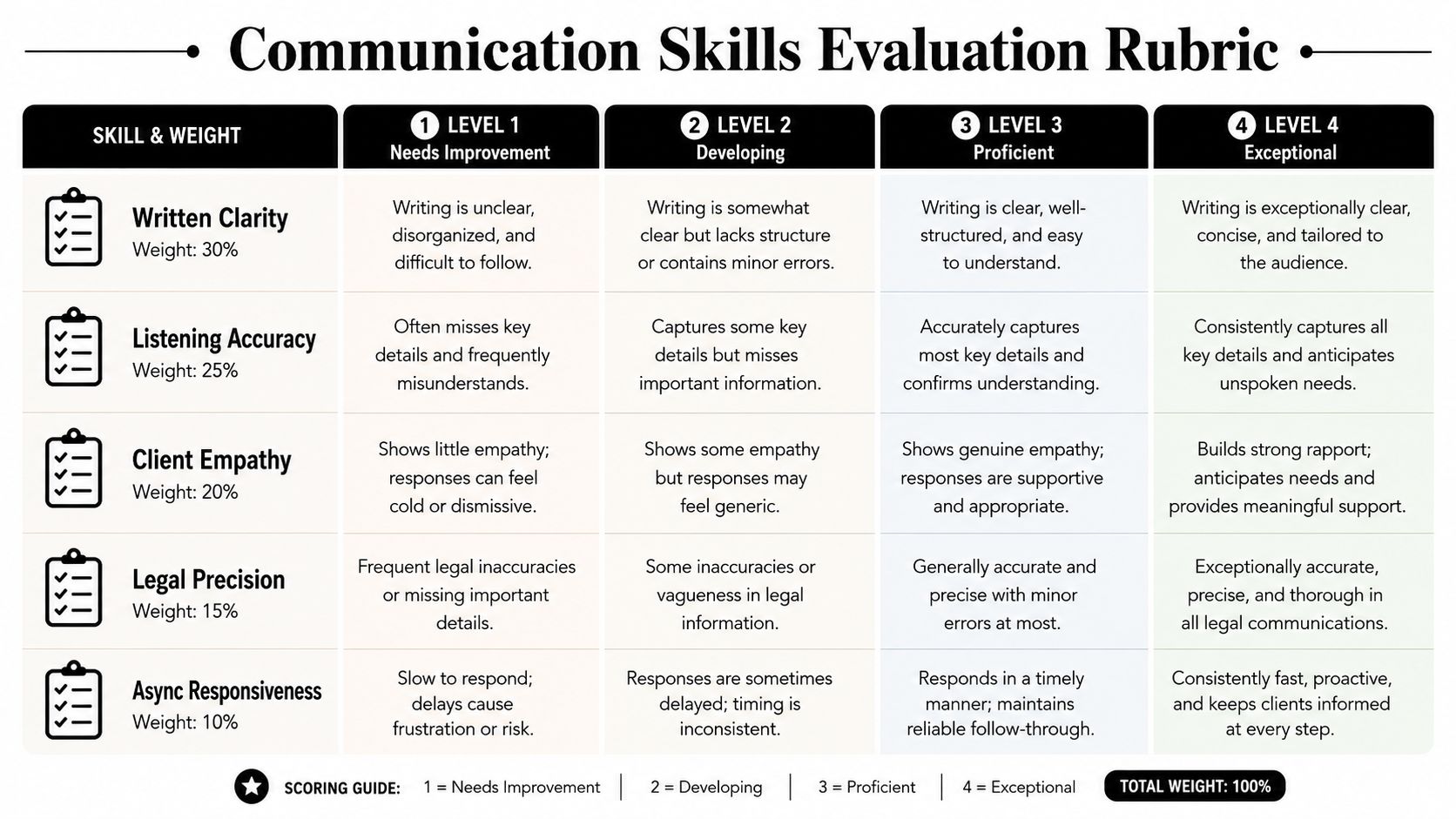
Score 1, needs improvement: The candidate misses material instructions, produces unclear work, or creates avoidable risk. They need substantial correction before the work is usable.
Score 2, developing: The candidate understands the general task but needs repeated editing, prompting, or clarification. The message may be serviceable after supervision, but the candidate doesn't yet show dependable independent judgment.
Score 3, strong: The candidate communicates accurately, organizes the information well, adapts tone to the audience, and identifies the next action. Minor edits may remain, but the work is operationally useful.
Score 4, exceptional: The candidate anticipates confusion, surfaces hidden risks, makes the recommendation easy to find, and preserves nuance without bloating the message.
Don't treat an edge score as a mathematical mystery. If two reviewers disagree between 2 and 3, they should point to the exact sentence or behavior causing the disagreement. The answer isn't averaging blindly. It's discussing the evidence and recording the reason.
Candidate A scores 4 in written clarity, 3 in listening accuracy, 2 in client empathy, 4 in legal precision, and 2 in async responsiveness. Candidate B scores 3, 4, 4, 3, and 4 in those same categories.
Candidate A may look more polished on the page and catch technical issues well. Candidate B may be safer for a client-heavy remote role because they listen more accurately, handle uncertainty with empathy, and keep asynchronous work moving.
That's the point of weighted scoring. Grammar shouldn't overpower judgment. A perfectly punctuated recommendation that buries the actual conclusion is less useful than a plain, direct update that tells the attorney what needs a decision.
Build the template in a spreadsheet with columns for candidate, exercise, reviewer, sub-skill, score, evidence, and follow-up question. The paralegal performance evaluation framework can help you connect hiring criteria to later performance reviews, so your rubric doesn't disappear the moment someone accepts the offer.
Small firms don't need an elaborate assessment platform. They need sequence, ownership, and discipline.
The hiring manager screens resumes against role requirements and sends a short async writing prompt to candidates who meet the baseline. The prompt should use fictional material and test a real task, such as a client email rewrite or case-status summary.
Allow enough time for thoughtful work, but set a clear submission window. The reviewer records scores before discussing candidates with the rest of the team.
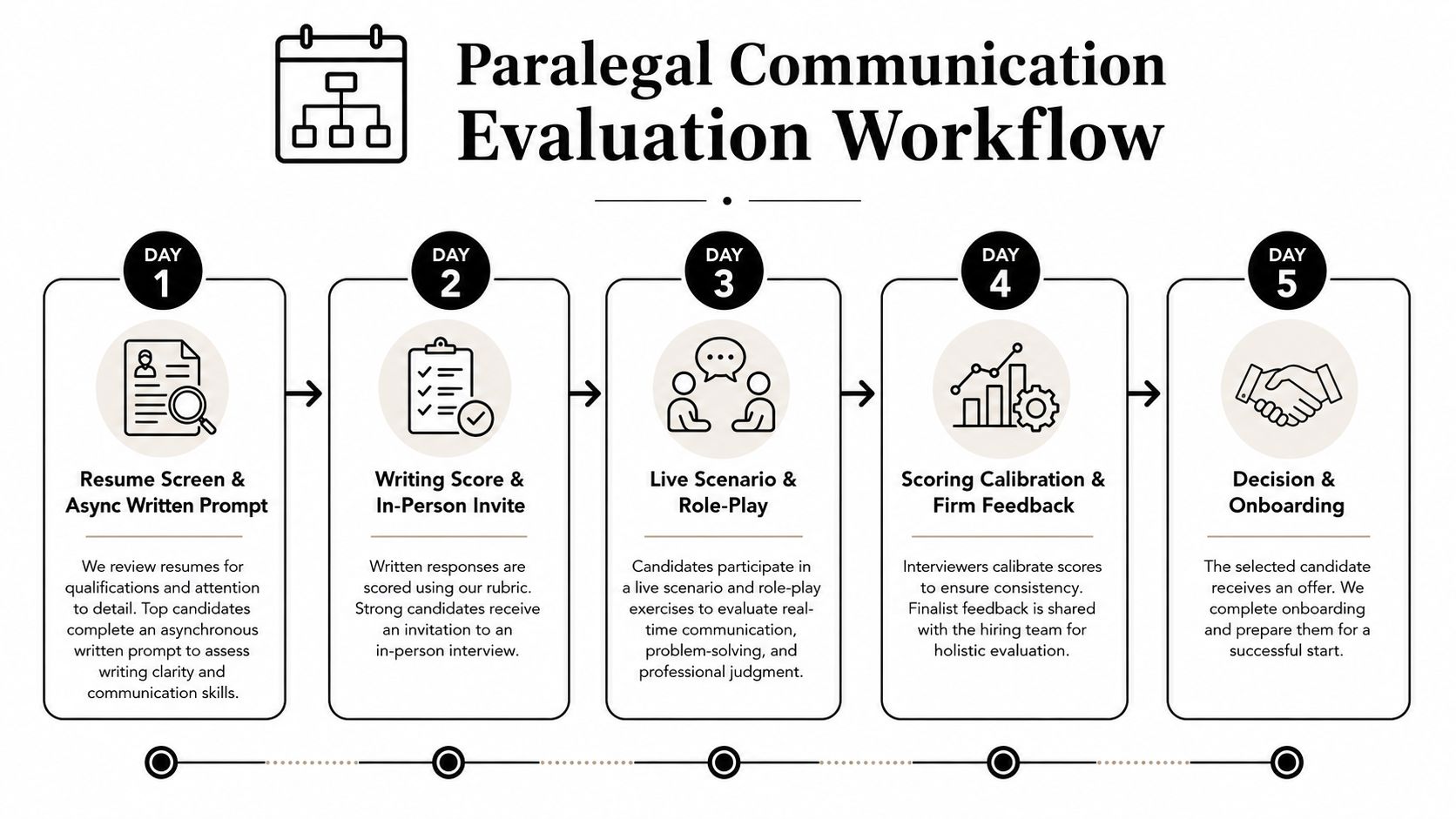
The hiring manager or designated reviewer scores the writing against the rubric. Invite the strongest candidates to a structured video conversation, preferably with the same prompts and the same time limits.
This video should be asynchronous if the role is heavily asynchronous. Ask for a short recorded explanation of a procedural update, then use the live conversation to clarify choices rather than repeat resume questions.
Run a short live scenario. Give the candidate competing instructions, an incomplete fact pattern, or a client concern that requires careful boundaries. The evaluator watches how the candidate clarifies, prioritizes, and escalates.
The exercise owner should write notes tied to rubric categories, not impressions such as “seemed sharp.”
Two reviewers compare scores and resolve material disagreements by looking at evidence. Then conduct a communication-specific reference check. Ask whether the candidate's written updates were clear, whether they surfaced problems early, and whether supervisors had to chase status information.
The decision-maker reviews the complete evidence trail and records the reason for the decision. Keep the resume, prompts, candidate submissions, rubric scores, interviewer notes, reference notes, and decision rationale together.
If your firm uses an external talent option, HireParalegals is one platform that provides curated remote legal professionals, candidate profiles, video introductions, and skills validation. Treat that as a sourcing option, not a substitute for role-specific evaluation.
The same assessment errors keep showing up because firms confuse convenience with accuracy.
Mistake one, confidence becomes clarity. A candidate who speaks quickly and maintains eye contact can still write confusing updates. Fix: score structure, accuracy, audience awareness, and actionability separately.
Mistake two, reviewers score against invisible standards. One partner rewards formal language. Another wants plain English. A third penalizes a style choice nobody documented. Fix: use shared behavioral anchors and require reviewers to cite evidence.
Mistake three, one writing sample carries the whole decision. Candidates have good days. Prompts also have blind spots. Fix: use multiple short exercises, such as an email rewrite, a case summary, and a delay update.
Mistake four, firms ignore response latency. Remote communication isn't only about what someone writes. It's also about whether they acknowledge an urgent issue before the team starts guessing. Fix: define baseline response expectations for the role and test prioritization explicitly.
Mistake five, grammar pedantry replaces legal judgment. A typo matters in a filing. It doesn't automatically outweigh a clear, accurate recommendation in an internal update. Fix: tie grammar standards to document type and risk rather than applying one blanket preference.
Watch for copied boilerplate and AI-generated drafts that collapse under live questioning. Ask the candidate to explain why they chose a phrase, what they omitted, and what they'd verify before sending. The draft is evidence. Their reasoning is evidence too.
For a broader checklist of preventable hiring problems, review these top interview errors to avoid, then tape this shorter version next to the hiring laptop:
If your current process still begins and ends with a 30-minute Zoom call, change it before the next hire. Create one realistic writing prompt, assign the five-skill rubric, and run the five-day workflow on your next remote paralegal search. You'll have better evidence, a more defensible decision, and far fewer mysterious Slack messages waiting for you at 8:00 a.m.
Start by drafting your first async exercise today, then use HireParalegals' candidate screening process or your existing recruiting workflow to put it in front of qualified applicants. A candidate who communicates clearly before they're hired is giving you the most useful preview of how they'll communicate after they join the firm.