
 14 minutes read
The partner wants a status update. The client wants a clean invoice. The paralegal is hunting through email for the latest intake form, while an associate is working from an old template and nobody can say who owns the next handoff. Meanwhile, the firm is considering another legal technology purchase because, apparently, the answer to a broken workflow is often a shinier broken workflow.
Legal process improvement works when you fix the work before you automate it. That means mapping ownership, standardizing repeatable decisions, measuring a small set of useful outcomes, and then giving people tools that move matters forward instead of creating another place to enter information.
A firm can have excellent lawyers and still run matters badly. The problem usually isn't legal judgment. It's the invisible operational layer around that judgment: intake arrives through five channels, scope lives in someone's head, documents move by attachment, review creates rework, and billing waits for a final scavenger hunt.

I've seen teams respond by buying a matter management platform before agreeing on what “opened” means. That's backwards. A system can route a task, but it can't resolve a dispute between two people who both believe the other owns it. It can report cycle time, but only if the start and finish points mean the same thing to everyone.
The American Bar Association's legal project management framework defines legal project management as a systematic approach to scoping, planning, managing, and controlling legal work within clear time, budget, and performance requirements. It also includes capturing lessons after the matter ends.
That definition matters because legal process improvement isn't a motivational poster about being organized. It's disciplined project work. Someone defines the deliverable. Someone owns each milestone. Someone watches the budget and timeline. Someone records what should change next time.

Practical rule: If a process has no owner, no definition of done, and no measurement point, it isn't a process. It's a recurring favor.
The shift is bigger than law firms. The World Bank's 2020–21 data collection across 120 economies found that 77 economies introduced additional electronic court features in 2021 alone (EU Justice Scoreboard coverage). Courts have adopted e-filing, remote hearings, case tracking, and administrative data tools at a pace that would have seemed unusual not long ago.
Think of improvement as a stack, not a product:
For practical examples of how to document repeatable work, see these resources on streamlining workflows with documentation examples and legal process documentation. The point isn't to create a museum of binders. It's to make the next correct action obvious.
Don't start with software. Start with one matter type and follow it from the first request to the invoice. Pick something frequent enough to reveal patterns, but bounded enough that the team can map it without turning the workshop into a constitutional convention.
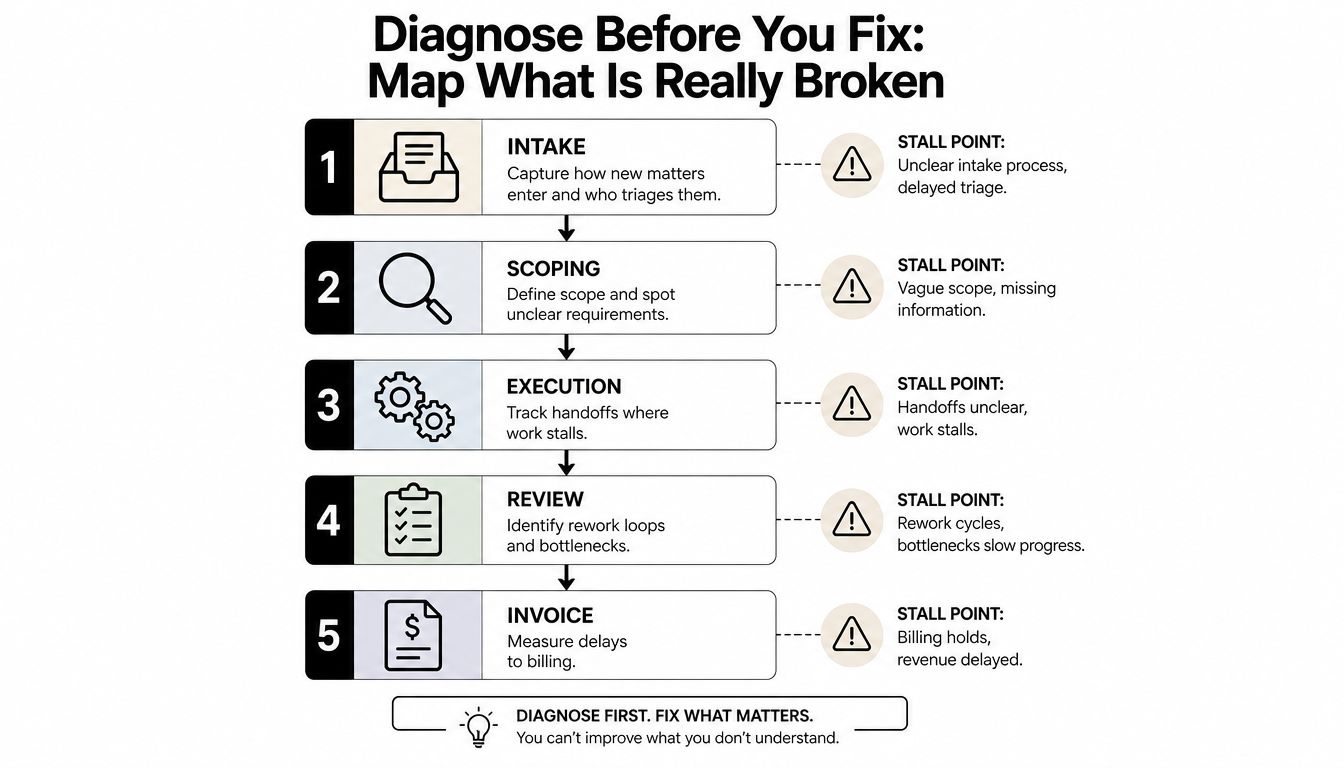
Invite the people who touch the work, not only the people who supervise it. Include the intake owner, responsible attorney, paralegal, billing contact, and anyone who handles client updates or document control.
Map five stages:
Don't make the map pretty. Make it honest. Write down the spreadsheet, inbox, Slack message, case-management screen, and personal notebook if those are part of the workflow.
A good workshop sounds less like a strategy retreat and more like an investigation.
Pull the simplest available evidence first. Review recent intake records, matter-opening timestamps, task histories, invoice approval records, budget reports, and examples of returned work. You don't need a data warehouse to find a recurring handoff failure. A handful of real matters will expose more than a polished opinion poll.
For a broader process lens, this business process guide from F1Group provides useful context for examining flow, ownership, and unnecessary friction. You can also use this practical overview of business process improvement techniques when turning observations into a shortlist of fixes.
At the end, create a one-page current-state map and rank issues by frequency, impact, and controllability. A painful problem that happens once a year may matter less than a modest delay repeated across every matter.
Use a simple scorecard:
| Question | What to capture |
|---|---|
| How often does it happen? | Occasional, recurring, or nearly every matter |
| What does it affect? | Time, quality, billing, client experience, or risk |
| Who can change it? | One role, several roles, or an outside dependency |
| What evidence exists? | Matter records, timestamps, emails, or returned work |
The output should be a short list, not a novel. If the team can't identify the first bottleneck and its owner, it isn't ready to automate.
Lean and Six Sigma sound like they belong on a factory floor. The useful parts translate cleanly to legal work, provided you leave the industrial cosplay behind.
Lean asks where effort creates no value. Six Sigma asks why outcomes vary and how defects recur. In a legal workflow, that means removing waiting and rework, creating standard work, and measuring enough to spot variation before it becomes a client problem.
Legal waste often hides behind respectable labels. “Reviewing for completeness” may mean checking the same missing field three times. “Keeping everyone informed” may mean copying twelve people on an email because nobody trusts the matter record.
Common waste includes:
The redesign is concrete. Replace a free-form intake email with required fields. Replace “please review” with a defined review task, deadline, and acceptance standard. Replace a recurring status chase with a report generated from recorded matter activity.
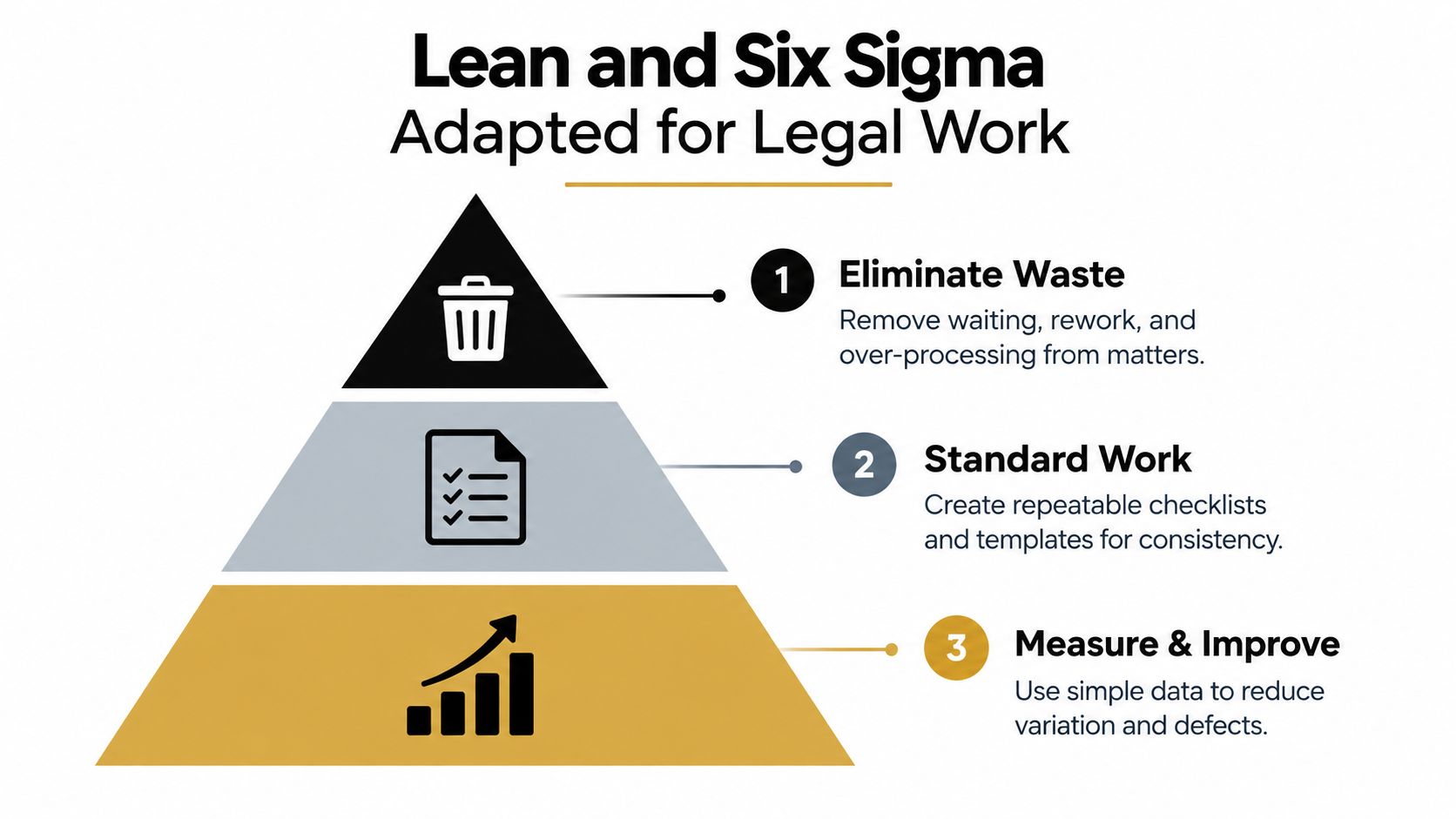
Standard work doesn't mean every matter gets treated like a toaster. It means repeatable parts have a repeatable starting point.
A contract review might use a standard intake form, a naming convention, an issue checklist, a clause library, and a review handoff. A litigation team might define how deadlines enter the calendar, who verifies them, and how completion gets recorded.
Use standard operating procedures for legal work as working instructions, not decorative documents. Keep them close to the task, write for the person doing the work, and update them when the team discovers a better method.
The OECD's judicial performance work linked faster courts with operational factors including computerization investment, systematic statistics, active case-progress management, specialized commercial courts, and managerial responsibilities for chief judges (OECD judicial performance research). The lesson applies inside firms and legal departments: technology helps, but management discipline gives technology direction.
Use a small test:
Capture lessons after closing. Which intake fields were missing? Which review step created the most returns? Which role became overloaded? That feedback turns each completed matter into operating knowledge instead of another isolated file.
There are three practical levers: automation, standardization, and human capacity. Teams need a mix, but they shouldn't reach for all three at once. Match the lever to the failure.
| Lever | Best For | Watch Out For |
|---|---|---|
| Workflow automation | Triggering tasks, routing work, calendaring deadlines, and generating routine documents | Automating unclear rules or spreading bad data faster |
| Templates and standardization | Repeatable documents, intake fields, checklists, naming rules, and review criteria | Creating rigid forms that force exceptions into email |
| Remote or outsourced support | High-volume administration, document preparation, intake follow-up, and matter coordination | Delegating work without access rules, training, or a clear owner |
Workflow automation uses software to execute repeatable actions. A matter reaches a defined stage, the system creates tasks, assigns work, calendars a deadline, generates a document, or routes the request to the right person (MyCase workflow automation).
That trigger-and-routing mechanic is valuable. It reduces duplicate entry and the constant human nagging that keeps routine work alive. But automation can't decide whether a client request changes scope unless the team has defined the rule.
Templates are the cheapest improvement lever when the work is familiar and the output is predictable. They help teams standardize document structure, client communication, naming, and review expectations before introducing complex software.
The danger is template sprawl. If nobody retires outdated versions, the firm turns consistency into a scavenger hunt. Keep one controlled source, name the owner, and include a visible revision date or status.
Human support wins when the work has volume but still needs context. A trained paralegal can chase missing records, prepare a draft packet, monitor task completion, and flag an exception that a rule-based workflow can't interpret.
For firms that need flexible legal support, HireParalegals provides access to remote paralegals and other legal professionals through a curated talent platform. Treat that capacity like any other operational component. Give the person a documented process, system access that matches the role, a communication cadence, and a named reviewer.
A useful decision rule is simple:
For teams comparing workflow design approaches, this guide by Technovation LLC offers additional practical context. Don't buy a platform to avoid making a decision. That's how firms end up paying subscription fees for a digital version of the same chaos.
A process improvement project fails when the old habits return. The new intake form becomes optional, attorneys bypass the queue, staff maintain a private tracker, and the dashboard keeps reporting a beautifully organized lie.
The cure is a sustainment rhythm. Benchmark first, assign ownership, review a tiny KPI set, and make the new behavior easier than the old workaround.
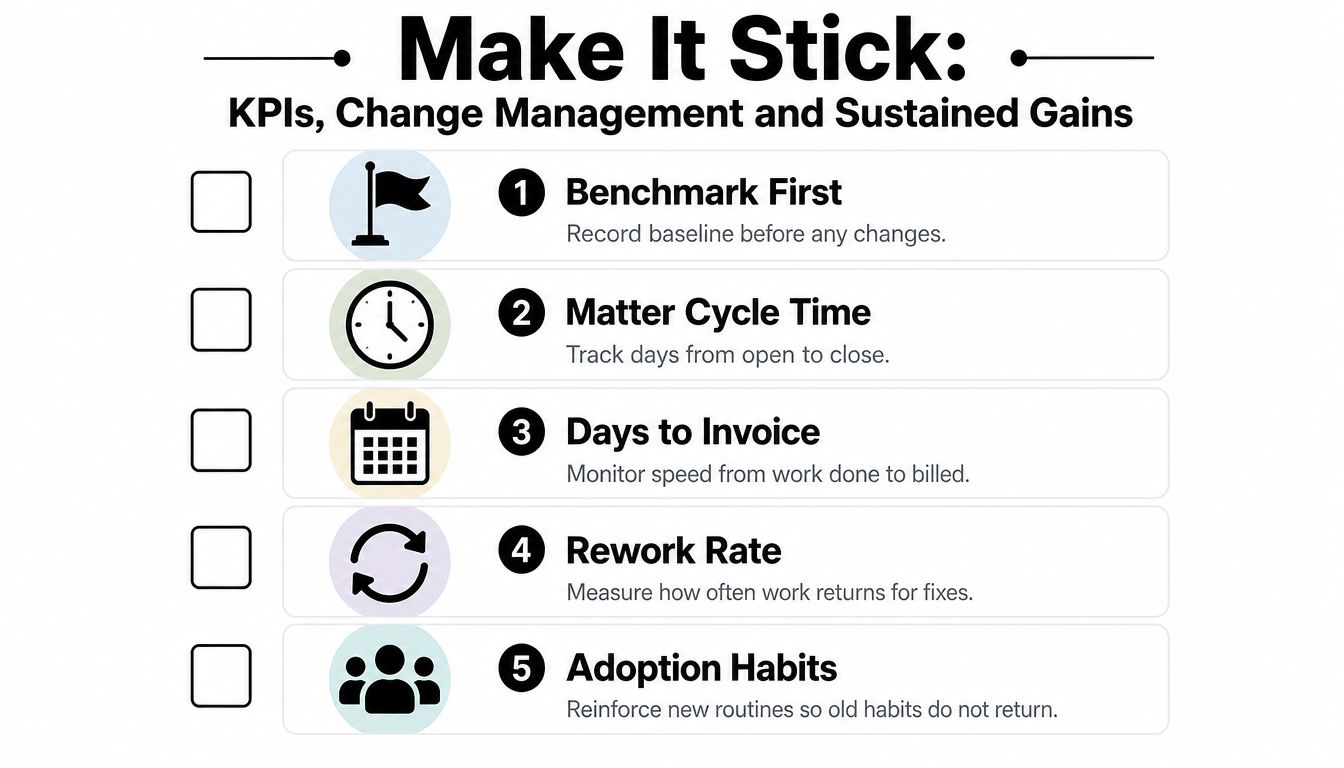
Thomson Reuters legal operations guidance recommends benchmarking the current state and tracking operational measures such as matter cycle time, days to create matters, invoice approval time, spend versus budget, and staffing ratios (Thomson Reuters Legal Department Operations Index).
Don't launch a dashboard with every field your systems can export. Start with a compact set:
Record the baseline before changing the workflow. Review the difference monthly or quarterly, depending on volume. A metric without an owner is just a number wearing office attire.
Name a process owner who can answer questions, approve changes, monitor exceptions, and remove outdated instructions. Give attorneys a reason to use the new path, such as faster status visibility or fewer repetitive questions, not a lecture about compliance.
A centralized legal front door helps when requests currently arrive everywhere. The 2025 Checkbox insights report found that 50% of respondents viewed a centralized legal front door as essential, while 38% wanted intake automation or AI (Checkbox 2025 insights report). Those figures point to a practical sequence: centralize the request first, then automate the parts that have stable rules.
Use short training, screen recordings, and real examples from the team's own matters. When someone bypasses the process, don't merely scold them. Find out whether the workflow is slower, missing a necessary exception, or unclear at the handoff. Fix the design, then reinforce the habit.
ROI doesn't begin with a software license. It begins with a baseline and a business problem. If intake delays create missed work, measure the delay. If invoice approval traps completed work in limbo, measure the approval path. If senior lawyers spend time on routine coordination, measure where their capacity goes.
Mature legal operations teams tend to behave differently across a connected stack of practices. Thomson Reuters reports higher technology adoption among teams with stronger operations maturity, 83% versus 47%, along with more advanced spend management through data analytics, 63% versus 29%. The same research reports greater use of alternative legal service providers, 24% versus 3%, and more strategic use of alternative fee arrangements, 27% versus 17% (Thomson Reuters legal operations ROI analysis).
Those comparisons don't prove that a tool alone creates value. They support the more useful conclusion: maturity shows up in coordinated behavior. Teams define work, measure it, allocate resources deliberately, and use technology where the rules are clear.
The 2024 CLOC State of the Industry material reports that legal departments responded to rising workload by increasing use of current technology, 36%, and re-engineering or standardizing work processes, 36%, while existing teams carried heavier workloads, 39%. AI remained a minority strategy at 21% adoption in that survey (CLOC State of the Industry report). Adding headcount can help, but it won't repair a workflow that loses requests and repeats checks.
Pick one high-volume workflow. Map it from intake to invoice. Name the owner for every handoff. Remove one unnecessary approval or duplicate entry. Automate one stable trigger. Track one KPI against a recorded baseline.
Then run the redesigned process on live work and ask the people using it where it breaks. Not in six months. This week.
If the bottleneck is capacity rather than design, add trained support only after the workflow is documented. That's how you turn legal process improvement into a measurable operating advantage instead of another initiative that dies in a shared drive.
Choose one workflow today, assign its owner, and schedule a short mapping session with everyone who touches it. By next week, you should have a current-state map, one agreed fix, one KPI, and a clear decision about whether automation, standardization, or additional legal support will move the work forward.