

 20 minutes read
The most popular advice on paying a remote assistant abroad is also the most misleading. Pick a transfer service, send the agreed amount each month, and call the person a contractor. That approach treats international payroll processing as a payment problem. It isn't. It's a cross-border compliance workflow that has to answer who the legal employer is, where the work is taxed, which social contributions are due, and what proof exists after the money lands.
If your firm gets those answers right before the first payment, monthly payroll becomes routine. If you get them wrong, a correctly sent transfer can still leave the assistant with a tax gap, missing contribution records, and a classification you can't defend. The sections below walk through what the process covers, how the three hiring models differ, which day-to-day signals override a contract label, and how to set up a monthly cycle that reconciles cleanly.
A firm sends its monthly transfer on time and at the exact agreed rate. Months later, the assistant discovers a local tax problem and no contribution record for the period. The transfer wasn't wrong. It was only the last step in a chain the firm never built.
International payroll processing is that full chain. It calculates, documents, withholds, remits, and reconciles pay for a worker whose residence, work location, and contract may sit in different countries. The International Labour Organization framework for measuring international workers lists the dimensions that matter when work crosses borders: country of origin and destination, occupation and skills, working hours, wages, contractual conditions, labor-force participation, and social-security coverage. That list doubles as a working checklist for what a payroll file has to capture, because wages, hours, and coverage differ from one country to the next.
The sequence works like a relay. Gross pay hands a figure to income-tax withholding, which hands a figure to employer contributions, employee contributions, and mandatory benefits, which produce net pay. Only then does the transfer happen, with any currency conversion applied. An error in an early leg doesn't stay there. It carries forward into the worker's take-home amount, the firm's records, and any filing built on those numbers.
A standard U.S. payroll platform often doesn't cover that sequence on its own. It may calculate U.S. withholding well, but it typically doesn't know another country's registration deadlines, contribution ceilings, or payment calendar. In 2025, 57% of respondents identified ensuring local compliance as the biggest global payroll challenge, according to the Global Payroll Association's Global Payroll Week survey results. For many employers, the survey points to local compliance, not the transfer rail, as the harder part of the job.
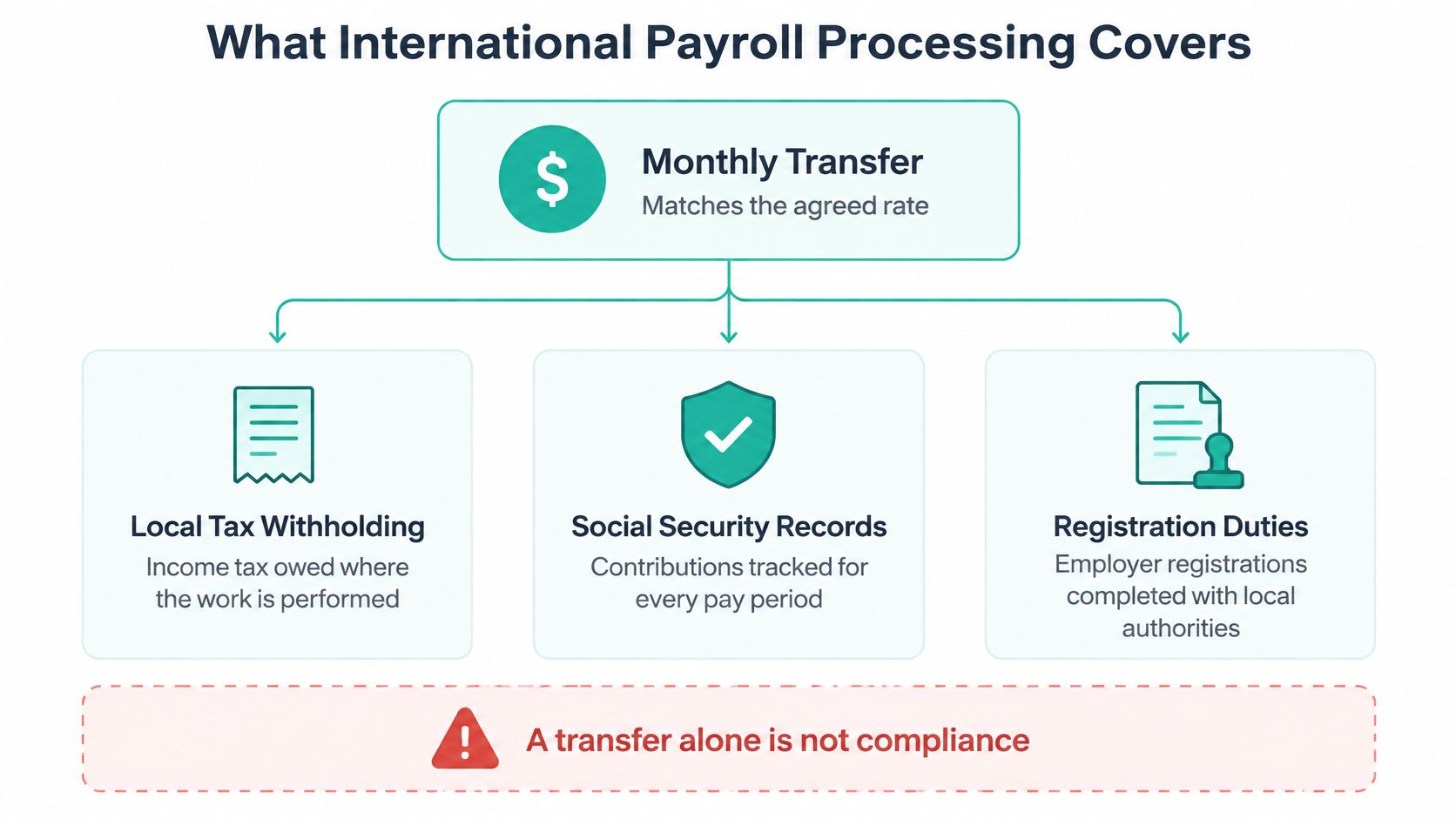
Before money moves, write down four things. Name the legal employer, confirm the worker's actual work location, fix the pay currency, and decide who approves each monthly figure. Those four entries sound administrative, but they determine which country's withholding applies and who is responsible if a filing is missed.

Practical rule: If you can't explain, in one paragraph, who employs the assistant, where the work is performed, and who remits what, you aren't ready to run the first payroll.
Firms exploring structured virtual outsourcing arrangements for legal support should apply the same test to any provider. Ask which layers the provider owns and which stay with you. A clear answer protects both sides. A vague one usually means the sequence has a missing leg, and the transfer itself is the step where small firms feel it first: the payment lands in minutes, while reconciling a wrong one at year-end is when corrections are slowest and most expensive to unwind.
One test separates the three models. Ask who is the legal employer, who withholds and remits local taxes, and who owns benefit obligations. Every model below is just a different answer to those three questions, and the differences matter more than the marketing labels attached to them.
A direct hire creates a legal employment relationship in the worker's country, usually through a local entity or another lawful route confirmed by local counsel. Your side runs registrations, payroll calculations, filings, and statutory benefits, often with a local payroll provider doing the mechanics. You get the most control over the employment terms and the clearest alignment when the role is long-term and fully integrated into the firm.
The tradeoff is weight. Registration, payroll configuration, and ongoing filings all sit with you, and they don't pause when the firm is busy. For a firm with one assistant in one country, that fixed burden can be disproportionate. For a firm building a durable team in a single country, it can be the most defensible structure available.
An independent contractor arrangement engages the worker's own business under a service agreement. Taxes and contributions sit with that provider, but only if the actual working relationship supports contractor treatment under local law. The agreement alone doesn't create that result, which is the point the next section examines in detail.
This model fits defined projects delivered by a genuinely separate business. It fits poorly when the firm sets fixed hours, dictates daily methods, and expects exclusive, ongoing coverage of core operations. In that second case, the savings are borrowed against a future reclassification, and the interest takes the form of back contributions, penalties, and corrected filings.
Under a Contractor of Record model, a third-party organization becomes the employer of record while your firm directs the day-to-day work. The provider runs local payroll and filings, and the firm manages performance, tasks, and quality. Employer of Record is a close relative of this model, and provider terminology varies, so read the agreement rather than trusting the label.
Consider a three-attorney immigration practice that needs a Mexico-based intake assistant on fixed hours, working inside the firm's case-management system with firm logins. Those facts point toward employment-like integration. Direct hire or Contractor of Record will usually be easier to defend than contractor status, even though a contractor agreement would be faster to sign.
| Model | Legal employer | Local payroll and tax | Typical fit | Main risk |
|---|---|---|---|---|
| Direct hire | Your firm or its local entity | Your firm or its local payroll provider | Long-term roles with fixed schedules | Compliance burden stays with you |
| Independent contractor | The provider's own business | The provider, if the arrangement is lawful | Defined projects with a separate business | Misclassification if daily control looks like employment |
| Contractor of Record | Third-party Contractor of Record organization | The Contractor of Record runs payroll and filings | Ongoing roles where you lack a local entity | Dependence on the provider's quality and fees |
No row in that table is universally correct. The right model depends on the country, the role, and how the work will be supervised in practice, so local counsel should review the choice for each country before you commit. A model that's sound in one jurisdiction can fail in the next, even for the same job description.
The contract label is the weakest control in the file. A personal injury firm can engage an assistant on a monthly agreement labeled independent contractor, then run the role on fixed Central time hours, firm logins, intake scripts followed word for word, and no other clients. If the arrangement is challenged, the document gets read against the working day, and the working day usually wins.
IRS guidance on independent contractor or employee status groups the evidence into three categories: behavioral control, financial control, and the relationship of the parties. Behavioral control covers instructions, training, procedures, tools, location, and schedules. Financial control covers payment method, expense reimbursement, investment in tools, availability to other clients, and opportunity for profit or loss.
The U.S. Department of Labor's six-factor economic-reality analysis under the Fair Labor Standards Act took effect on March 11, 2024, covering opportunity for profit or loss, investments, permanence, the nature and degree of control, whether the work is integral to the business, and whether specialized skills show business-like initiative, as set out in the Department of Labor small entity compliance guide on misclassification. DOL said in 2025 that it would no longer apply that 2024 rule in enforcement and planned to rescind it, so treat the factors as a useful reference for economic dependence while counsel confirms the current federal position. For a worker in Mexico or Colombia, local law controls the outcome.
Contrast the intake assistant above with an outside bookkeeping provider running a defined project for several clients, using its own software, and setting its own hours within agreed deliverables. Same country, similar hourly cost, opposite classification answer. The difference is who controls the work and who carries the business risk.
| Factor | Points toward employee | Points toward independent provider | Question to ask |
|---|---|---|---|
| Schedule | Fixed hours set by the firm | Availability set within agreed deliverables | Who decides when the work happens? |
| Tools and systems | Firm supplies devices, software and logins | Provider uses its own equipment and business tools | Who pays for the tools? |
| Work method | Firm dictates steps, scripts and training | Provider chooses how to deliver the outcome | Who sets the process? |
| Exclusivity | Works mainly or only for your firm | Serves several clients | Can the person take other clients? |
| Duration | Open-ended, renewed month to month | Defined project with an end date | How long is the engagement planned? |
| Integration | Core intake, scheduling and case-system updates | Separate, project-based tasks | Is the work central to daily operations? |
| Financial risk | Hourly pay with no business risk | Invoices for deliverables and bears own costs | Does the provider carry real financial risk? |
No single row decides the outcome. Regulators and courts weigh the whole relationship, which is why a firm should test the full pattern rather than cite the rows it likes. Recent Latin America coverage identifies increased scrutiny of contractor classification, outsourcing, fixed-term contracts, payroll reporting, social-security alignment, and worker registration, with notable attention to Mexico's REPSE framework, as described in the CXC Global LATAM workforce risk report. Scrutiny is rising in exactly the fact patterns small firms create without thinking about it.
The cheapest apparent model becomes the most expensive one when your daily operating behavior contradicts the contract you signed.
Write a short working-practices memo describing the actual arrangement: hours, tools, supervision, exclusivity, leave handling, duration, and how invoices will be approved and reconciled. Test that memo with counsel before anyone signs. If you proceed with a service arrangement, the agreement should match those facts, so review what a simple service contract should cover before the first task is assigned. When classification is wrong, the final cross-border payment and reconciliation step is often where the mismatch turns into rework, penalties, and delayed month-end close.
An assistant moves from Monterrey to Bogotá mid-year. Nothing about the job changes. The taxing country, the social-security system, the registration duties, and the payment calendar all change at once, across two jurisdictions. Payroll built on a static location now has a gap in both places.
Under Article 15 of the OECD Model Tax Convention, employment income is generally taxable where the work is physically performed. A treaty exception can keep taxing rights in the home country when the employee spends fewer than 183 days in a 12-month period in the other state, the remuneration is not paid by an employer resident there, and the cost is not borne by a permanent establishment there. Those conditions come from the treaty text itself, and each bilateral treaty applies them with its own wording, so your tax adviser should confirm which treaty governs the countries involved. Once a country holds taxing rights, withholding obligations can follow for the employer.
Two controls keep this manageable. Capture a monthly location-and-days certification linked to payroll approval, so a move or extended trip surfaces before payment runs instead of at year-end. Then assess permanent-establishment exposure with your tax adviser, because a worker's presence and activities can create a tax footprint for the firm itself, separate from the worker's own return.

Income-tax treatment and social-security treatment run on different rules. The ILO material on cross-border social-security payments describes the governance and infrastructure needed to move social-security payments across borders, and the operational fact behind it: contribution obligations and benefit entitlements follow their own calendars, ceilings, and registration systems. Your payroll needs separate layers for gross remuneration, income-tax withholding, employer social contributions, employee social contributions, mandatory benefits, and net pay, each mapped to the worker's classification and jurisdiction.
No regional guide can hand you the registration deadline for Mexico or Colombia. Registration windows, contribution ceilings, and remittance calendars differ by country and shift with little notice, so each obligation has to be confirmed against that country's own official sources, ideally with local counsel reviewing the answer. What you can standardize is the process for finding out.
Build a one-page country profile sheet for each jurisdiction where you have staff: registration deadlines, contribution ceilings, payment calendars, remittance evidence requirements, mandatory benefits, statutory leave, and termination rules. Keep the remittance evidence filed as you go, because reconciliation is where small firms lose the most time, matching cross-border payments against filings nobody organized. When someone relocates, you retire one sheet and activate another, and a mid-year move becomes a planned transition instead of a reconstruction project months later.
The case for Latin America starts with the clock. Several countries in the region share or nearly share U.S. business hours, though offsets vary by country and season, which supports live coordination on intake, scheduling, and client follow-up instead of overnight handoffs. Bilingual English and Spanish staff can serve Spanish-speaking clients directly in immigration, personal injury, and family matters, where a missed nuance on an intake call can cost the firm a viable case. The cost structure can also differ from U.S. local salaries for comparable administrative roles, though the gap varies by role, experience, and firm.
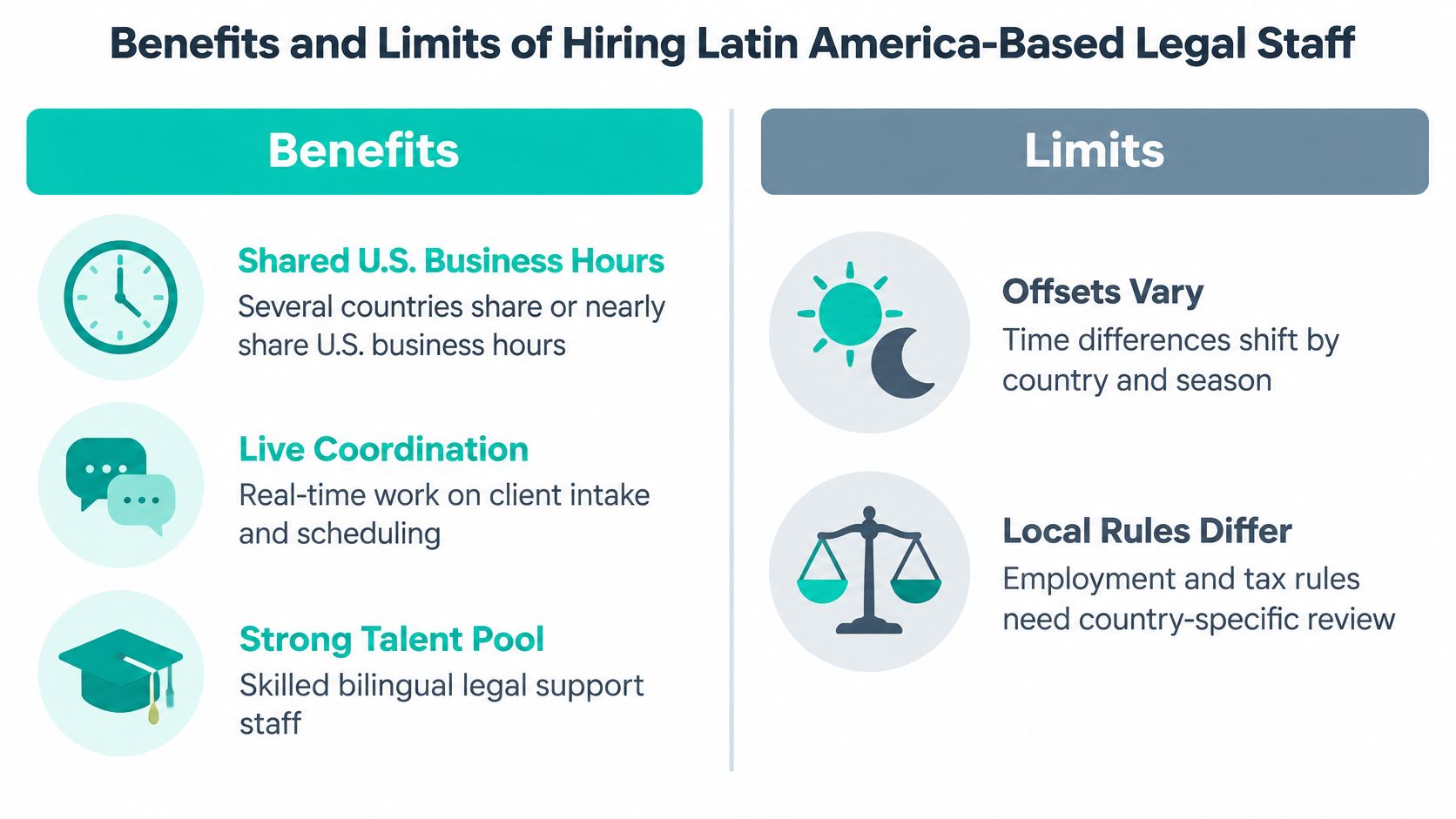
Attorneys remain responsible for legal judgment. An assistant cannot give legal advice, set strategy, or decide whether the firm takes a matter, and ABA Model Rule 5.5 on unauthorized practice is the starting point for drawing that line.
Confidentiality has a similar limit. It holds through risk-based safeguards around systems, permissions, and devices. A confidentiality clause in a signed contract protects the firm once someone operationalizes it. Until then it is paperwork.
The financial limits are quieter but real. Half of companies reported committing payroll errors during the last five years, according to Alight's Company Payroll Complexity Report findings. That figure describes general payroll operations rather than Latin America-based staff specifically, but the mechanism applies: the cross-border payment and its reconciliation are the last step in the process, after the contract, classification, and filings are done. Payment friction, FX timing, and reconciliation failures are where small firms leak the savings they hired for. One error cycle can erase a year of rate savings.
| Task | Assistant under supervision | Keep with the attorney |
|---|---|---|
| Scheduling, calendar holds and deadline tracking | Yes, within defined limits | Setting deadlines that depend on legal judgment |
| Intake data collection and document organization | Yes, using the firm's approved forms | Assessing whether a matter is accepted |
| Client-message routing and status updates | Yes, using approved templates | Answering substantive legal questions |
| Case-management data entry | Yes, with access limited to needed fields | Deciding strategy or case outcomes |
| Billing and invoice preparation | Yes, as administrative drafts reviewed by staff | Approving fee arrangements or write-offs |
Some situations should not use this model at all. Roles that require licensed judgment, access to highly sensitive matters without proper controls, and firms that cannot supervise daily are poor fits. One-off tasks are usually better handled by a short-term vendor than by building cross-border payroll infrastructure you will use once and abandon. Whichever setup you land on, have local counsel in the assistant's country confirm the rules before the first payment runs.
The cheaper model is the one whose last payment you can reconcile cleanly. Setup speed matters, but the recurring leak is usually the cross-border leg: bank charges, spread, timing gaps between approval and delivery, and the admin hour spent explaining why a deposit is short. Paper labels price fast. Daily working practices decide the true exposure, so the comparison has to start from how the role will run in practice, then local counsel should confirm which statutory items belong in each column for that country.
| Factor | Direct hire | Independent contractor | Contractor of Record |
|---|---|---|---|
| Setup time before first payment | Longest, because registration and payroll setup come first | Fastest to start, mainly contract and payment rails | Moderate, driven by provider onboarding |
| Recurring administration | High, you run payroll, filings and corrections | Low on filings, high if the working relationship changes | Low to moderate, you manage output and provider fees |
| Employer-side statutory cost | Set by local law for your employing entity | Not yours while classification holds; confirm the signals monthly | Bundled into provider fee and pass-through items; get the schedule |
| Currency and transfer exposure | You choose rails and absorb FX timing | Set by agreement; silence leaves it disputed later | Set by provider process; confirm rate source and cutoff |
| Exit cost | Local termination and severance rules apply | Contract end, plus possible reclassification claims | Notice, handover and exit terms in provider agreement |
Count more than salary or hourly rate. Add originating and intermediary bank fees, the exchange-rate method, lifting or receiving charges, failed-payment repairs, holiday delays, and the staff time spent approving, chasing and reconciling each cycle. Keep any staffing placement or administration fee separate from payroll cost. A public page such as Virtual Legal Assistants' published virtual assistant fee information can be one input, but the decision needs current terms checked directly and identical assumptions across every option.
Settle two points in writing before the first run: who bears FX movement between approval and delivery, and how a short or late payment is disputed and corrected. Then ask each option for a twelve-month landed-cost estimate using the same hours, currency, statutory costs and payment calendar. Headline prices that look far apart often converge once the last mile is priced with full accuracy.
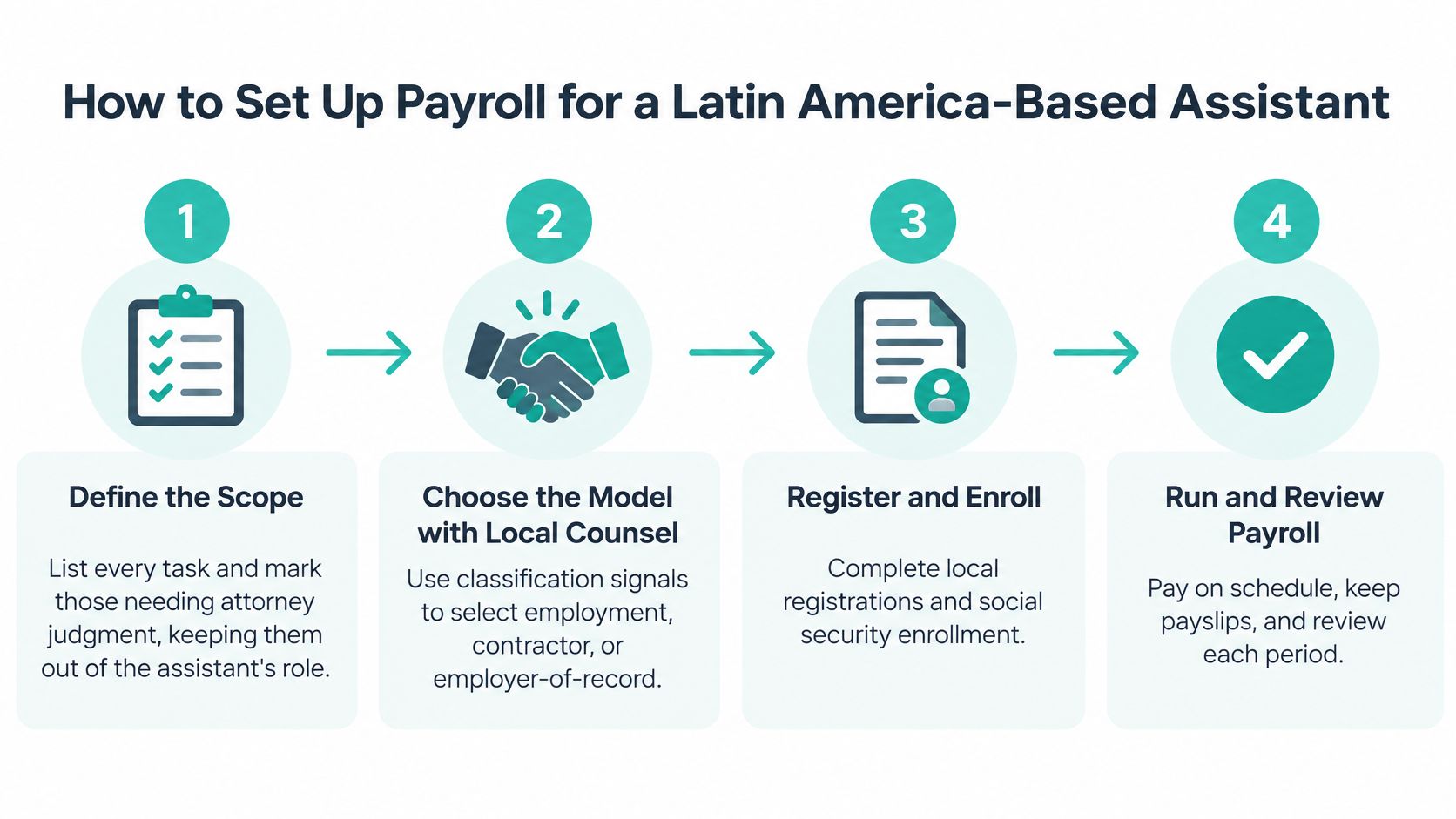
Most setup advice starts with the contract. Start with the workflow instead. The signature is the weakest control in the arrangement, because classification follows the daily working relationship and local law rather than the title on page one. What protects the firm is the order in which decisions get made, and skipping ahead to payment details before classification is settled is how firms end up rebuilding the arrangement under time pressure.
Step six follows the risk-based approach in ABA Formal Opinion 477R, which supports transmitting client information through remote systems when the firm takes reasonable measures against unauthorized access, with stronger safeguards where client agreements, applicable law, or the sensitivity of the information require them, as set out in ABA Formal Opinion 477R on securing client information. Highly sensitive litigation, immigration, family, financial, or criminal-defense matters may need protections beyond ordinary email and password controls. Decide that during setup, when you can still limit which matters the assistant touches.
Steps seven and eight guard the place where small firms lose money most often: the last mile between approved payroll and delivered pay. A payment that leaves the firm's account is not finished until it reconciles.
Reconciliation habit: Every payment should leave three matching records, the approved payroll figure, the bank movement, and the worker-facing pay statement. If one is missing, the cycle isn't closed.
Connecting payroll outputs to the firm's accounting ledger during setup also pays off monthly. In 2025, 41% of businesses reported integrating their accounting and finance systems with payroll at a global level, according to ADP's global payroll survey. For a small firm, even a simple mapped export removes manual re-entry, which is where transposed figures and missed employer-side costs usually enter the books.
International payroll processing is a cross-border compliance workflow, not a transfer with paperwork attached. The right model follows the actual working relationship and local law rather than the contract title, so classification, work location, and the degree of firm control determine the answer before price does. A firm that respects that order ends up with payroll that's boring in the best sense, predictable amounts, clean records, and an assistant who can document income and contributions without surprises.
Your next steps, in one line, are to define the tasks, test classification against actual practices, get country-specific advice, choose the model, set access controls, and reconcile the first payment. The setup section above gives the full eight-step sequence if you want the detailed version. Don't compress those steps to save a week. The arrangements that fail almost always fail at a step someone decided was a formality.
If you're comparing candidates now, Virtual Legal Assistants can share matched profiles within 24 hours, with bilingual English and Spanish options, U.S.-aligned hours, and no deposit before selection. The team can also walk you through how its contract, payroll, and Contractor of Record support would apply to your state and the assistant's country, so you can interview with the compliance structure already mapped.