

 17 minutes read
You finished a deposition prep session, checked your inbox, and found three unreturned intake forms, two clients waiting for status updates, and a calendar invite nobody had confirmed. None of that work requires your bar license. All of it requires somebody competent, available during business hours, and careful with confidential information.
That's the practical case for virtual outsourcing solutions. Done well, you move intake, reception, scheduling, document coordination, and case follow-up to trained remote professionals who work inside your systems under your supervision. Done poorly, you hand sensitive files to someone you barely vetted and hope for the best. The difference isn't geography. It's role design, access controls, and documented oversight.
A solo personal injury attorney I worked with described her week bluntly. She was the lawyer, the intake screener, the receptionist who caught overflow calls, and the person chasing medical records at night. Her cases weren't suffering from a lack of legal skill. They were suffering from a lack of operational capacity between court appearances.
Virtual outsourcing in a legal context means engaging remote support professionals, outside your physical office and often through a third party, to handle defined administrative and case-support functions. That includes answering and routing calls, responding to new leads, booking consultations, updating Clio, MyCase, Filevine, or SmartAdvocate, preparing standard documents for attorney review, coordinating filings, tracking milestones, and managing routine client follow-up. It does not mean delegating legal judgment, client advice, or strategy.
Remote delivery is no longer an experiment firms tried during lockdowns. U.S. Census Bureau American Community Survey data on home-based work shows the share of U.S. workers who usually worked from home rose from 5.7% in 2019 to 17.9% in 2021, roughly 9 million people growing to about 28 million. Adoption was especially strong in professional, scientific, management, and administrative work, the same environment where most legal support sits.
That shift matters because clients, courts, and vendors now expect cloud files, video meetings, and electronic workflows as normal. If your intake script, conflict check, and case updates already live in software, the person executing those steps doesn't need a desk outside your office. They need the right permissions, a clear escalation path, and a supervisor who reviews the work.

Practical rule: Outsource a workflow, not a vague need for help. If you can't write down the inputs, steps, and finished output, you're not ready to delegate it.
Three engagement models cover most of what firms use, and each shifts hiring, payroll, and supervision responsibilities differently. Choosing among them is less about finding a universal winner and more about matching the structure to your firm size, your tolerance for administrative work, and how tightly you need to control day-to-day output.
Most firms land in one of three arrangements, sometimes without realizing they've chosen. Naming the model early helps you price it correctly and assign responsibility for taxes, contracts, replacement coverage, and performance management before a problem forces the conversation.
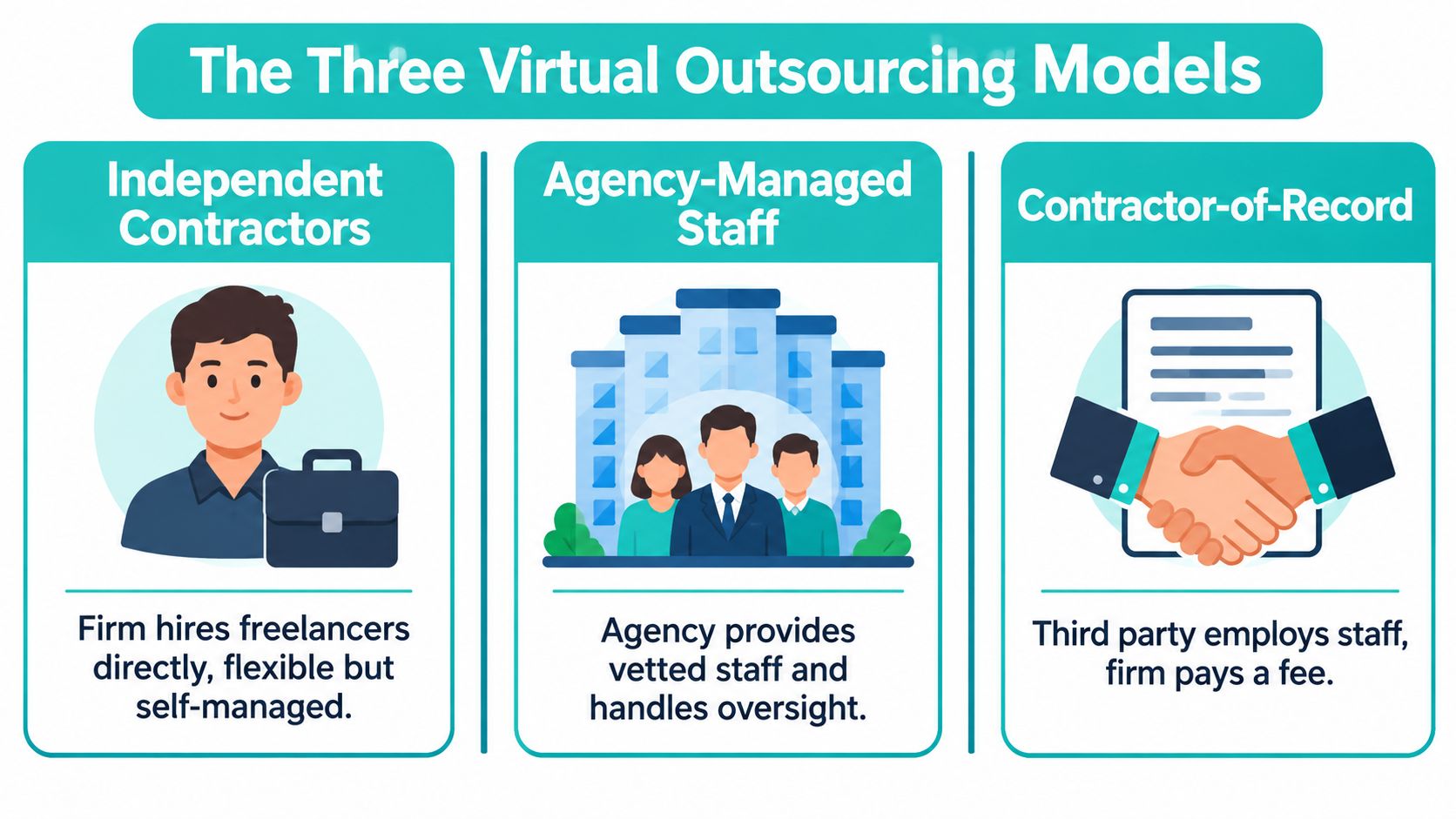
You find, interview, contract with, and pay a freelancer yourself, usually through a marketplace or referral. You control selection and negotiate the rate directly, and there's no intermediary taking a margin. For a narrow, well-defined task such as overflow document formatting, that directness can work.
The tradeoff is that you also own everything else. Vetting, background checks, confidentiality agreements, payment logistics, backup coverage during illness, and performance coaching all fall to you or your office manager. Contractors who serve several firms may not be available when a lead calls, and if they leave, your documented process leaves with them unless you built it yourself.
An agency recruits and vets candidates, presents a shortlist, and often provides ongoing oversight, training support, and replacement if someone exits. You interview before committing, then direct the person's daily work in your systems while the agency handles much of the sourcing and administrative layer. VirtualLegal operates in this category, matching U.S. firms with bilingual Latin America based legal support professionals and handling contractor-of-record and payroll functions.
This model costs more than a direct freelancer relationship because you're paying for screening, matching, and continuity. What you buy back is time and reduced hiring risk. For intake specialists, receptionists, legal assistants, and case managers who face clients daily, that screening depth, including software proficiency checks and prior U.S. firm experience, usually matters more than shaving a small amount off an hourly rate.
A contractor-of-record provider becomes the contracting and payment intermediary for a worker you've selected or who's been sourced for you. The provider manages the contract, international payroll, and related compliance administration, while you supervise the work itself. Think of it as separating the employment mechanics from the operational relationship.
This structure suits firms that want a specific person embedded in their team long term without building foreign payroll capability in house. It doesn't, however, supervise the work for you. Quality, training, and ethical oversight remain yours.
| Model | How It Works | Best For | Key Tradeoff |
|---|---|---|---|
| Independent contractor | Firm hires and pays freelancer directly | Narrow, short-term tasks with clear outputs | Full vetting and backup burden sits with the firm |
| Agency-managed staff | Agency sources, vets, and supports placement | Client-facing roles and firms without hiring capacity | Higher cost in exchange for screening and continuity |
| Contractor of record | Third party handles contract and payroll, firm directs work | Long-term embedded roles across borders | Payroll is handled, supervision is not |
Whichever structure you choose, ABA Formal Opinion 08-451 on lawyer outsourcing duties makes the boundary clear. The lawyer remains ultimately responsible for competent legal services under Model Rule 1.1 and for supervision under Rules 5.1 and 5.3. You can outsource tasks. You can't outsource accountability.
A solo practitioner testing demand might start with part-time agency-managed intake help. A midsize litigation firm with a strong operations director might use a contractor-of-record model for several case managers. Match the model to the management capacity you have, not the capacity you plan to have someday.
The strongest argument for virtual outsourcing isn't cheap labor. It's capacity without fixed overhead. You add intake coverage, follow-up discipline, and document throughput without leasing space, buying workstations, or committing to a full-time local hire before caseload justifies it.

Speed to hire is the first gain most owners notice, because a provider maintaining an active candidate pool can present vetted options far faster than a firm posting a job and screening from scratch. The second is consistency. A dedicated intake specialist working a defined queue responds to leads while you're in court, which an attorney juggling hearings cannot do reliably.
Scale matters in the underlying occupation too. Bureau of Labor Statistics employment projections for paralegals and legal assistants identify approximately 376,200 paralegals and legal assistants in the 2024 national employment matrix, with projected employment of about 376,800 in 2034. BLS wage data place median annual pay at $60,970, with the lowest 10% earning below $39,710 and the highest 10% above $98,830. Those U.S. employee figures don't set an outsourcing price, but they explain why firms evaluate distributed models carefully, and our breakdown of virtual legal assistant cost walks through how engagement structures affect your total spend.
Remote staff don't absorb your firm's habits by osmosis. Every undocumented preference in your head becomes a training gap, a rework cycle, or an error a client notices. Firms that skip written procedures, call scripts, and escalation rules usually conclude outsourcing failed, when their onboarding failed first.
Supervision is real work as well. Someone must sample calls, audit case notes, review documents before they leave the firm, and coach early mistakes. Budget management attention for the first weeks especially, or you'll pay for it later in corrections.
A remote assistant amplifies the system you already have. If your intake process is disorganized in the office, moving it online makes the disorganization faster, not better.
Consider two firms. A solo personal injury practice gains most from intake and records follow-up, because signed-case conversion and treatment tracking drive revenue and both slip when the attorney is in depositions. A midsize immigration practice gains most from case managers who track filings and client document collection in DocketWise, because volume and deadlines punish any lapse in status communication. Same model, different first role, because the bottleneck differs.
The honest test is whether the work you're delegating is repeatable, reviewable, and currently consuming attorney hours or leaking revenue. If it's judgment-heavy, relationship-sensitive at a senior level, or impossible to document, keep it in house.
For many plaintiff, immigration, family, and consumer practices, the first client conversation doesn't happen in English. When a Spanish-speaking caller reaches voicemail, an English-only intake form, or a staff member improvising translation, you haven't just created friction. You've created a record-accuracy risk on names, dates, injuries, and household facts that the rest of the case depends on.
Intake specialists and receptionists benefit most directly. A bilingual professional can qualify a lead, explain what documents to bring, book the consultation, and enter accurate notes without a family member interpreting sensitive details. That protects both conversion and confidentiality, since clients disclose more, and more precisely, when they aren't filtering through a relative.
Case managers carry that advantage through the life of the matter. Treatment updates in a personal injury file, document collection in an immigration case, and scheduling in a family matter all involve repeated, sometimes emotional follow-up. Clients who understand each request the first time respond faster and call less often in confusion.
Back-office roles are different. A legal assistant formatting discovery or organizing records may use Spanish occasionally, but software fluency and attention to deadlines usually matter more. Don't pay a premium for a skill the role rarely uses, and don't under-resource the roles where language is the job.
Latin America based professionals work hours that overlap U.S. business hours, so intake calls, team huddles, and client callbacks happen live rather than through overnight message exchanges. Our overview of time zone overlap details how that alignment maps across U.S. regions. Real-time overlap sounds minor until you've managed a team twelve hours ahead and waited a full day for a one-line clarification.
Fluency alone isn't a hiring standard. Evaluate candidates on:
That last point deserves emphasis. A bilingual assistant who helpfully explains likely case outcomes has crossed into unauthorized practice territory, however good the intention. Scripts should include, in both languages, exactly how to defer legal questions to the attorney. Test that scenario in the interview, not after the first client complaint.
Most outsourcing content stops at cost and convenience. That's precisely where a law firm can't afford to stop, because the asset you're protecting isn't office efficiency. It's client trust and your license.
Concern here is well founded. AffiniPay's 2025 Legal Industry Report discussion of remote work concerns notes remote adoption constrained primarily by data privacy concerns at 65% and cybersecurity concerns at 61% among surveyed legal professionals. Treat those concerns as a design brief, not a reason to avoid the model.
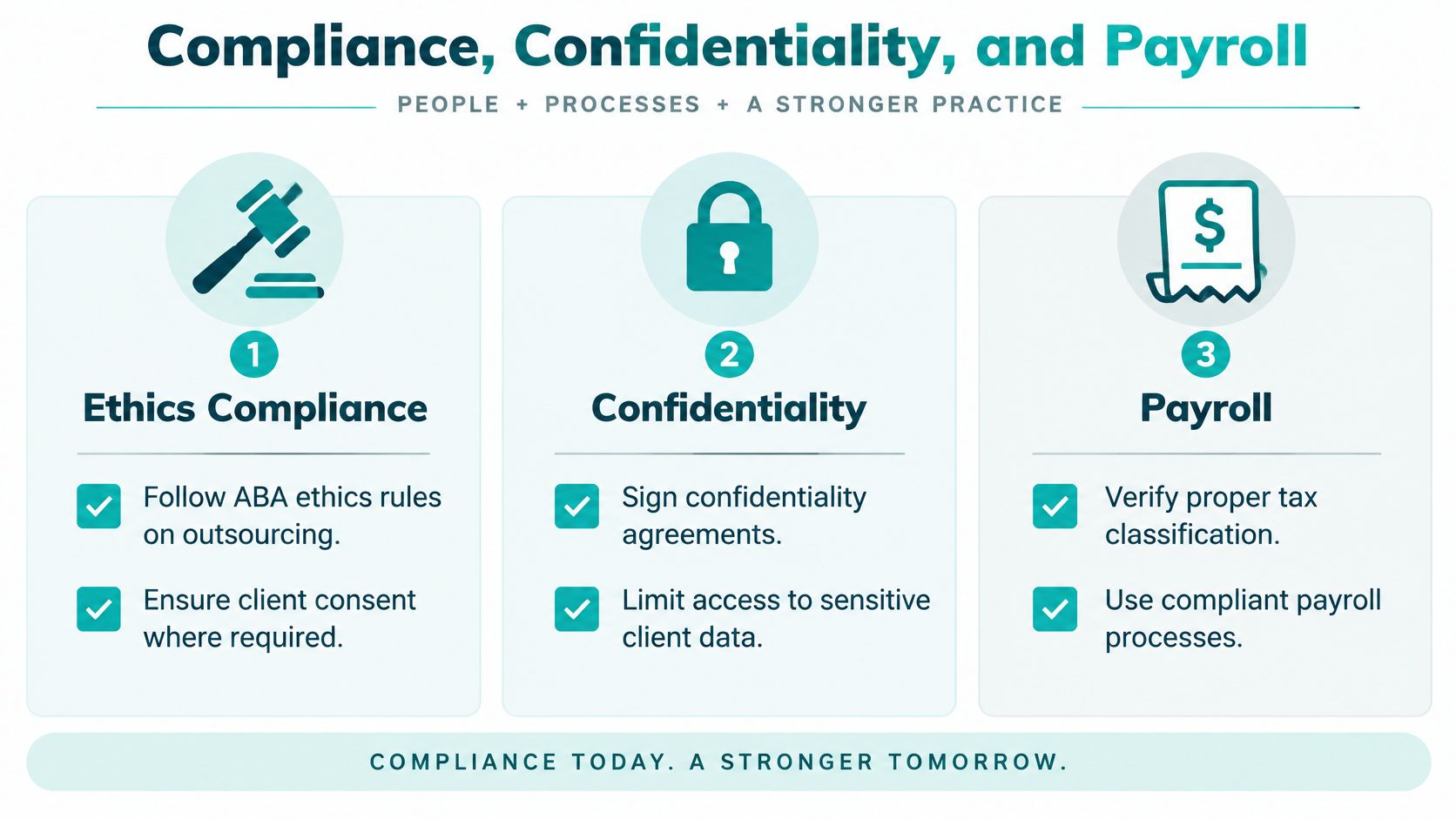
Outsourcing legal or nonlegal support is permitted, but your duties travel with the work. You must assign tasks only to people competent to perform them, define what they may do independently, and review output at a level proportionate to risk. Remote staff may update case systems, prepare drafts, and manage follow-ups. They must not give legal advice or exercise professional judgment reserved for a lawyer.
Disclosure deserves a decision before onboarding, not after. Determine whether your engagement letters should describe outside support and whether specific matters require client consent. State rules and matter sensitivity vary, so confirm your obligations with qualified counsel in your jurisdiction.
ABA guidance in Formal Opinion 08-451 on confidentiality in outsourcing explains that implied authorization to share information inside a firm doesn't automatically extend to outside entities you don't effectively supervise. Written confidentiality agreements, evaluated provider procedures, and efforts to minimize disclosure risk are therefore baseline, not optional extras.
Build access as a controlled system:
NIST guidance on telework and remote access security supports each of those steps, recommending authentication of every teleworker, authorization limited to required resources, and strong authentication, preferably multifactor authentication, with encryption and endpoint controls. Limiting permissions reduces the damage a compromised account can do. MFA reduces the chance stolen credentials work at all.
North Carolina State Bar Formal Ethics Opinion 2011-14 on outsourcing warns that where the firm's relationship with the individuals performing services is attenuated, information protected by Rule 1.6 may not be revealed without the client's informed consent. Before granting access, identify the employing entity, confirm where personnel and data are located, review security and incident-response procedures, and verify confidentiality commitments for both provider and individual worker. Put the essentials in writing, as our simple service contract framework illustrates.
Documentation standard: If a regulator asked tomorrow who accessed a client's file, why, and under what agreement, you should be able to answer from records, not memory.
Finally, classify and pay people correctly. A contractor-of-record arrangement shifts international payment administration to the provider, but you should still confirm who the contracting entity is, how the worker is classified where they live, and what happens contractually if the engagement ends. Misclassification risk doesn't disappear because the worker is abroad. Ask for the paper trail before the first login is issued, and keep signed agreements with the same care you'd keep a retainer.
Firms that succeed with remote staffing treat launch as an operations project with a measurable pilot. Firms that struggle hire a person, grant broad access, and wait to see what happens. The roadmap below is the sequence that consistently works.
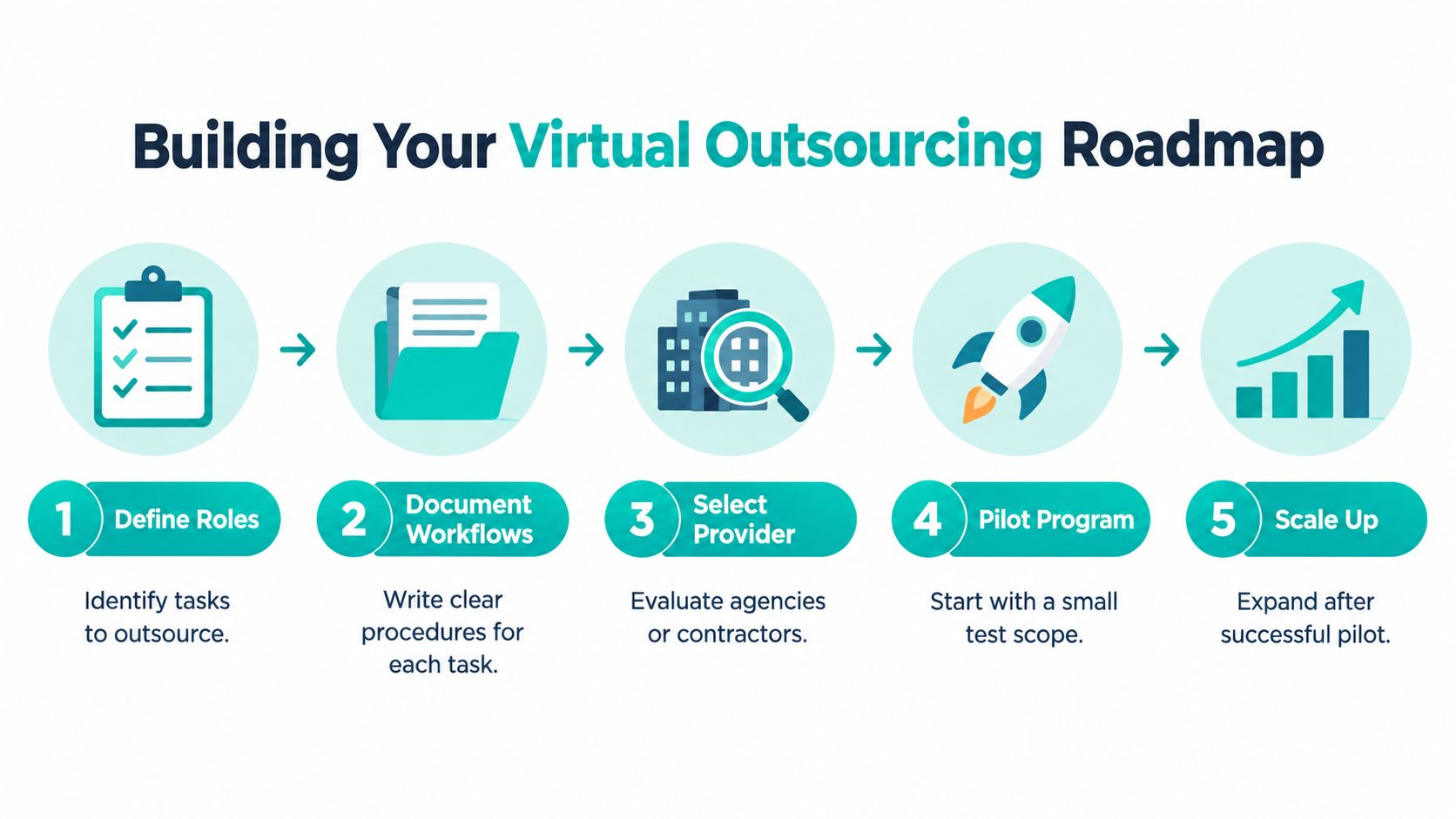
Start with the work that's leaking. Unanswered calls, slow lead response, stale case notes, records requests nobody tracks, billing tasks piling up at month end. Group those tasks into one coherent role with a clear owner, such as intake specialist or case manager, rather than hiring a general assistant for everything at once.
Write the role as outputs. Not "help with intake," but respond to new leads during business hours, complete the intake form in CASEpeer, run the conflict-check step, book qualified consultations, and escalate anything outside the script. That specificity becomes your interview criteria and your scorecard.
For each task, record the trigger, the steps, the system used, what finished looks like, and when to escalate. Include the uncomfortable scenarios. A caller discloses a deadline tomorrow, a client asks whether they should accept a settlement, a name matches an existing adverse party. Your assistant needs a rule for each, written before it happens live.
Keep documents short and usable. A one-page checklist a person follows daily beats a forty-page manual nobody opens.
Choose among direct contractor, agency-managed, and contractor-of-record based on your management bandwidth and how client-facing the role is. Then vet the individual, regardless of model. Run a practical exercise in your actual software, test a bilingual intake scenario if relevant, check references from U.S. firms, and confirm the confidentiality and access setup described in the previous section.
Interview before you commit. Communication style on a live call predicts client experience better than any résumé line.
Grant the minimum permissions the pilot requires and expand as competence is demonstrated. Pair the new hire with a named supervisor, schedule a brief daily check-in during overlapping hours, and review work the same day it's produced while corrections are cheap. Scripts, templates, and example case notes shorten this phase considerably.
Remote staff perform best when expectations are explicit. Stanford reporting on a randomized work-from-home trial describes an experiment with approximately 1,000 Ctrip employees where working from home increased performance by 13% and reduced quit rates by 50%. That's a travel company, not a law firm, so treat it as support for structured measurement rather than a promised result.
The common mistakes are all avoidable. Granting full system access on day one, skipping conflict-check training, failing to document who supervises whom, and evaluating by hours online instead of completed, accurate work. Avoid those four and your pilot tells you something true about the model, which is the whole point of running one.
Virtual outsourcing solutions work for small and midsize U.S. law firms when they're built as supervised operating systems, not purchased as extra hands. Pick the engagement model that matches your management capacity, staff bilingual and client-facing roles where language changes outcomes, and treat confidentiality controls, written agreements, and least-privilege access as essential from day one.
Your next steps are concrete. Identify the one queue that's leaking revenue or consuming attorney hours, document that workflow and its escalation rules, and run a measured pilot with a named supervisor and a two-week baseline. If the pilot holds up on both output and accuracy, scale it. If it doesn't, your data will show whether the person, the process, or the model needs to change.
You don't need to rebuild your firm to start. You need one well-defined role, clean access controls, and the discipline to review the work. That's a manageable first month, and it's how remote support earns a permanent place in a practice instead of becoming another abandoned experiment.
If you're ready to staff intake, reception, legal assistant, or case manager roles with pre-vetted bilingual professionals who work your hours under your supervision, VirtualLegal can present a custom shortlist and handle contracting and payroll while you interview before hiring. Visit us to describe the role you need filled and see candidates matched to your practice, software, and schedule.