

 17 minutes read
A solo plaintiff firm hires a bilingual intake specialist who works from another country and covers the firm's evening inquiries. The owner signs a one-page template that names the parties, states an hourly rate, and allows either side to terminate. Within the first month, the assistant is asked to update a case-management system, schedule consultations, follow up with leads, and coordinate documents. Nobody wrote down which tasks require attorney review, who approves extra hours, what happens when a client sends confidential information through an unapproved app, or how an invoice is disputed.
That is where a short agreement stops being simple.
A simple service contract for remote legal support should define the engagement in practical, executable terms. It should establish scope, deliverables, payment, supervision, confidentiality, system access, ownership of work product, change control, and termination without becoming an unwieldy master-services agreement. The contract is not a substitute for professional judgment, ethical supervision, secure systems, or jurisdiction-specific advice. It is the written control layer that makes those responsibilities visible.
A service contract principally exchanges labor, skill, expertise, or professional performance rather than a physical product. That distinction usually places the agreement under common-law contract principles instead of Article 2 of the Uniform Commercial Code, which primarily governs transactions involving tangible and movable goods. The classification matters because a remote legal assistant provides human labor, not a product being sold to the firm. Mixed arrangements may require a “predominant purpose” analysis, particularly when an agreement combines software, equipment, and services. This law-review analysis of services contracts and the UCC explains why services are generally only marginally and indirectly covered by Article 2.
There is no single federal statute governing ordinary service contracts. Courts and parties generally rely on state common law, statutes, judicial decisions, and general contract principles addressing offer, acceptance, consideration, mutual obligations, performance, breach, damages, and termination. That makes the drafting job more practical, not less. The agreement must say enough for the parties to understand what they promised, how performance will be judged, and what happens when the relationship changes.
The phrase “provide administrative support as requested” looks efficient, but it gives neither side a usable boundary. A legal-support agreement should identify roles, tasks, deliverables, exclusions, assumptions, deadlines, client dependencies, and approval points. For example, “intake support” might include answering assigned calls, recording caller information in Clio, sending an approved consultation questionnaire, and booking appointments within designated calendars. It should exclude legal advice, legal strategy, conflict determinations without firm approval, and representations about case outcomes.
The scale of service work explains why this structure matters. Services expanded from approximately one-half of U.S. gross domestic product in the early 1950s to more than three-quarters in the modern economy, while the ratio of service workers to nonservice workers rose from about 1.3 at the beginning of 1950 to 5.3 by the end of 2025, according to the Federal Reserve Bank of St. Louis overview of the services sector. The same source reports that private service-providing industries accounted for 113.434 million jobs, or 71.6% of total U.S. employment, in 2025. A remote assistant agreement is one small example of a much larger commercial pattern, firms obtain specialized labor through defined recurring arrangements rather than building every function internally.

Practical rule: If a task can't be assigned, measured, reviewed, and closed, it isn't yet a contract deliverable.
A concise agreement won't decide whether a lawyer has adequately supervised a nonlawyer, whether a particular task is permitted in a jurisdiction, or whether a vendor's security controls are sufficient for a firm's client base. Those questions require operational decisions, documented supervision, and, where appropriate, advice from qualified counsel or a compliance professional.
The document also shouldn't pretend that every request is included. The Project Management Institute scope guidance reports that 52% of projects experienced scope creep, compared with 43% five years earlier. The lesson for a small firm is straightforward. Scope should be treated as a measurable boundary, and additional work should follow a written process rather than an informal message that becomes an implied amendment.
A workable method is:
That is the difference between a short agreement that works and a short form that merely records a handshake.
The contract should be short enough for a practice owner and assistant to understand without a meeting devoted to interpretation. It still needs enough precision to answer the questions that arise during intake, scheduling, document coordination, and billing support.
Use the following as drafting prompts, not as a substitute for reviewing the governing law or the firm's professional obligations.
Name the firm's legal entity, business address, and the service provider's correct legal name and address. If a staffing company, Contractor of Record, or other intermediary is involved, identify whether it is the contracting provider, an administrative agent, or only a referral source. Confirm that each signer has authority to bind the relevant party.
Adaptable language: “The Firm and the Provider agree that the Provider will perform the services described in Exhibit A. Each signer represents that they have authority to enter this Agreement on behalf of the party identified below.”
A trade name alone can create uncertainty about who owes confidentiality, who sends invoices, and who receives notice of termination.
Separate recurring responsibilities from occasional outputs. A virtual receptionist might answer calls, route messages, and maintain a call log. An intake specialist might record approved information, schedule consultations, and flag urgent matters for attorney review. A case-management assistant might update milestones and request missing documents without interpreting legal rights.
Adaptable language: “Provider will perform the administrative services listed in Exhibit A during the agreed coverage hours. Provider will not provide legal advice, select legal strategy, make legal determinations, or communicate legal conclusions unless expressly authorized and reviewed by the Firm.”
Write exclusions directly. “General support” is not a substitute for a task list.
State the expected schedule, time zone, response-time expectation, approved systems, holidays or planned absences, and the firm's responsibilities. If the assistant needs access to Clio, MyCase, Filevine, CASEpeer, SmartAdvocate, Smokeball, RingCentral, or another platform, identify who provisions access and who approves permissions.
For a firm serving clients across multiple U.S. time zones, “business hours” is too vague. Specify the coverage window and the escalation path when a client reports a deadline, safety concern, or urgent legal issue.
Payment terms should state whether compensation is hourly, fixed, or recurring; how time is recorded; when invoices are sent; when they become payable; the payment method; treatment of disputed amounts; and whether extra hours require advance approval. If the firm pays a monthly fee, define what coverage or deliverables that fee buys.
Adaptable language: “Provider will invoice monthly for approved services performed during the prior service period. The Firm will notify Provider in writing of any disputed item, with reasonable detail, while undisputed amounts remain payable under the agreed payment schedule.”
Don't leave “expenses” as a blank concept. Require written approval for reimbursable costs and state whether ordinary equipment, internet access, software, or banking charges are included.
The agreement should state who owns documents, completed intake records, process materials, and other work product created for the firm, subject to any applicable legal limits. It should establish the start date, renewal approach, termination rights, notice method, payment for completed work, return or deletion of information, and transition assistance.
Adaptable language: “Either party may terminate on written notice under the period stated in this Agreement. Upon termination, Provider will stop accessing Firm systems, return or delete Firm information as directed, and reasonably assist with transition of open administrative tasks.”
A governing-law clause identifies the law intended to apply, but it doesn't guarantee that every provision will be enforced as written. Venue, dispute procedures, liability limits, indemnity, and restrictive covenants deserve jurisdiction-specific review.
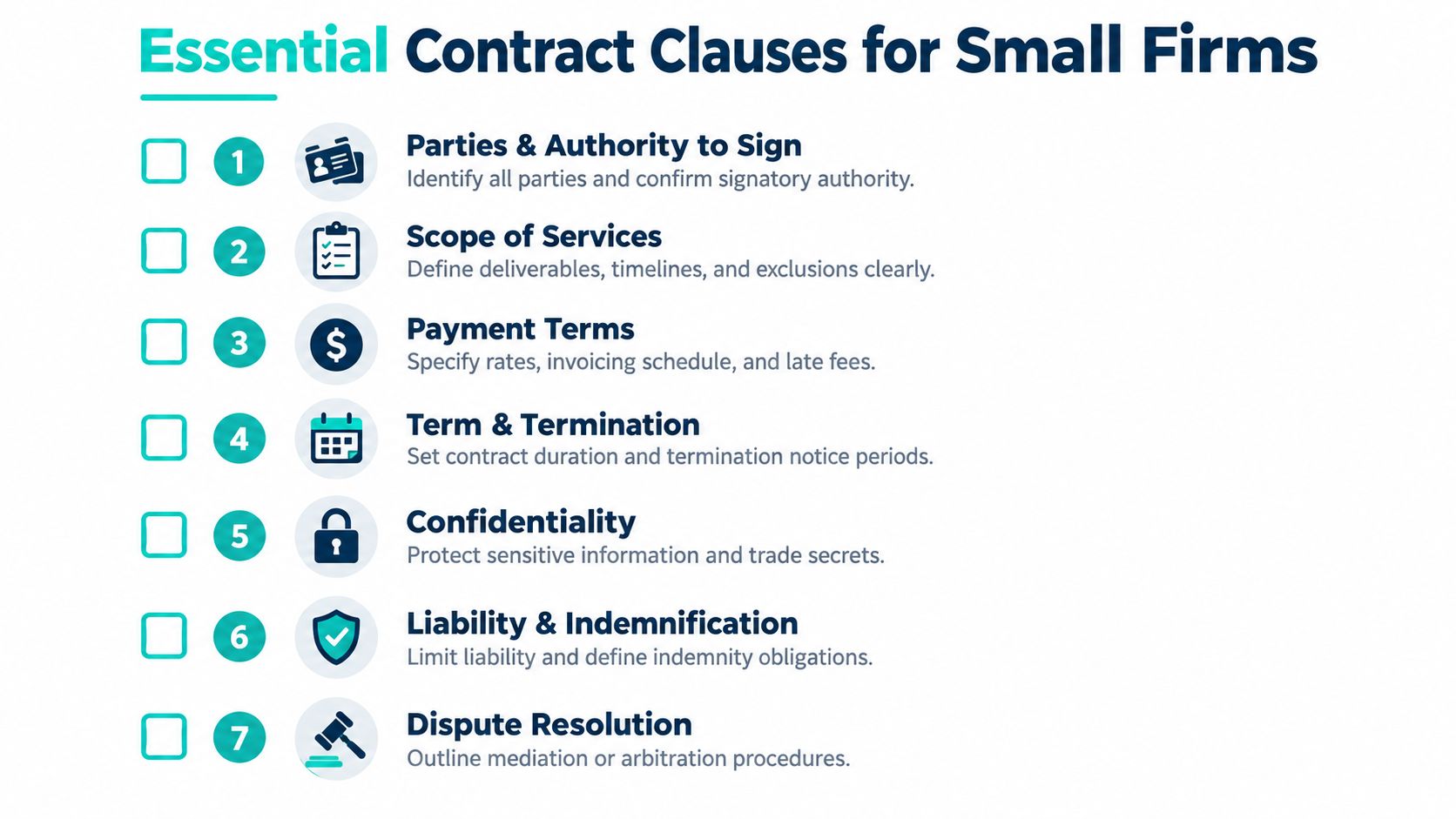
| Clause | Purpose | Sample Language |
|---|---|---|
| Parties and authority | Establish who is bound and who may sign | “Each signer represents that they have authority to enter this Agreement.” |
| Scope and exclusions | Define the work and prevent implied legal duties | “Provider will perform the administrative services in Exhibit A and will not provide legal advice.” |
| Deliverables and acceptance | Give the firm a way to confirm completion | “A deliverable is accepted when it meets the requirements stated in the applicable task description.” |
| Hours and coverage | Set availability, time zones, and escalation | “Services will be performed during the coverage hours listed in Exhibit A.” |
| Fees and invoicing | Make charges and payment timing predictable | “Invoices will identify the service period, hours, and approved expenses.” |
| Confidentiality and access | Protect client information and limit system use | “Provider may access confidential information only to perform authorized services.” |
| Termination and transition | Define the exit process | “Upon termination, Provider will stop access and return or delete information as directed.” |
The payment clause deserves special attention because ambiguity often appears before a larger performance dispute. If the firm asks for work beyond the agreed schedule, require approval before the assistant performs it. If the assistant expects a recurring fee, identify the service period and what happens when the firm pauses work. A contract that answers these questions early is easier to administer and less likely to produce an invoice argument later.
A confidentiality paragraph that says “the provider will keep all information confidential” is a starting point, not a complete control. The contract should define confidential information broadly enough to cover client communications, intake records, pleadings, medical or financial information, credentials, calendars, billing data, internal procedures, and information received from opposing parties. It should then limit use to authorized services and prohibit disclosure, copying, personal storage, and unapproved tool use.

Contractual confidentiality creates an obligation between the firm and provider. It doesn't replace the lawyer's continuing professional responsibility. ABA Model Rule 5.3 requires lawyers with managerial authority to make reasonable efforts to ensure that nonlawyer conduct is compatible with professional obligations. A supervising lawyer may also remain responsible when the lawyer knows of conduct that would violate professional obligations and fails to take reasonable remedial action.
The agreement should name the supervising lawyer or firm manager, identify prohibited tasks, and establish review checkpoints. A contractor can collect information from a prospective client using an approved script, but the firm should decide who conducts conflict checks, who evaluates legal merit, who gives advice, and who approves representations about fees or case outcomes.
A concise confidentiality block should cover:
Ownership language should identify the firm's rights in work product, templates, intake records, process documentation, and information supplied by the firm or its clients. It should also require cooperation when access is revoked or a matter is transferred. A firm's document process should match the agreement, which is why a defined law-firm document management workflow is more useful than a broad promise to “handle files securely.”
Security recommendations should be specific enough to supervise. Require organization-approved devices or accounts where appropriate, multi-factor authentication when available, screen privacy in shared environments, secure transmission, and prompt revocation after termination. These are controls the firm must configure and monitor. They aren't created merely by adding the word “secure” to a contract.
Supervision principle: The agreement allocates responsibility, but the supervising lawyer still has to know what the assistant can access and what the assistant is actually doing.
A signed contract in a folder will not prevent scope creep, missed deadlines, or disputed invoices. The firm needs a lightweight operating record that converts contractual promises into assigned work, review points, and evidence.
Create one row for each recurring deliverable or material task. Record the deliverable, responsible person, due date or service period, acceptance test, evidence of completion, and escalation path. For intake, evidence might be a completed record in the firm's case-management system plus a calendar entry approved by the responsible attorney. For document coordination, it might be a file saved in the correct matter folder under the required naming convention.
The register should also show client dependencies. If an insurance-verification task requires policy information or portal credentials, the firm owner responsible for supplying those inputs belongs in the register. This prevents the provider from appearing responsible for a delay caused by missing firm information.
Invoices should identify the service period, approved hours or recurring coverage, relevant deliverables, and authorized expenses. The contract should state when an invoice becomes payable, how the firm must report a disputed item, and whether undisputed portions remain due. That creates a reconciliation record instead of leaving payment decisions to memory or a long email chain.
Unbilled work creates a material operational risk. Services-firm billing guidance from Tier 2 Systems reports that firms can lose 4–8% of potential revenue through time and expenses performed but not billed. For a law firm using support staff, the practical control is to check that approved work, extra hours, and recurring coverage appear consistently in the invoice record.
A minor change in task order can be logged in the delivery register. A material change in role, hours, systems, deadline, fee, data access, or responsibility should be documented before the provider begins that work. This keeps a short agreement operational without turning every adjustment into a full contract rewrite.
Use a four-step approval process:
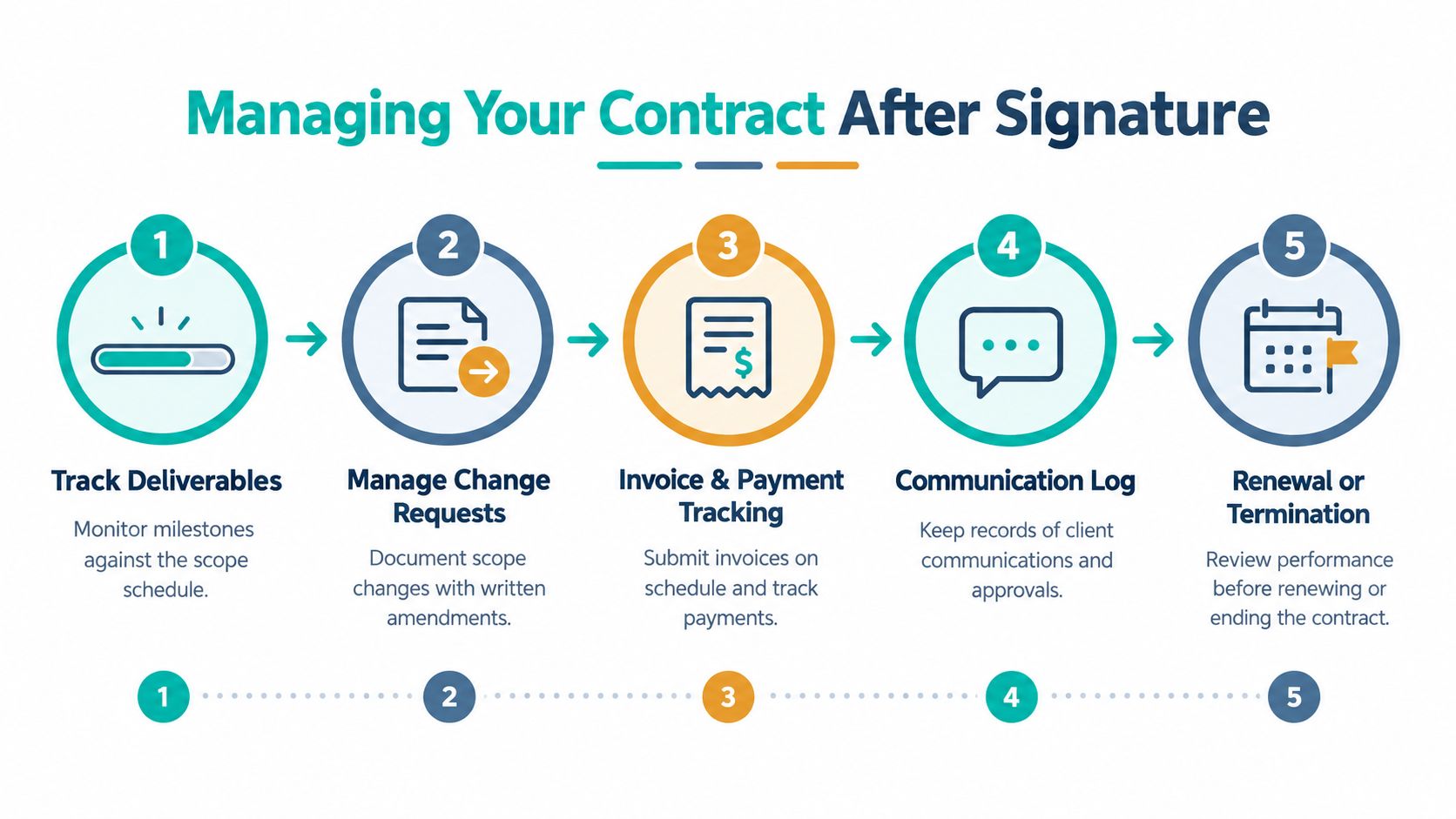
Review the arrangement against response time, completion rate, error rate, missed deadlines, utilization, client acceptance, software proficiency, time-zone coverage, and manager approval. The review can be brief, provided it identifies whether the contract still matches the workflow. Use the remote legal assistant management process to support recurring supervision, access reviews, and documented feedback.
Termination needs its own checklist. Confirm final invoice status, transfer open tasks, export or return work product, revoke credentials, remove shared links, retrieve firm equipment, and document the date access ended. For a law firm, immediate access revocation is part of controlling client information, not merely administrative cleanup.
When the assistant works in another country, the agreement should identify where the work occurs and how information moves, is stored, and is retrieved. The lawyer's professional obligations depend partly on the provider's experience and reputation, the services performed, the protections in the contract, and the legal environments involved, as discussed in ABA commentary on nonlawyer assistance.
Low hourly cost doesn't remove the firm's oversight obligations. A cross-border arrangement needs role-based access, documented supervision, restrictions on subcontracting and personal devices, approved software, an incident process, and a workable exit plan. Confidentiality and non-compete provisions may also be treated differently across jurisdictions, so a U.S. form shouldn't be assumed enforceable everywhere.
| Topic | Mandatory Clause | Risk-Reducing Option |
|---|---|---|
| Work location | Identify the country where services are performed | Identify the city or region and approved work locations |
| Client information | Limit use to authorized firm services | Add matter-specific access rules and periodic permission reviews |
| Subcontractors | Prohibit delegation without written approval | Require named personnel, screening, and equivalent written obligations |
| Devices and apps | Require approved accounts and secure handling | Prohibit personal devices, consumer cloud storage, and unapproved messaging |
| AI tools | Prohibit input of confidential information into unapproved tools | Require written approval, usage logs, and human review of generated material |
| Incident response | Require prompt notice of suspected disclosure or loss | Set a defined reporting channel, escalation contact, and response procedure |
| Termination | Require access revocation and return or deletion | Require written confirmation and an audit trail of completed steps |
| Governing law and disputes | Select governing law, venue, and notice method | Obtain local review of enforceability, remedies, and restrictive terms |
The contract should address whether the provider may use personal devices, whether household members can access the workspace, and whether the firm can require deletion from local storage and business applications. It should also identify the time and method for reporting a suspected breach. Avoid promising a remedy the firm can't enforce in practice.
For a small firm, the most useful approach is to keep the core agreement readable and place detailed security or cross-border requirements in an addendum. The addendum can identify approved platforms, permitted locations, access levels, incident contacts, retention instructions, and prohibited tools. That structure preserves the benefit of a short service contract without hiding operational requirements in vague language.
Run this confirmation pass before anyone countersigns:
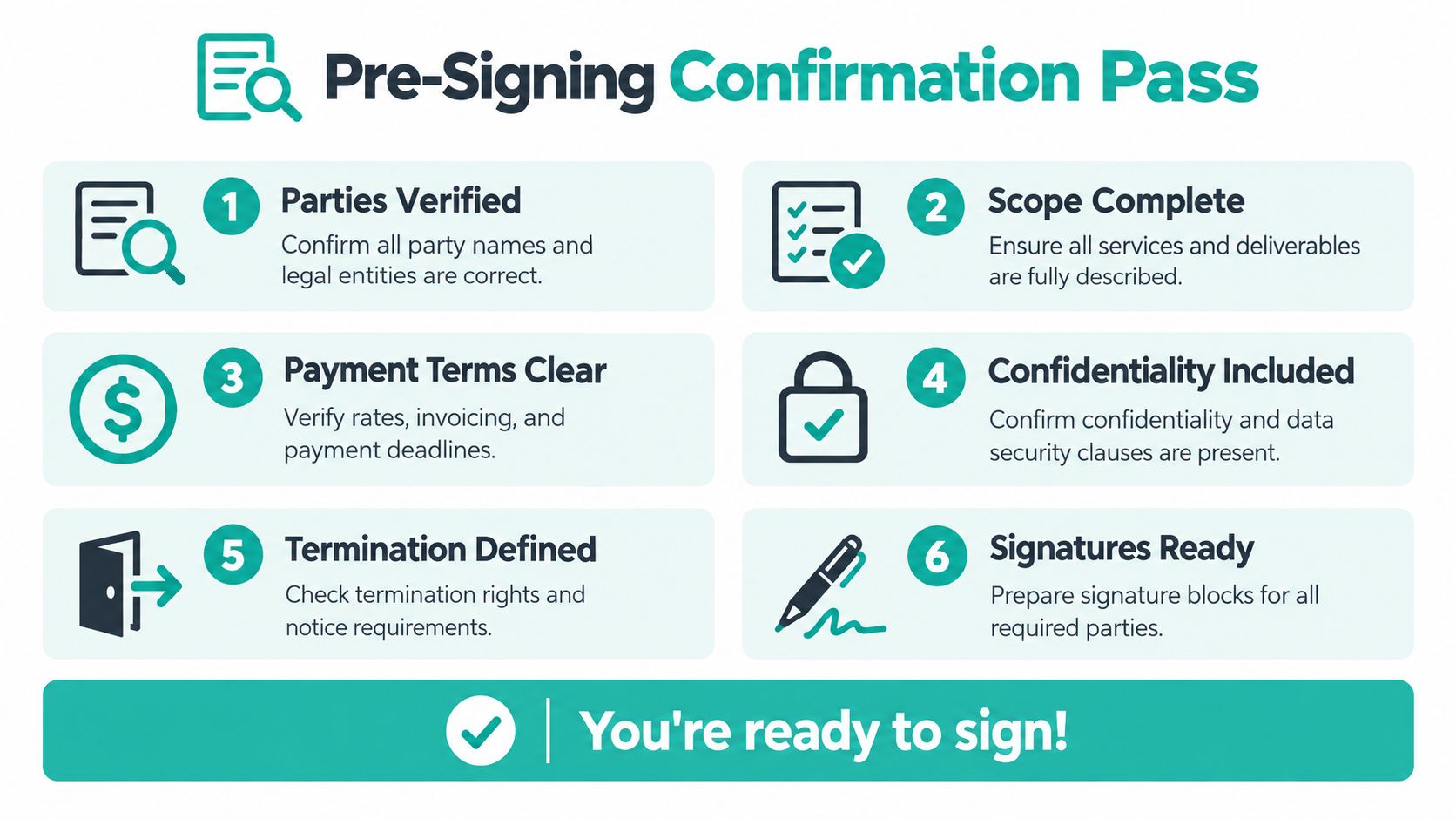
Read the agreement aloud with the assistant and ask whether the actual workflow matches every task, system, and approval point. Set a 30-day review as an internal operating checkpoint, document supervision expectations, and confirm jurisdiction-specific issues with qualified counsel. A guide to hiring a virtual legal assistant can help connect the contract to role definition and onboarding.
A simple service contract for remote legal support works when it defines the engagement in executable units and operates as a living control system. Keep the document concise, but don't omit scope boundaries, supervision, confidentiality, access, payment mechanics, change control, ownership, and termination duties.
Before signing, test the agreement against a real intake, scheduling, or document-coordination workflow. Then maintain the delivery register, review permissions, approve material changes in writing, and confirm that the firm's professional obligations are supported by actual supervision.
VirtualLegal connects U.S. law firms with pre-vetted bilingual legal support professionals in Latin America for roles such as intake, reception, scheduling, case management, and administrative assistance. If you want help matching the contract to a practical remote-support role, visit VirtualLegal.