

 15 minutes read
Outsourcing operational legal work can reduce the cost of outsourced functions by approximately 20%–30% compared with equivalent in-house operations, while giving a small firm more flexible access to support capacity (2023 Deloitte outsourcing survey, as summarized by Stealth Agents). The advantage only pays off when you define the work, protect system access, and measure completed tasks rather than comparing hourly rates alone.
A managing partner might start the week planning to focus on legal work, then spend the gaps between calls chasing intake details, moving appointments, checking case updates, and answering billing questions. By Friday, routine work has stretched into after-hours catch-up, while prospective clients have waited for a response and attorneys have interrupted their day to find information that should already be in the file.
That's the practical case for outsourcing: not paying less for labor, but converting a fixed staffing commitment into capacity matched to actual work. For a solo or small firm, a trained remote professional can handle defined operational tasks while attorneys retain responsibility for legal judgment, client advice, and supervision. This guide looks at what operational outsourcing covers, where it can help, how to match bilingual LATAM professionals to firm workflows, and how to calculate whether the arrangement is delivering real value.
A typical small-firm week can lose its shape without a single major crisis. An attorney begins with a client meeting, then takes an intake call because the receptionist is busy, reviews a calendar conflict, asks whether a document was received, and checks why a client hasn't heard back. Each task may be brief, but switching between them makes it harder to protect uninterrupted time for legal analysis and client strategy.
The same pattern affects the client experience. A prospective client who doesn't receive timely follow-up may contact another firm. An existing client who has to ask repeatedly for a routine update may lose confidence, even when the legal work itself is sound. The firm may not see these problems as a staffing issue because the work gets done eventually, often by the person least suited to spend time on it: an attorney.
Before deciding whether to hire another employee, list the administrative queues that keep recurring. These might include new-lead response, appointment scheduling, matter updates, document coordination, billing follow-up, and routine client communications. For each queue, note who handles it now, how often it waits, and whether it requires legal judgment or a consistent process.
This inventory changes the question from “Do we need another full-time person?” to “What capacity does the work require?” A firm with uneven intake volume may need reliable coverage during business hours without having enough consistent work for a full-time local hire. Another firm may have steady case-management tasks but no documented handoff process, making a new hire more likely to inherit confusion than relieve it.

Practical rule: Don't outsource a task just because it's taking time. First decide what a correct completion looks like, who handles exceptions, and where the result must be recorded.
Outsourcing isn't a fix for every operational problem. If the task changes constantly, depends on an attorney's judgment at every step, or lacks a clear system of record, adding remote support can create more supervision and rework. Start with repeatable work that currently pulls attorneys or senior staff away from higher-value responsibilities, then make the handoff dependable before expanding it.
Operational legal outsourcing assigns defined law-firm support work to an external professional or managed staffing provider. It may cover intake calls and follow-ups, reception, scheduling, client communication, case-system updates, document coordination, billing administration, and routine status tracking. The objective is to keep repeatable processes moving, not to transfer the firm's professional responsibilities.
That distinction matters. A legal assistant can prepare documents or coordinate filing steps according to attorney direction and firm procedures. An intake specialist can collect information, follow an approved script, and book a consultation. Neither role should independently advise a client on legal strategy or make a decision reserved for a licensed attorney.
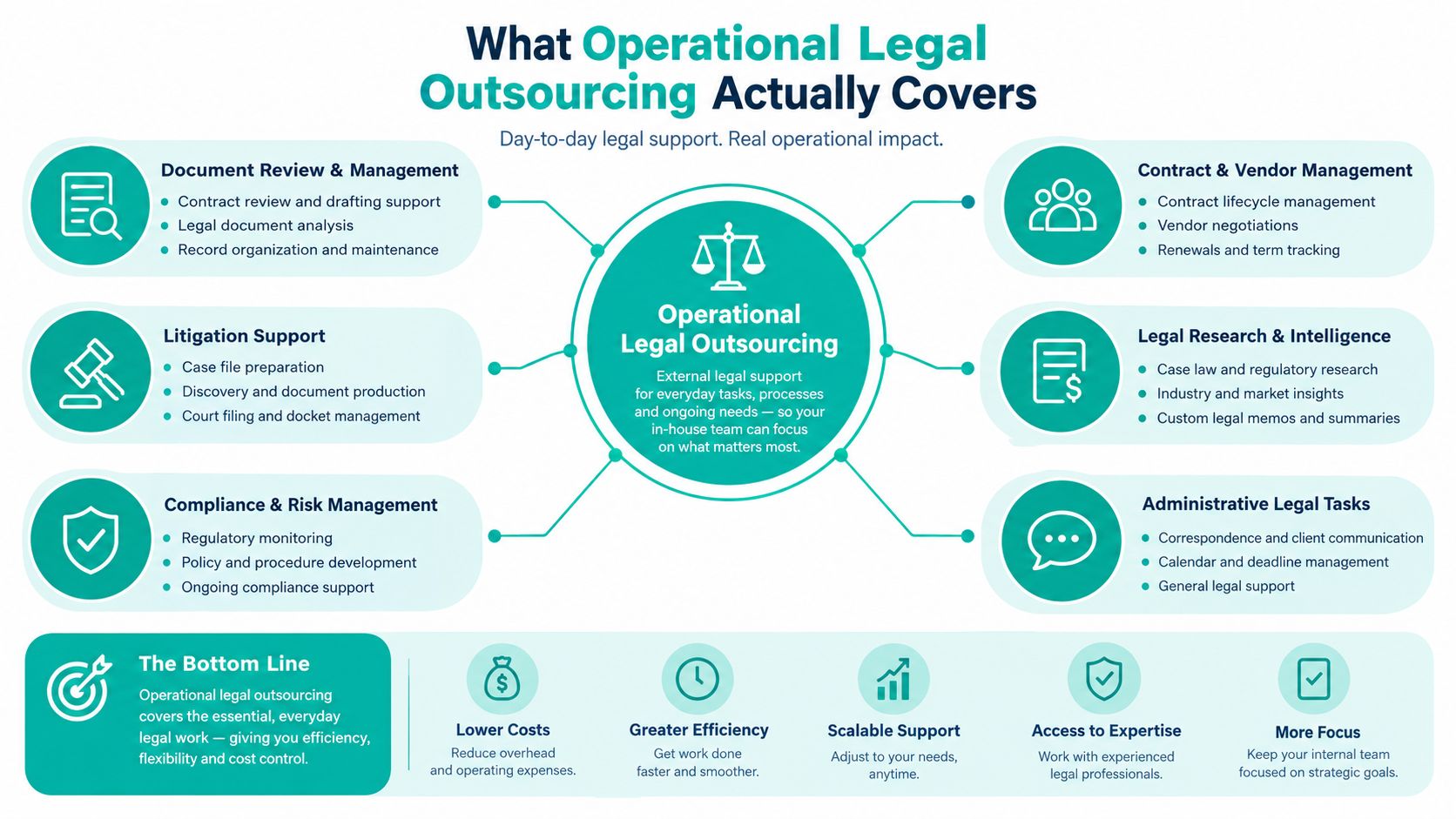
Some firms also outsource specialized legal-process work, such as document review or drafting support. Those assignments require clear attorney direction, appropriate review, and careful control of client information. They're different from operational roles, which are designed to keep the firm's administrative work organized and responsive.
A useful test is to ask whether the worker can follow a documented process and escalate exceptions without deciding what the law requires. If the answer is yes, the task may fit an operational role. If the work requires an independent legal conclusion, the attorney must retain that judgment.
A role-by-role overview of virtual legal assistant tasks can help firms identify which recurring activities are suitable for delegation and which need attorney involvement.
A staffing provider may recruit and match a professional, support onboarding, and handle a Contractor-of-Record arrangement. That model can take contracting and international payroll administration off the firm's plate, but it doesn't make the provider responsible for the firm's legal advice, client relationships, file standards, confidentiality policies, or supervision.
The firm still needs to decide what the professional may access, what instructions govern the work, how the professional reports progress, and which issues must go directly to an attorney. Define those responsibilities before access is granted. A well-drawn boundary protects the firm and gives the outsourced professional a clearer path to do useful work.
An immigration practice may see intake follow-up surge while calendar management and routine client updates remain steady. That mix calls for flexible staffing, not automatically a permanent hire. The advantages of outsourcing operational roles are real when the work, supervision, and service expectations are defined.
An external arrangement can cover recurring work without requiring a full-time employee for every function. It may also reduce recruitment, training, office, and equipment costs. Those savings are only part of the calculation: include the time firm staff spend supervising work, correcting errors, and completing handoffs.
The SCORE survey figures cited in the outsourcing-cost report offer context: 68% of small-business owners said outsourcing produced savings that met or exceeded expectations, and 14% said savings significantly exceeded expectations. Treat these results as a reference point, not a forecast for your firm. Compare the delivered cost of completed work, including review and rework, rather than relying on hourly rates alone.
Action: Select a recurring queue you can measure, then compare the full internal cost of completing it with the cost of an external arrangement.
A general hiring process requires the firm to find candidates, screen for fit, assess practical skills, and check their ability to work with its tools and schedule. A specialized staffing process can narrow the search around defined requirements. Industry reporting identifies access to talent as an outsourcing objective alongside cost considerations (outsourcing trends and priorities).
A quick shortlist has little value if candidates lack the communication skills, experience, or work habits the role demands. A receptionist and a case manager need different assessments. Define the queue, expected output, and escalation points before evaluating candidates.
Action: Draft a short scorecard covering the work the hire will own, the software they'll use, and the exceptions they must send to firm staff.
For firms serving Spanish-speaking clients, an English-Spanish professional can support intake, appointment coordination, and routine follow-up. That support can help immigration, personal-injury, family-law, and civil-litigation practices manage administrative next steps in the client's preferred language. Keep scripts and escalation rules clear: language skills do not authorize a staff member to provide legal advice.
Set the coverage window before hiring so schedule expectations are explicit in the role scorecard. Live calls and same-day handoffs require working-hour overlap; tasks that can be completed asynchronously may need less. Make the schedule serve the queue, rather than assuming every role needs identical coverage.
Action: Decide whether the role needs live phone coverage, same-day internal handoffs, or mostly asynchronous work, then set its working hours accordingly.
Prior familiarity with the firm's practice-management tools can reduce basic orientation time. The relevant software may include Clio, MyCase, Filevine, CASEpeer, SmartAdvocate, Smokeball, RingCentral, or DocketWise. Still, familiarity does not replace training on the firm's matter stages, naming conventions, permissions, and documentation standards.
A mismatch can produce duplicate records or incomplete updates, even when the professional is capable. Test a representative task in a sandbox or controlled training environment before granting wider access. Judge the quality of the completed workflow, not just confidence with the software.
Action: Include a practical exercise, such as recording an intake outcome or updating a matter milestone.
A provider may handle contracts, international payroll, onboarding, and replacement arrangements. For a small practice without dedicated HR staff, that support can reduce administrative work. It does not replace firm-owned process documentation, backup coverage, or supervision. The firm remains responsible for its workflow, even when a provider manages staffing administration.
Action: Confirm in writing who handles contracting, payroll, onboarding, and replacement. Keep role instructions and access permissions in a firm-controlled record so the work can continue through staffing changes.
A firm's queue should define the role. An intake specialist can respond to new inquiries, collect required details, and book consultations. A virtual receptionist can answer and route calls in the firm's preferred language and tone. A case manager can track milestones and follow up with clients. Billing support can handle specified administrative steps, while leaving decisions about legal fees and disputes to the firm.
Match the professional to the work inside your systems, not just to a job title. Prior experience with U.S. law firms does not guarantee familiarity with your matter lifecycle or client communication standards. Assess written and spoken English-Spanish communication, relevant workflow experience, software skills, and judgment about when to escalate.

A personal-injury firm handling a steady flow of inquiries might assign an intake specialist to follow an approved checklist, enter contact details in the designated system, flag urgent issues, and schedule consultations. A case manager could own follow-up tasks and keep clients updated on administrative milestones. The value comes from completed work that fits the firm's process, not from filling a role at a lower hourly rate.
An immigration practice may need bilingual communication and careful intake. A family-law practice may prioritize reliable scheduling and sensitive call routing. For either role, set clear boundaries: what the professional may say, what they must not promise, and where to direct a legal question or complaint.
A strong handoff tells the professional what to do next and gives the attorney a clear signal for when to step in.
Ask candidates to perform a representative task in the firm's software. Have them show how they would record a new inquiry in Clio or route a call through RingCentral, then compare their approach with your rules. A résumé listing a product does not prove the candidate can use your setup correctly.
Bilingual coverage should map to actual calls and client needs. Decide which calls require Spanish support, how translated information should be documented, and when a bilingual professional must bring an attorney into the conversation. Then set hours against specific coverage requirements. For example, a Chicago firm open from 8 a.m. to 6 p.m. Central can seek coverage from at least 9 a.m. to 3 p.m. Central, a window that LATAM time zones can support. Use the guide to time-zone overlap for remote legal support to compare schedules.
A curated shortlist can save time when the role requires a particular mix of language skills, legal-office experience, schedule, and software knowledge. Evaluate each candidate's demonstrated work, the screening process, and the support available after hiring. Judge fit by how well the professional completes the workflow and how much attorney time that work returns.
Outsourcing succeeds when the firm transfers a defined process, not a vague expectation. Use a staged rollout so the professional learns the firm's systems and boundaries before taking full ownership of a queue.
Start by documenting the task, expected result, system of record, and escalation point. Grant only the access needed for the assigned work, use individual credentials, and confirm how access will be reviewed or removed. The professional should learn the firm's communication standards, matter naming conventions, confidentiality expectations, and procedures for handling unusual requests.
Move the professional into live work with clear boundaries. Establish response-time expectations, handoff rules, and exception triggers. A receptionist might own call routing and message entry, while an attorney or designated staff member handles legal questions, complaints, and sensitive decisions.
The firm should review a sample of completed work and discuss errors promptly. Don't wait for a problem to surface through a client complaint. If a task repeatedly needs correction, determine whether the instructions are incomplete, the training is insufficient, or the work belongs in a different role.
Once the workflow is stable, review service quality and capacity together. Useful measures include completed tasks, response-time compliance, record accuracy, rework, and the amount of attorney time spent on the queue before and after delegation. The AMA reports that 45.2% of physicians reported at least one burnout symptom in 2023, and identifies administrative burden and poorly designed EHR workflows among relevant contributors (AMA's national physician burnout survey). For law firms, the parallel lesson is to assess whether the handoff removes work or merely adds oversight.
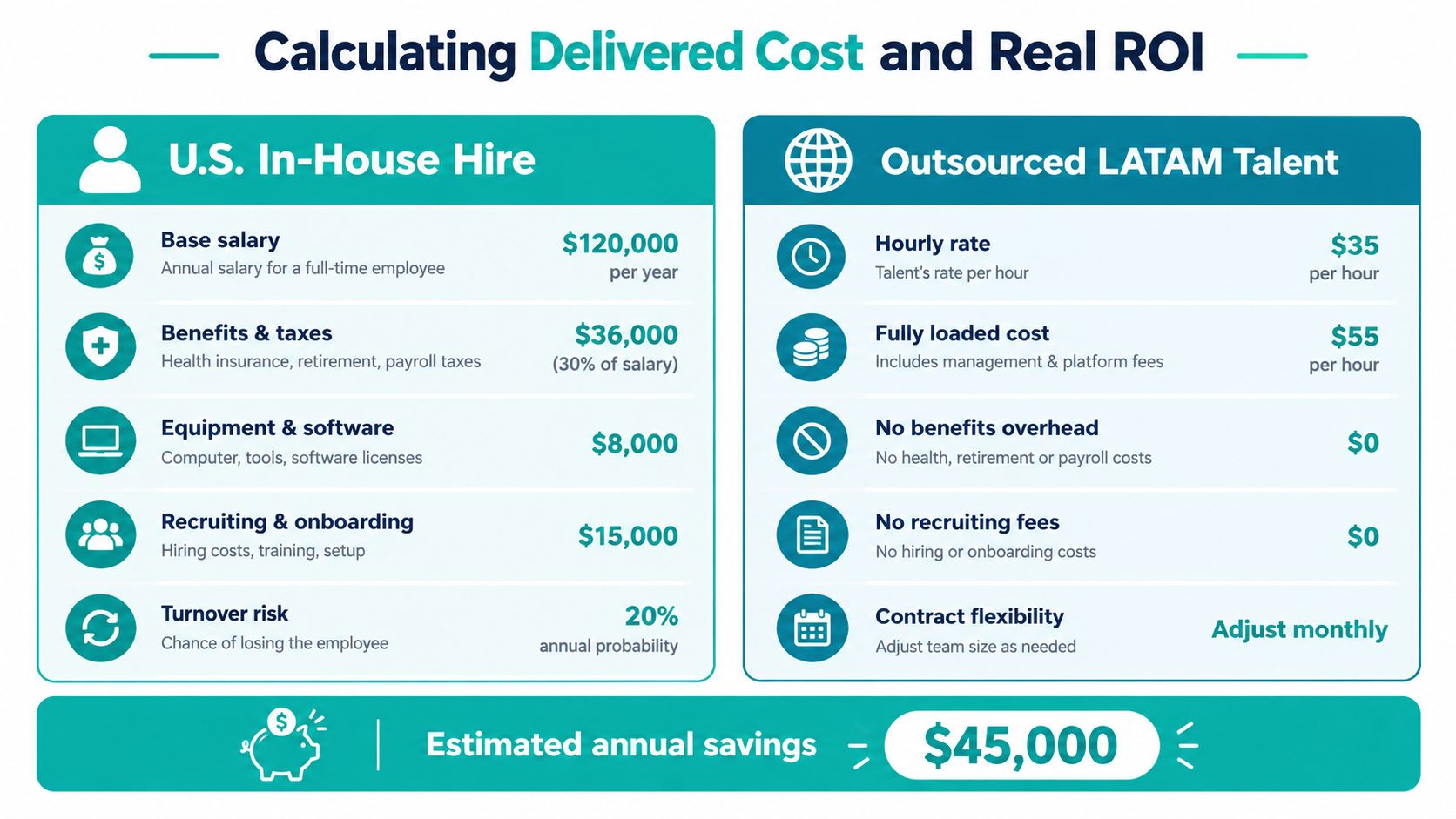
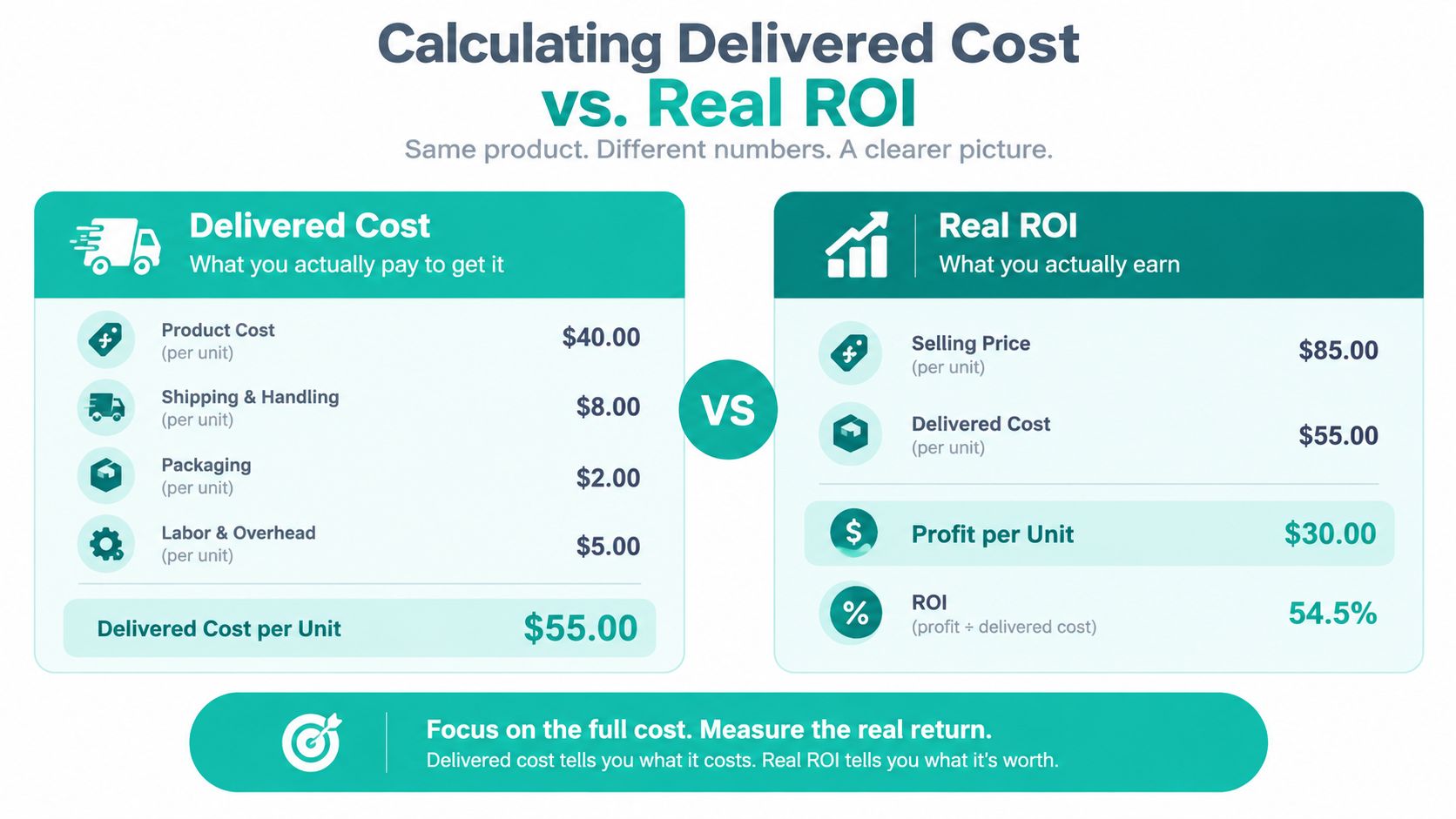
A lower hourly rate doesn't automatically make outsourcing less expensive. Compare the total cost of producing a reliable result, including staffing, recruitment, onboarding, software, supervision, quality review, rework, and coverage gaps. Then compare the cost per completed task, such as a properly documented intake, a scheduled consultation, or an accurately updated matter.
That measure is more useful than wage comparison because it includes whether the work was done correctly and whether an attorney had to fix it. A 2025 PwC/Strategy& study reported that only 21% of respondents had full transparency into outsourced-process cost drivers, while 79% did not conduct a full cost assessment (PwC's outsourcing-cost analysis). Firms should avoid making the same mistake by comparing only an employee's base pay with a vendor's hourly charge.
Use a consistent period and define the output before doing the math:
The overview of virtual legal assistant costs can help frame the external-cost side of the comparison, but the firm should use its own workload and quality data.
Outsourcing may not be worthwhile when the work is too infrequent to justify onboarding, when each task requires attorney judgment, or when no one inside the firm can supervise the process. A nominally cheap arrangement can become expensive if staff repeatedly correct errors or duplicate entries. Keep the pilot narrow, measure real completed work, and expand only if quality and attorney capacity improve.
The advantages for outsourcing operational legal work are flexible capacity, access to role-specific talent, bilingual client support, software alignment, and less in-house administration for international staffing. None of these benefits substitutes for a clear process. The firm still needs to own the workflow, limit access, set escalation rules, and review whether completed work meets its standard.
This week, list the two administrative queues that consume the most attorney or senior-staff time. Define what successful completion looks like for each, then set a service-level target and identify the software and schedule requirements. If you're ready to compare candidates, request a shortlist that fits your firm's workflows rather than hiring around a generic job description.
VirtualLegal connects U.S. law firms with pre-vetted bilingual legal support professionals based in Latin America, with matching based on role, software, and schedule needs. If you're assessing remote capacity for intake, scheduling, case updates, or billing administration, visit VirtualLegal to discuss a fit for your firm's workflows.