

 15 minutes read
A solo attorney finishes a hearing, returns to a full inbox, finds three missed intake calls, and realizes that case updates still haven't been entered into the firm's system. Hiring another lawyer isn't the answer, but handing confidential matters to an unqualified remote worker isn't one either. A virtual assistant agency for law firms can solve the capacity problem, but only when the agency understands legal workflows and the firm controls access, supervision, and data handling.
The right provider does more than forward resumes. It identifies a role, sources candidates, tests their skills, manages contracting and payroll where applicable, and helps place the assistant inside your intake, calendaring, document, billing, and case-management processes. Your job is to verify that the person can perform the work and that the arrangement won't create unnecessary confidentiality or security risk.
This guide focuses on the decisions that matter: what an agency provides in practice, when legal specialization is worth paying for, how to compare engagement models, where a remote assistant fits into a law firm workflow, and which onboarding controls should be mandatory.
A virtual assistant agency sits between the law firm and the remote professional. Instead of recruiting alone, you typically describe the role, required schedule, software, practice area, and workload. The agency then sources candidates, screens them, coordinates interviews, and supports the administrative relationship after placement.
That differs from hiring a freelance VA directly. With a freelancer, your firm usually manages sourcing, references, contracts, payment, coverage, and replacement risk itself. A business-process outsourcing firm, or BPO, usually provides a larger service operation with standardized scripts and centralized supervision. That can work for high-volume reception, but it may offer less familiarity with matter-specific legal procedures.
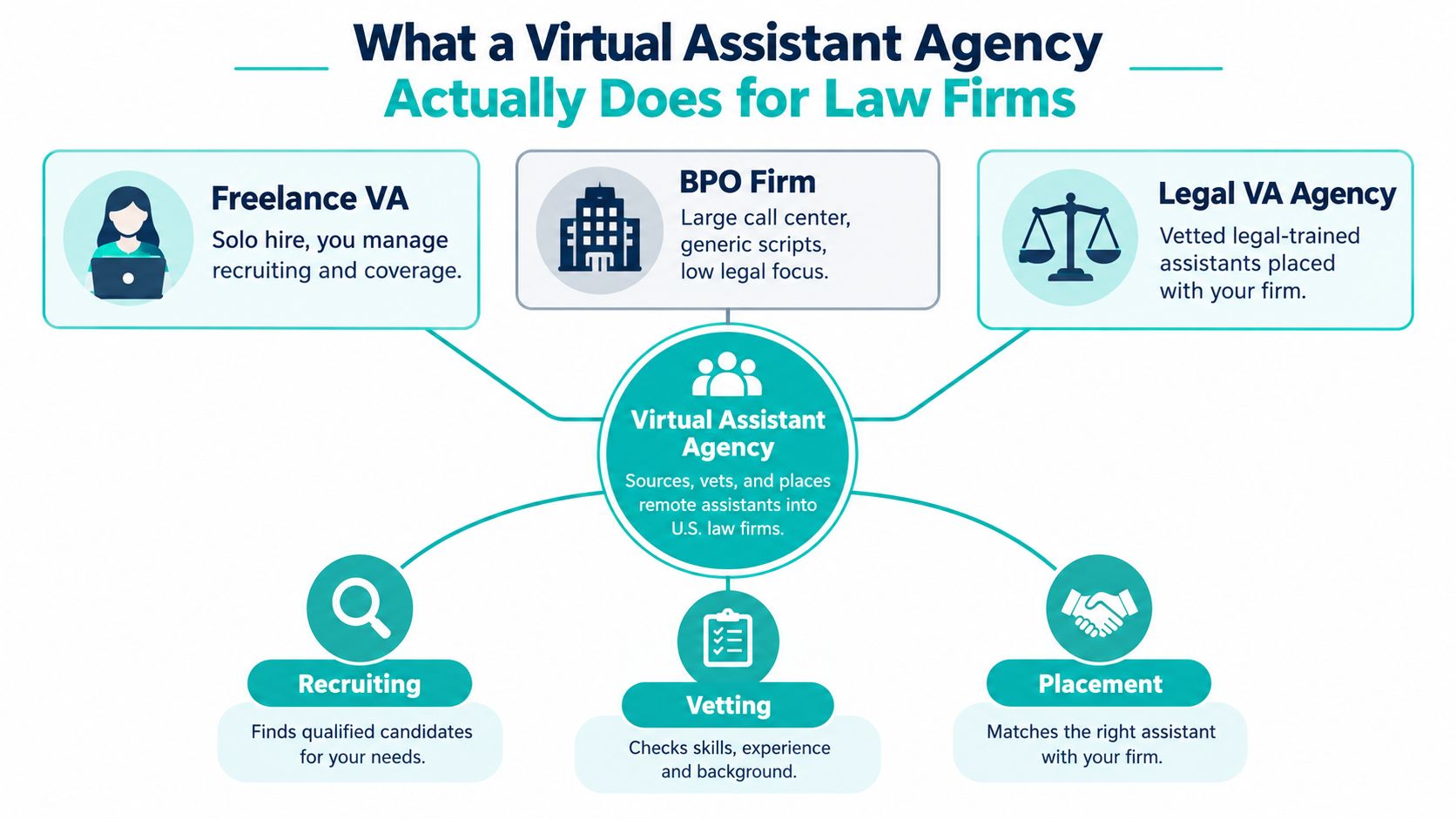
A legal-focused agency may place a legal virtual assistant, intake specialist, law firm receptionist, case manager, or administrative assistant. The work can include:
The agency may also act as a Contractor of Record, manage international payroll, support onboarding, and help coordinate a replacement if the placement ends. Those services are operational plumbing. They reduce administrative work for the firm, but they don't replace your responsibility to supervise the work, protect client information, and define what the assistant may do.
A useful overview of role boundaries and common responsibilities appears in this guide to legal virtual assistants. Read it as a role-planning resource, then adapt the duties to your jurisdiction, practice area, and internal procedures.
The agency model makes the most sense when you need repeatable capacity, not a one-off task. A small personal-injury practice might need a dedicated intake specialist who works during U.S. business hours. A family-law firm might need bilingual reception and document follow-up. A litigation practice might need an assistant who already understands matter naming, discovery coordination, and deadline tracking.
The agency should be able to explain how it vets candidates, how it tests software proficiency, who manages the employment or contractor relationship, what happens when someone is unavailable, and how access is removed at the end of the engagement. If the answers are vague, the agency is selling labor without showing that it can support a controlled legal operation.
A generalist agency can be perfectly suitable for low-sensitivity work. If you need someone to organize a public spreadsheet, coordinate internal meetings, or format nonconfidential marketing material, broad administrative experience may be enough. The risk rises when the assistant handles client communications, case records, documents, financial information, or legal deadlines.
A niche legal VA agency should understand that the same task has different consequences in a law firm. “Update the CRM” may mean entering a lead into a conflict-sensitive intake system. “Send the document” may require checking the matter, recipient, approved channel, and attorney instructions. “Schedule a call” may involve consultation type, attorney availability, language preference, and escalation rules.
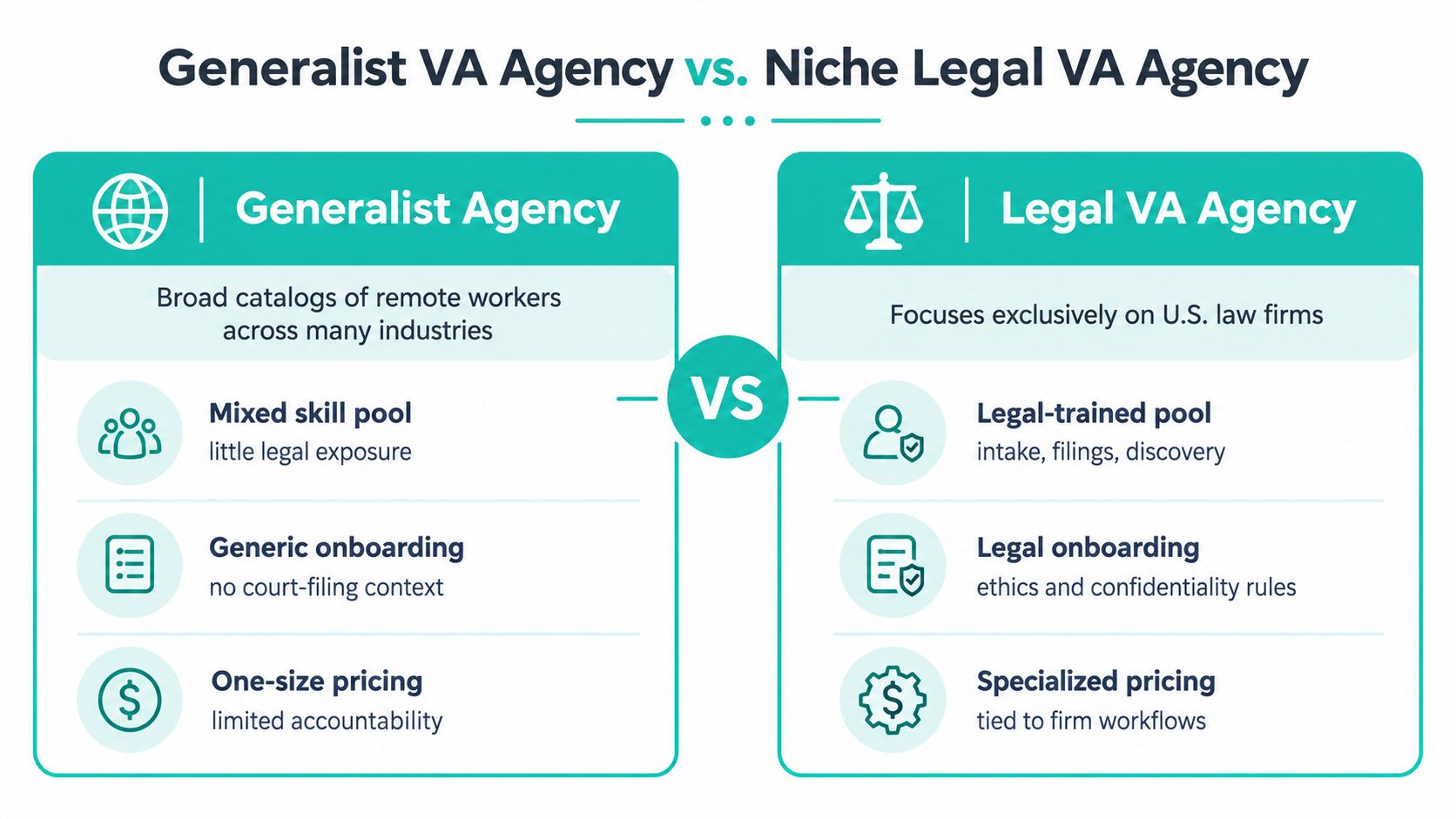
Ask what the assistant will see, change, send, and decide. A generalist agency may be acceptable when the answer is “almost nothing involving a client matter.” A legal-specialist agency becomes more appropriate when the assistant will work inside a case-management system, communicate with prospective or current clients, coordinate filings, or handle documents tied to an active matter.
| Dimension | Generalist VA agency | Legal-specialist agency |
|---|---|---|
| Candidate pool | Broad administrative experience across industries | Experience aligned with law-firm workflows |
| Software fit | May know general office tools | Should assess tools such as Clio, MyCase, Filevine, CASEpeer, SmartAdvocate, or Smokeball |
| Intake work | Generic customer-service scripts | Legal intake, qualification, conflict-check collection, and consultation booking |
| Confidentiality context | General nondisclosure practices | Familiarity with client confidentiality and restricted matter access |
| Bilingual coverage | Depends on the candidate pool | May offer English-Spanish support suited to immigration, family, or plaintiff practices |
| Best use | Low-sensitivity back-office work | Intake, case coordination, document handling, and legal administration |
A candidate who says they have used Clio may mean they logged in once or managed matters daily. Ask the agency to distinguish those experiences. Give the candidate a controlled practical exercise, such as classifying an intake, locating a sample matter, drafting an approved follow-up, or identifying which fields require escalation.
The test shouldn't expose real client information. Use fictional records and observe whether the candidate follows instructions, checks details, documents actions, and asks for clarification when the workflow is ambiguous. Legal familiarity is useful, but disciplined process behavior matters more than impressive terminology.
Generalist providers remain useful for clearly separated work. Keep the boundary explicit. If an assistant starts with calendar support and later receives access to intake records, documents, or billing tools, reassess the provider and the access level instead of allowing the role to expand informally.
There isn't one correct pricing model for every firm. The right structure depends on whether the work is steady, seasonal, project-based, or tied to unpredictable intake volume. A headline hourly rate tells you very little until you know what the agency includes and what the firm must manage itself.
Common arrangements include:
Some providers advertise legal support from $12 per hour, including Legal Virtual's published engagement options, but the rate isn't the same as total cost. Review the cost structure for a virtual legal assistant alongside the scope of work, included support, and contractual terms.
Ask whether the quote includes Contractor of Record services, international payroll, onboarding, replacement support, time tracking, and administrative coordination. Determine whether the firm pays for software seats, phone systems, password-management tools, equipment, or secure connectivity separately.
Also ask about onboarding fees, minimum-hour commitments, cancellation notice, after-hours coverage, replacement charges, and what happens if the assigned assistant is unavailable. A low hourly rate can become expensive when the firm pays for repeated training, missed appointments, correction work, and attorney supervision.
Treat pricing as a capacity decision. If an assistant will protect scheduled intake coverage every business day, continuity may matter more than a flexible hourly arrangement. If work arrives unevenly, start with a defined scope and review actual workload before expanding access or hours.
The strongest use case is repeatable administrative work with clear inputs, clear outputs, and a defined escalation path. A remote assistant should make the process more consistent, not become an unofficial decision-maker.
Consider a plaintiff practice receiving inquiries through phone calls, web forms, and text messages. The assistant can record the lead, capture the approved intake fields, collect information needed for a conflict check, identify the requested language, schedule a consultation from permitted calendar slots, and send an approved confirmation. An attorney still decides whether the firm should accept the matter and what legal advice to provide.

Before assigning work, document:
This structure applies to appointment scheduling, document requests, billing follow-up, insurance-related information collection, case-status calls, and client reminders. It also prevents a common failure: hiring someone for “administration” without deciding which parts of the workflow they can own.
Immigration and family practices may benefit from bilingual English-Spanish assistants who can handle initial communication and follow-up without forcing every interaction through a monolingual staff member. Personal-injury practices often need fast intake documentation, consultation booking, medical-record request coordination, and consistent case updates. Civil litigation teams may prioritize document organization, deadline tracking, and filing coordination.
Bilingual support still needs written rules. Record the client's language preference, define when an interpreter or attorney is required, and prohibit the assistant from explaining legal options. The assistant can communicate approved information and collect facts. They cannot diagnose a legal problem, give legal advice, sign filings on behalf of an attorney, or exercise judgment reserved for licensed professionals.
A good workflow gives providers and paralegals more uninterrupted time for legal analysis and client decisions. It doesn't eliminate supervision. The firm remains accountable for the instructions, review process, and quality of the work.
A remote assistant can become a confidentiality incident before completing a single task. A shared password, personal email account, or unapproved laptop can expose case files before the firm has established who may view, download, or send them. Set security requirements before issuing any login.
The Federal Trade Commission's small-business cybersecurity guidance, which draws on the NIST Cybersecurity Framework, recommends multi-factor authentication, restricted access, separation of vendor-accessible data, and encryption in transit and at rest. Apply those controls to the firm's actual workflow, not just to the agency's general policy.
Create an individual account for every assistant and assign permissions by role and matter. Avoid shared credentials. Limit access to the case-management, document, communications, billing, and e-filing functions required for assigned work. Keep a current record of access to Clio, MyCase, Filevine, CASEpeer, email, cloud storage, phone systems, and filing tools.
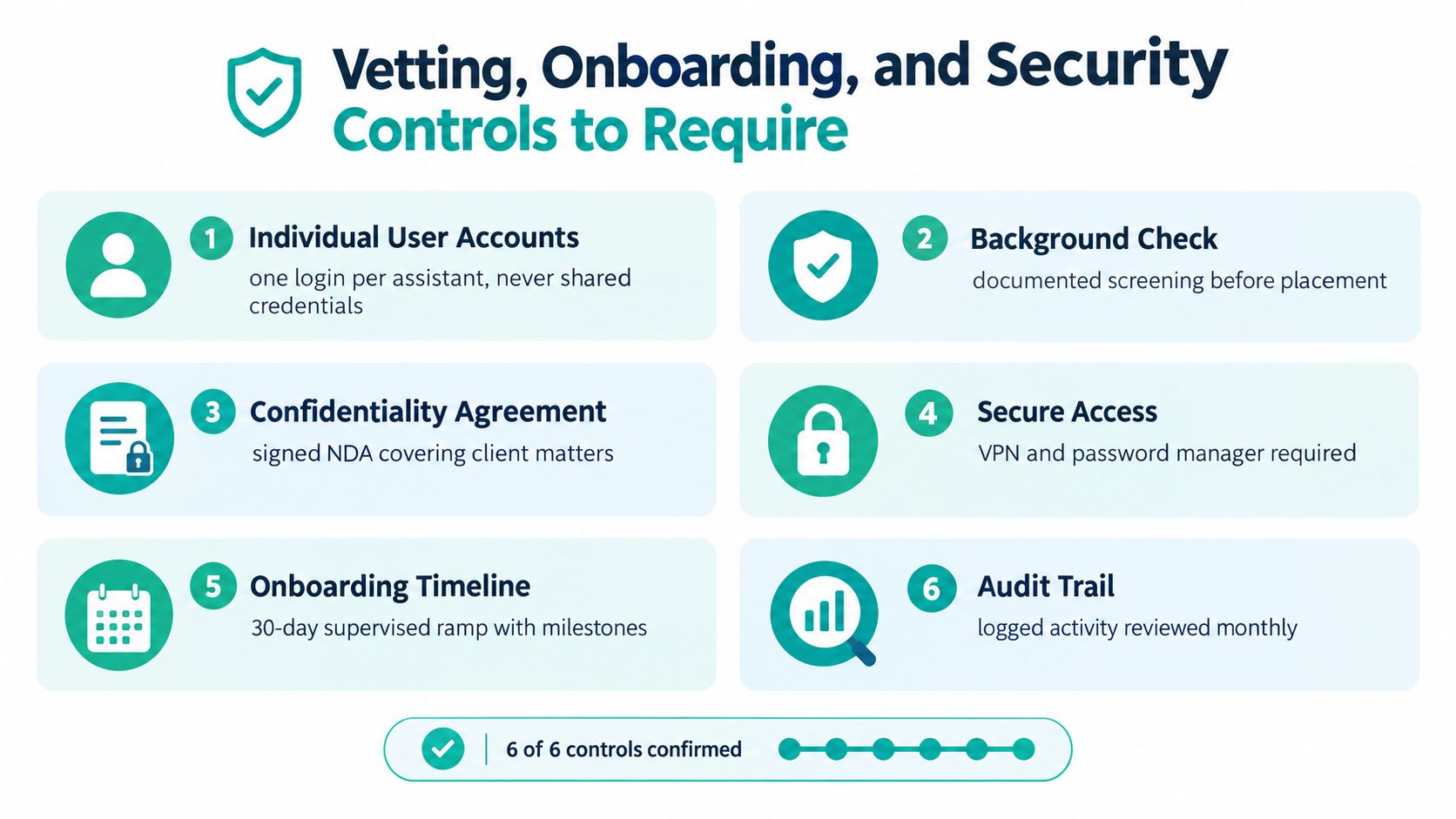
Require the agency to explain how it handles:
The FTC advises limiting vendor access to the data and duration necessary for the work. Narrow permissions reduce exposure if credentials are phished, misused, or left active after termination. Encryption and MFA strengthen the control environment, but they do not excuse excessive access.
Use a repeatable sequence that tests both the worker and the agency:
The firm should interview candidates before selecting a placement. Legal Virtual describes this approach in its guide to hiring a virtual legal assistant, including a pre-vetted shortlist, interview involvement, Contractor of Record, and payroll support. A shortlist within 24 hours can reduce recruiting delay, but speed must not replace the practical assessment or access review.
Confidentiality obligations, supervision duties, client-consent questions, and outsourcing restrictions vary by jurisdiction and practice area. Have qualified counsel or a compliance professional review the arrangement when the role involves sensitive matters, external communications, or unusual data access.
Do not describe a provider or worker as “HIPAA certified” based only on a label, and do not treat a signed confidentiality agreement as a complete security program. The agreement establishes obligations. The firm still needs individual accounts, permission reviews, device rules, audit logs, incident reporting, and prompt offboarding.
The cheapest quote often shifts work back to the firm. If the assistant needs extensive correction, misses intake follow-up, lacks software proficiency, or leaves without a documented transition, the invoice understates the actual cost. You pay through attorney time, rework, supervision, delayed client response, and repeated onboarding.
The risk deserves attention. A 2025 ABA-aligned risk and compliance survey found that 54% of law-firm respondents identified cybersecurity threats as one of the most disruptive trends affecting their organizations, while 40% placed data privacy among their top three expected disruptive trends. Review the survey findings on law-firm risk and compliance before treating security controls as an optional premium.
Estimate the engagement using:
Expected hours × provider rate + management overhead + rework cost + uncovered-work cost
Management overhead includes training, review, meetings, corrections, and access administration. Uncovered-work cost includes the time attorneys or paralegals continue spending on tasks the assistant was supposed to absorb. You don't need false precision. The purpose is to compare providers on operational output rather than hourly price alone.
Ask each provider:
The agreement should define scope, confidentiality, data ownership, permitted systems, supervision, audit rights, incident reporting, subcontractor restrictions, replacement terms, and termination for cause. It should also state what happens to firm data, credentials, documents, and local copies when the engagement ends.
Avoid agreements that promise “full support” without defining response responsibilities. Ask whether the agency may substitute another worker without approval, whether your firm can interview replacements, and how quickly access and records are transferred. A provider that can't explain these mechanics isn't ready to manage confidential legal operations.
This week, choose one workflow rather than outsourcing “everything.” Define the trigger, required fields, permitted actions, escalation rules, system of record, and completion standard. Set a budget, schedule expectation, software list, and access boundary before speaking with agencies.
This month, interview candidates, run a role-specific practical test, complete a paid trial, and finalize the contract before granting broad permissions. Require individual accounts, MFA, least-privilege access, approved devices and channels, documented confidentiality obligations, activity review, and prompt offboarding.
Judge the arrangement by operational evidence: response time for new inquiries, attorney hours recovered, correction volume, completion quality, and continuity when the assigned assistant is unavailable. The right virtual assistant agency improves capacity while preserving control. The lowest hourly quote is not the objective.
Legal Virtual connects U.S. law firms with pre-vetted bilingual legal support professionals from Latin America for intake, reception, case coordination, scheduling, document support, and billing administration. Visit Legal Virtual to review candidates who can be interviewed before hire and matched to your firm's workflows and schedule.