

 18 minutes read
You're answering intake calls while preparing filings, chasing medical records, and trying to keep the calendar accurate. A new lead waits for a response, a client needs a document request explained, and routine case updates keep pulling you away from legal work. That's the operating problem remote legal staffing can solve, but only when the firm treats it as a controlled workflow rather than a low-cost substitute for an office employee.
Remote legal staffing means assigning defined administrative, intake, case-support, or coordination work to professionals who operate outside the firm's physical office. The arrangement may involve an independent contractor, a full-time remote employee, or an agency-placed professional. The right choice depends on workload stability, supervision capacity, security requirements, and the firm's ability to manage payroll and compliance.
Remote work is now embedded in U.S. law-firm operations. Clio's 2022 Legal Trends Report found that lawyers worked in the office approximately 13 days per month, compared with substantially higher attendance before 2020. Before the pandemic, about 40% of lawyers worked exclusively from the office, while the average from 2020 through 2022 was 23%. By 2022, fewer than 30% still worked exclusively from an office, and remote work formed part of daily operations for 44% of firms. The practical question is no longer whether remote staffing is possible. It's how to build it without losing control of client service, confidentiality, or attorney oversight.
Remote legal staffing is an operating model for distributing repeatable work across a team, not just hiring someone who happens to work from home. A remote legal assistant may manage calendars, update Clio or MyCase, organize documents, and handle follow-up. An intake specialist may answer calls, collect preliminary information, run approved conflict-check workflows, and book consultations. A case manager may track milestones and escalate missing information without making legal decisions.
The distinction matters because remote work succeeds when the firm defines ownership before recruiting. If a lawyer hires “general help” without specifying which inbox, calendar, case stages, or client communications the person owns, the attorney remains the bottleneck. The worker may be busy, but the firm won't gain reliable coverage.
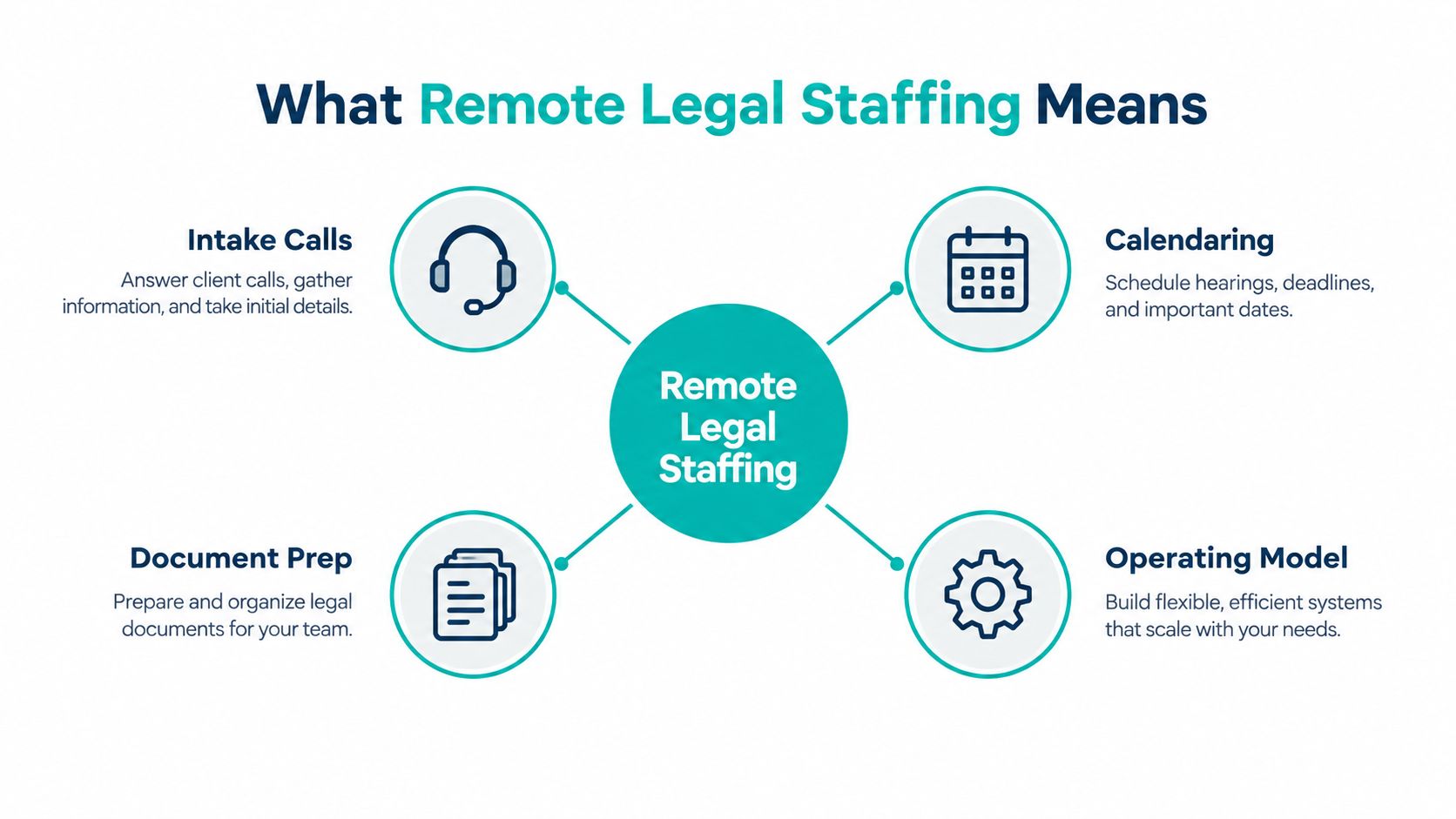
The strongest remote roles have clear inputs, repeatable steps, defined permissions, and a visible handoff point. Common examples include:
Work that requires legal judgment doesn't transfer merely because a worker is experienced. A remote professional can gather facts, prepare materials, and follow a script. The supervising lawyer must retain decisions about legal advice, strategy, representation, and eligibility.
Clio's 2021 Legal Trends Report found that 85% of legal professionals used software to manage their firms, 83% met clients virtually, and 79% stored firm data in the cloud. The same report found that 81% of firms enabled remote working for staff and clients, while 71% prioritized remote interaction over in-person interaction. Remote staffing fits this infrastructure when the person can work inside the firm's actual systems, not just communicate by email.
Most firms choose among three arrangements:
Remote work gives a small firm access to broader talent, schedule coverage, and bilingual capability. It also creates obligations that are easy to underestimate. The firm must decide who can access each matter, what happens when a worker leaves, how quality is reviewed, and which tasks require attorney approval.

Practical rule: If you can't describe a role's first five recurring workflows, its escalation rules, and its system permissions, you aren't ready to hire for it.
The three models differ less in whether the worker is remote than in who owns the administrative burden around the relationship. A contractor may be quick to engage, but the firm carries more responsibility for vetting and controls. An employee offers deeper integration, but payroll and employment administration become more involved. An agency placement can reduce sourcing work, though the firm pays for that support and must inspect the provider's practices rather than assume outsourcing removes responsibility.
An independent contractor is usually appropriate when the work is variable, project-based, or limited to a defined service. A firm might use a contractor to clear a document backlog, cover intake during a leave, or provide part-time administrative support while it tests a new workflow.
The advantage is flexibility. The drawback is that direct engagement doesn't eliminate classification, confidentiality, security, or supervision questions. The firm should define deliverables, approved tools, access limits, response expectations, and offboarding steps in writing. It should also avoid treating a contractor as an unstructured employee while relying on the label alone.
Contractors work best when the firm has an internal owner who can review output. They work poorly when the lawyer expects the contractor to invent processes, interpret ambiguous legal issues, and manage client relationships without clear boundaries.
A full-time remote employee makes sense when the role is central to daily operations and the workload is stable. A dedicated receptionist, intake coordinator, or case manager can become familiar with the firm's voice, practice area, matter stages, and preferred software.
The trade-off is management depth. The firm must provide regular supervision, documented procedures, performance feedback, equipment or endpoint requirements, and appropriate payroll administration. If the worker is located outside the United States, the firm should confirm how the arrangement will be structured and obtain qualified advice about employment, tax, and local requirements.
A full-time hire is not automatically more secure or more loyal than a contractor. Security depends on permissions, devices, account management, and monitoring. Cultural integration depends on communication and management habits.
An agency placement is useful when the firm needs speed, specialized screening, bilingual coverage, or help with international contracting. A provider may source candidates, conduct skills testing, manage a Contractor of Record arrangement, administer international payroll, and support replacement if the match fails.
The firm still owns the work product and client relationship. Before signing, ask who performs background checks, who controls accounts, where records are stored, how incidents are reported, and what happens at termination. Confirm whether the provider's role is limited to recruiting or includes ongoing administrative support.
| Dimension | Independent Contractor | Full-Time Remote Hire | Agency Placement |
|---|---|---|---|
| Best fit | Variable workload or defined projects | Stable, recurring daily coverage | Fast hiring, specialized or bilingual support |
| Payroll and taxes | Usually managed through the direct arrangement, subject to applicable rules | Managed through the firm or an appropriate employment structure | Often administered by the provider, depending on contract |
| Supervision | Firm directs deliverables and reviews work | Firm manages the employee's daily performance | Firm directs legal work while the provider may support administration |
| Software access | Firm should issue role-specific access | Firm should issue managed access and equipment standards | Firm should approve systems and permissions before onboarding |
| Replacement responsibility | Usually the firm's responsibility | Firm recruits and manages a replacement | Provider may offer replacement support |
| Main risk | Misclassification, weak oversight, inconsistent availability | Administrative burden and fixed commitment | Less control over provider practices and added service cost |
| Strong use case | Backlog reduction or limited coverage | Dedicated intake, reception, or case management | Bilingual staffing or rapid expansion |
Choose based on the shape of the work, not on a preference for a particular label. A solo attorney with unpredictable needs may start with limited contractor coverage. A growing plaintiff firm may need a dedicated employee or agency-placed intake professional. A multilingual immigration practice may value an agency's screening and bilingual talent pool more than the simplicity of direct sourcing.
Remote legal staffing should be evaluated against the cost of uncompleted work, not just the hourly rate. The relevant comparison includes compensation, payroll or provider fees, software, equipment, training, supervision, and the attorney time required to correct mistakes. A low rate can be expensive if the person misses consultations, enters incomplete matter data, or creates rework.
Start with a fully loaded cost:
Fully loaded staffing cost = compensation or service fee + software and equipment + onboarding time + supervision time + correction time
Then identify what the role is supposed to recover. For an intake specialist, the relevant outcomes may include faster first response, more complete lead information, and fewer abandoned follow-ups. For a legal assistant, measure document turnaround, calendar accuracy, and the attorney hours no longer spent on administrative work.
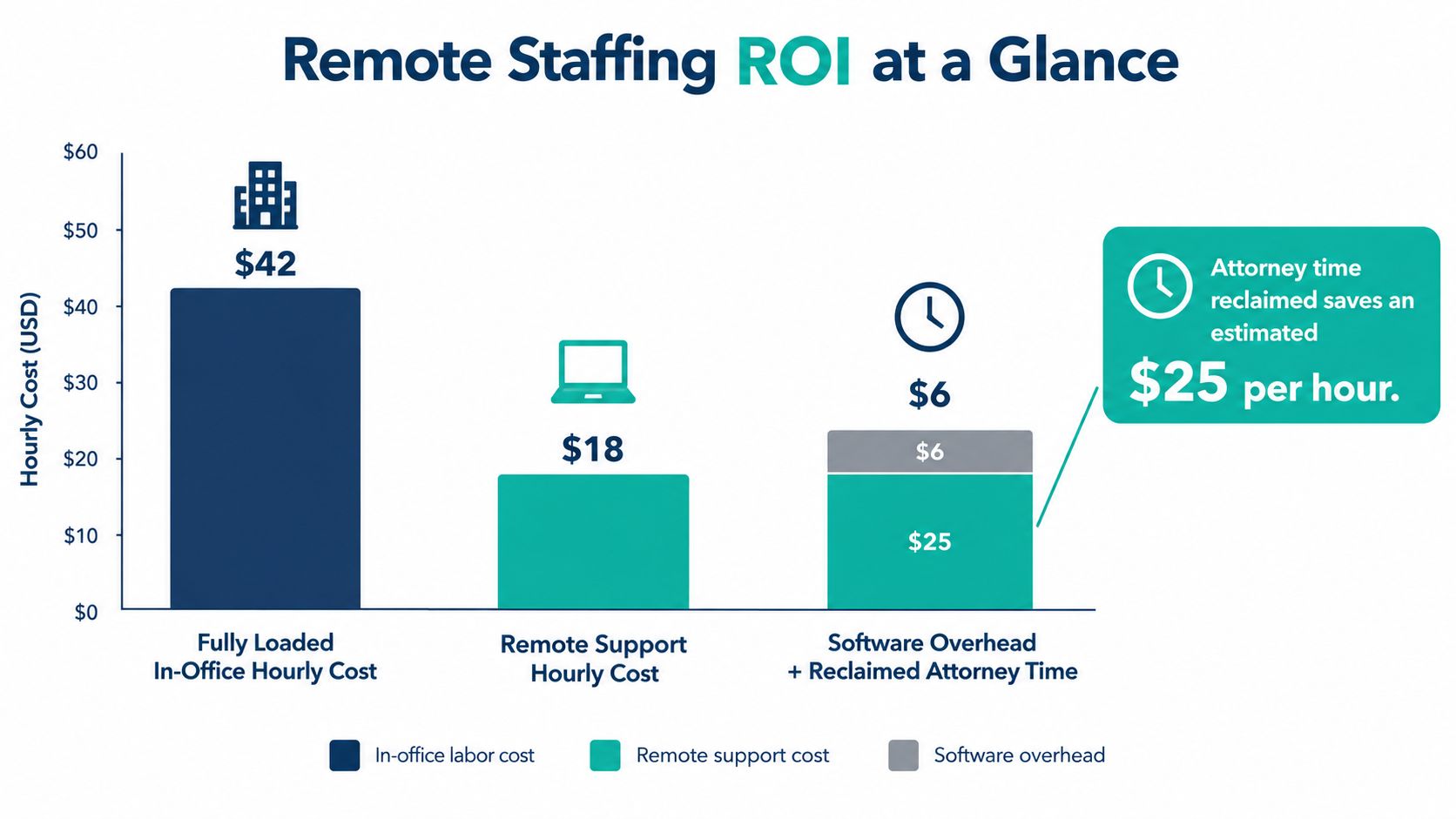
Don't assign value only to hours billed by the remote professional. Calculate the attorney time recovered, the overtime avoided, the consultations handled, and the work that moved forward because someone owned follow-up.
A practical formula is:
Estimated operating return = value of attorney time recovered + avoided overtime or vacancy cost + value of additional completed workflows − fully loaded staffing cost
The formula doesn't prove causation by itself. Track the baseline before the rollout, define the role's ownership, and compare results during a controlled period. A practice manager might report:
A firm should also compare the cost of delay. A missed call may represent a lost consultation. An attorney who spends the morning on calendar corrections may postpone billable work. A vacant administrative position can leave case progression stalled even when the firm has enough matters to justify help.
For a broader discussion of what firms should include when estimating virtual legal assistant cost, ask the provider to separate labor, management, software, payroll administration, replacement support, and termination terms. Don't accept one blended figure without knowing which services it includes.
The right question isn't “What does this person cost per hour?” It's “What recurring work will this person own, and how will the firm know that ownership is producing value?”
Avoid promising a financial return before the workflow is measured. Remote staffing can reduce routine workload, but it won't fix an unclear intake script, poor matter naming, missing templates, or an attorney who refuses to delegate decisions that are safely administrative.
Remote location doesn't transfer professional responsibility. Under ABA Formal Opinion 08-451 on outsourcing legal and nonlegal services, together with Model Rules 1.1, 5.1, and 5.3, the responsible lawyer must select competent personnel, provide appropriate supervision, protect confidentiality, check conflicts, avoid unreasonable fees, and prevent unauthorized practice of law.
A remote assistant may schedule a consultation, organize documents, update a CRM, or follow up on missing information. The person shouldn't give legal advice, select legal strategy, decide whether a client qualifies for representation, or present themselves as licensed to practice law. Put those boundaries into the role description and the daily workflow.
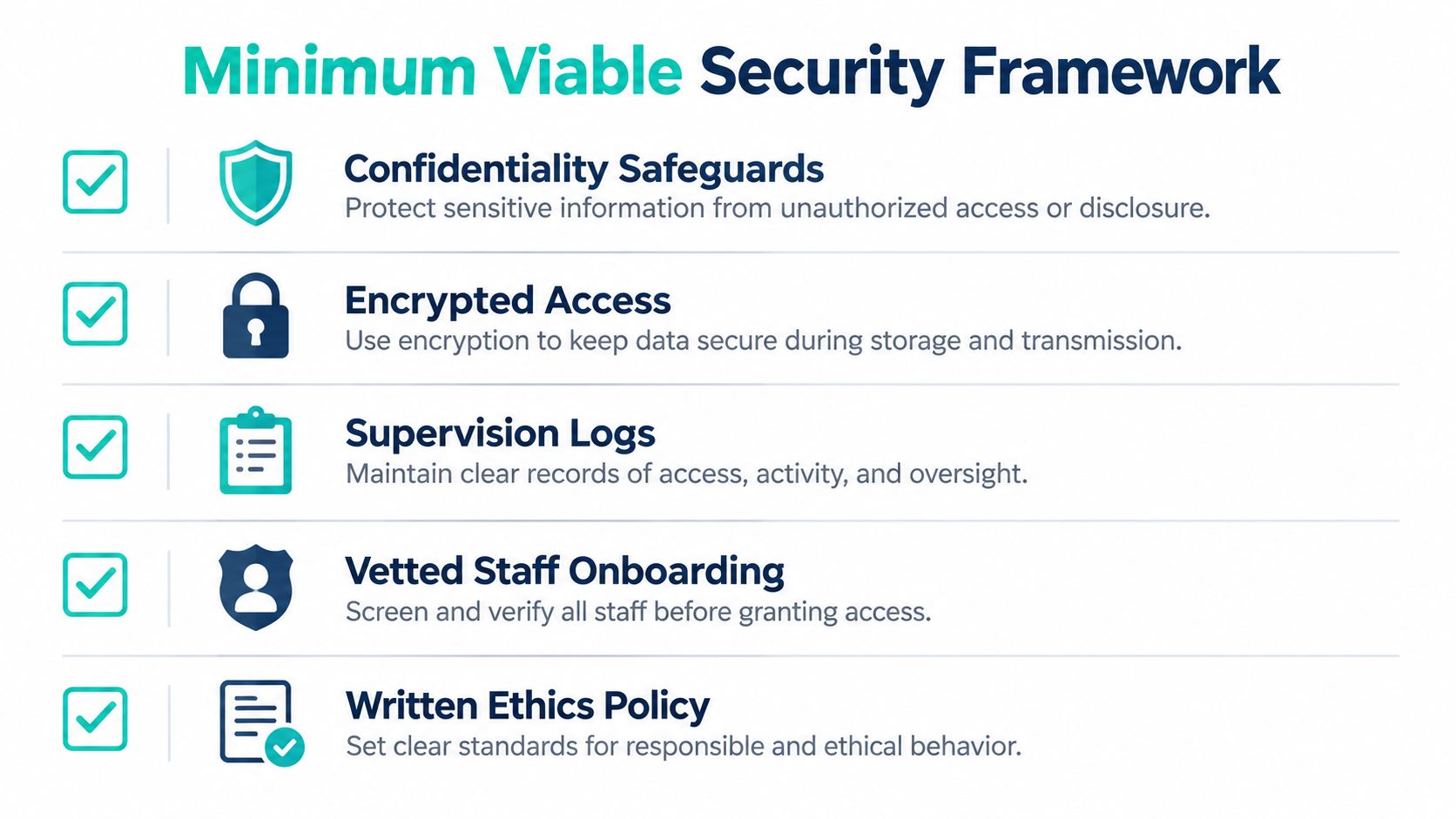
NIST guidance on security for enterprise telework and remote access recommends defining permitted remote-access methods, device types, account provisioning, and access levels. For a law firm, that means an intake specialist might access a CRM, calendar, and approved communications platform, while a case manager might access matter-management records but not accounting administration.
Use a minimum viable framework:
The ABA's 2024 solo and small-firm technology report found that 23.8% of solo attorneys had no cloud-computing security measures, compared with 15.8% of firms with 100 or more attorneys. It also found that 62% of solo practitioners used remote-access tools, while small firms reported 71% adoption after previously exceeding 80%. Adoption isn't maturity. A firm can use cloud systems and still lack access reviews, offboarding, or a written incident process.
The same report found that 65% of firms cited data privacy and 61% cited cybersecurity as obstacles to greater remote-work adoption, while 66% viewed remote-work technology as critical to long-term business continuity. Treat these figures as an operational warning, not a reason to avoid remote staffing. Remote workers often expose weak controls that already exist for in-office users.
A remote virtual email assistant should never receive unrestricted access because email feels less sensitive than a case system. Use delegated access, approved folders, clear escalation rules, and periodic review. HIPAA is not the governing framework for law firms generally, and a vendor's claim that it is “HIPAA certified” would not establish compliance with legal confidentiality duties. Requirements vary by jurisdiction and client matter, so confirm specific obligations with qualified ethics counsel or a compliance professional.
Bilingual support matters when language affects whether a prospective client can explain what happened, understand next steps, and complete documentation. U.S. Census Bureau American Community Survey reporting shows that 70.0% of children ages 5 to 17 who spoke a language other than English at home spoke Spanish during 2018 through 2022, as reported in the Census Bureau's language-at-home release. The operational takeaway is not that every firm needs Spanish coverage. It's that practices serving multilingual communities should measure communication quality instead of treating language as a résumé checkbox.

An immigration firm may assign a bilingual intake specialist to answer first calls, collect basic history through an approved script, identify urgent facts, explain document requests, and book consultations. The professional shouldn't determine eligibility or give legal advice. Those decisions remain with the attorney.
Measure first-response time, contact-to-consultation booking rate, abandoned calls, accuracy of names and dates, and the number of records returned for clarification. The specialist should escalate detention, imminent deadlines, safety concerns, and other defined triggers immediately rather than improvising.
A personal-injury practice may use a bilingual receptionist to answer calls, route Spanish-speaking leads, collect incident details, and request permission for a follow-up. The receptionist can improve continuity by owning the handoff from first call to consultation booking, but the script must avoid promises about liability, settlement value, or representation.
Review call recordings or approved quality samples for completeness, tone, disclaimer use, and escalation. Track show rate, booking accuracy, abandoned-call rate, and whether medical or accident details are entered accurately enough for attorney review.
A family-law firm may use a bilingual case manager to coordinate document requests, explain administrative next steps, and follow up on missing forms. This role can reduce repeated calls when the same professional owns the follow-up queue, but it must not interpret legal advice beyond the person's training or replace a qualified interpreter when accuracy is critical.
Track document turnaround, follow-up completion, language preference, client satisfaction in Spanish, and attorney rework. Bilingual fluency is only one qualification. Legal-intake competence includes issue spotting within the approved script, careful data capture, confidentiality discipline, and knowing when to stop and escalate.
Before adding bilingual coverage, answer these questions:
The ABA Journal's coverage of the 2025 legal industry report describes broad use of cloud-based remote-work tools, including firms that are fully remote and firms using hybrid arrangements. Availability alone doesn't prove service quality. Measure whether bilingual support improves the workflow without allowing language ability to blur the boundary between administrative assistance and legal judgment.
Start with the role, not the résumé. Write the recurring tasks, systems, permissions, escalation triggers, schedule overlap, and definition of acceptable work. A receptionist, intake specialist, case manager, billing assistant, and document coordinator need different tests even if all are called remote assistants.
Score candidates against the work your firm needs:
| Criterion | What to test |
|---|---|
| U.S. law-firm experience | Familiarity with client confidentiality, matter structure, deadlines, and attorney workflows |
| Software proficiency | Ability to complete tasks in the firm's actual Clio, MyCase, Filevine, CASEpeer, Smokeball, RingCentral, or related systems |
| Written communication | Clear client messages, accurate summaries, professional tone, and careful names and dates |
| Spoken communication | Call handling, active listening, script discipline, and escalation judgment |
| Confidentiality discipline | MFA use, secure workspace habits, no shared credentials, and correct handling of downloads |
| Schedule overlap | Reliable availability during the hours clients and attorneys need live coverage |
| Workflow judgment | Ability to identify an incomplete task and escalate rather than guess |
Interview with realistic scenarios. Ask the candidate to classify a new message as routine, urgent, or attorney-only. Have them schedule a consultation inside the firm's calendar, update a sample matter, prepare a document request, and write a follow-up message. General administrative tests aren't enough if the daily work happens inside legal software.
For international staff, due diligence should include references, background screening, written confidentiality obligations, security procedures, and role-specific skills testing. Oregon State Bar guidance on outsourcing also supports examining competence, the provider's security environment, and the relevant jurisdiction when evaluating outsourced legal work.
A 30-day rollout should begin with limited permissions and a small set of workflows. Assign one internal owner, hold regular check-ins, audit samples of completed work, and record questions that reveal unclear procedures.
Measure:
Put the relationship under a written statement of responsibilities. Separate administrative work from attorney-only decisions, name the supervising lawyer or manager, define response-time expectations, and explain how incidents are reported. Guidance on managing a remote legal assistant is useful only when adapted to the firm's own systems and review habits.
Use a short weekly meeting to examine exceptions, not merely activity. Ask what was delayed, what was unclear, which client communication needed correction, and whether permissions remain appropriate. After the first month, expand access only when the worker demonstrates task-level reliability.
Remote legal staffing works when the firm treats it as an operating system for intake, scheduling, documents, case administration, and follow-up. It fails when the owner hires for availability without defining ownership, gives broad access without role controls, or measures activity instead of response time, accuracy, and reduced rework.
This week, document one role, set its permissions, create a hiring scorecard, define attorney-only decisions, and establish a 30-day measurement window. Review the arrangement against your jurisdiction's ethics, employment, confidentiality, and data-security obligations with qualified counsel or a compliance professional. For bilingual or specialized coverage, test the professional inside the software and scripts your firm already uses.
Legal Virtual connects U.S. law firms with pre-vetted bilingual legal professionals in Latin America for intake, reception, scheduling, case support, document coordination, and administrative workflows. Review available candidates and discuss a role aligned with your firm's systems and schedule at Legal Virtual.