 14 minutes read
It's 9:12 a.m. You're in a deposition, your paralegal is on another line, and a prospective client injured yesterday is listening to your phone ring. She doesn't leave a voicemail. She calls the next firm on her list. That's not a marketing failure. It's a law firm reception desk failure, and it's the most expensive kind because you usually never learn it happened.
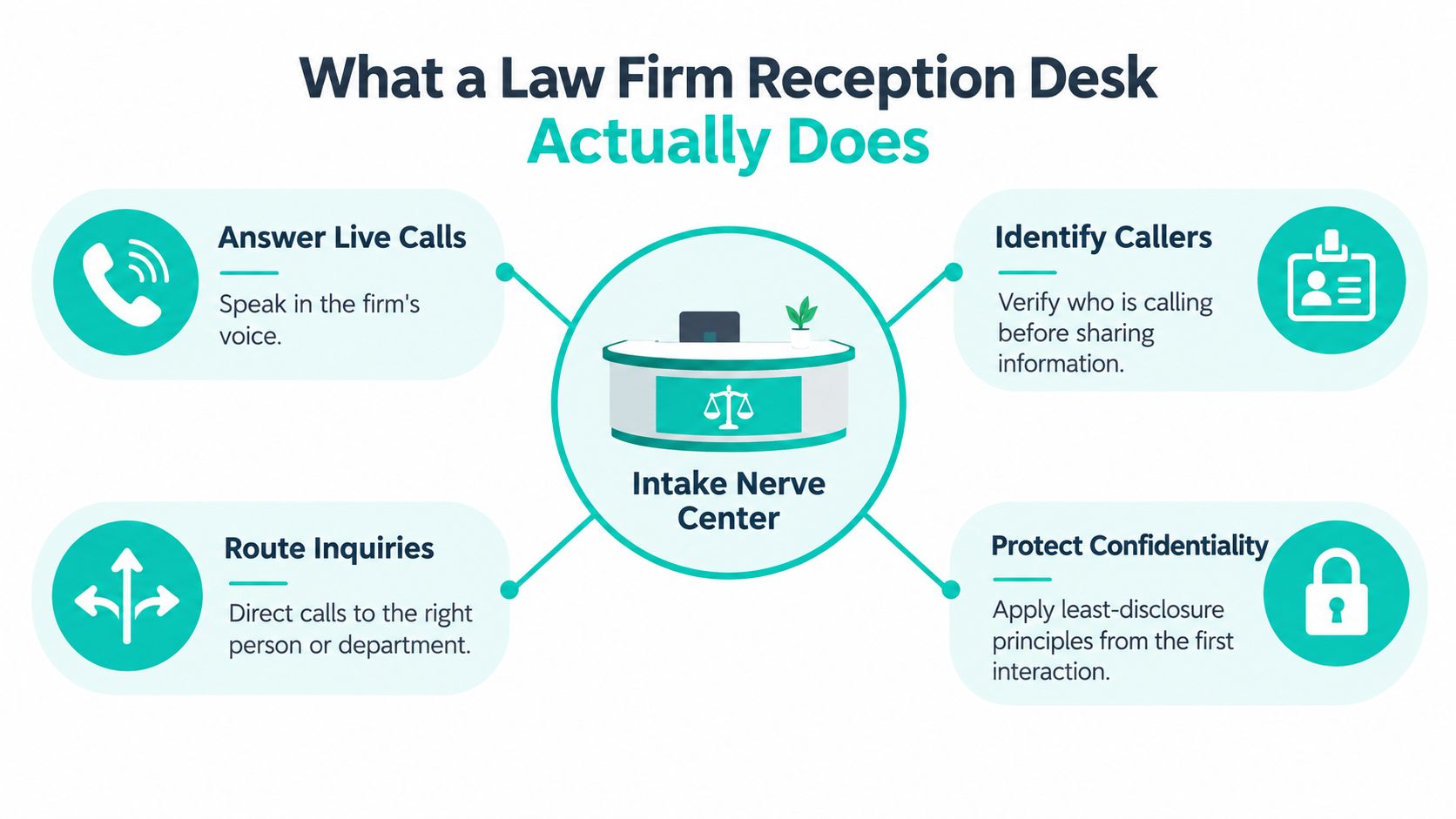
A well-run reception desk isn't a switchboard. It's a governed intake and confidentiality workflow that answers live, identifies the caller's need, collects only what's needed to route safely, books the consultation, and creates a clean record your team can act on. This guide covers the duties, scripts, staffing models, routing and software, confidentiality and accessibility controls, and the KPIs that tell you whether the system is working.
In Clio's secret-shopper research, only 40% of law firms answered prospective clients' phone calls, while 48% were unreachable by phone, and the American Bar Association reported the phone-answering rate had fallen from 56% in 2019 to 40% in the later study ABA reporting on Clio's secret-shopper intake findings. For plaintiff, immigration, family law, and criminal defense practices, that gap is lost consultations, not missed courtesy calls.
I've audited reception setups where the phone was whoever wasn't busy. It never worked for long. Attorneys in court can't answer consistently, and a paralegal pulled off billable work to improvise intake produces rushed notes and no follow-up owner. The reception desk needs named outputs every business day, not good intentions.
Consider a common pattern. A caller reaches voicemail, leaves a detailed message, and gets a callback days later from someone who can't find the note. By then she's retained another firm, and your team has still spent time on a record that goes nowhere. Worse, a loose note with sensitive facts sitting in a shared inbox creates confidentiality exposure with no client benefit to show for it.

Operating rule: Every inbound contact should end in one of three places, a booked consultation, a warm transfer to an owner, or a logged callback with a named person and a time.
When you can list those outputs and assign them, you've stopped treating reception as coverage. You've built an intake function you can train, supervise, and measure.
Start every new-matter call with the same five data points, in the same order. Get name, callback number, matter category, urgency, and referral source before you invite any narrative. That order protects you if the call drops, gives the attorney enough to prioritize, and keeps the caller from disclosing extensive sensitive facts before anyone has checked conflicts or confirmed the firm handles the category.
A 2016 American Bar Association Journal report summarized a client-intake study of approximately 17,000 inbound telephone calls to law firms, finding fewer than 10% of callers reached an attorney directly, nearly one-third reached voicemail, and in more than 40% of cases a return call or response to an online intake form arrived three or more days after initial contact Clio summary of the ABA Journal intake study. Slow, unstructured follow-up is exactly what a fixed intake sequence prevents.
Use language that helps without advising. Phrases that work include, "I can take your information and have an attorney review whether we can help," and, "I can't assess the legal merits, but I can schedule a consultation so an attorney can." Phrases to ban include promises of representation, opinions on deadlines or likely outcomes, and fee commitments the firm hasn't authorized.
Verify identity before you confirm anything about representation. Ask who is calling and what matter they're calling about before you acknowledge that a person is a client. That habit guards against impersonation and against the accidental disclosure that happens when a well-meaning receptionist tries to be helpful too quickly.
Bilingual intake deserves the same discipline. For Spanish-speaking callers, use approved terminology for matter types and next steps, confirm material facts back to the caller, and escalate when nuance matters rather than guessing. Translation improves access, but an unconfirmed mistranslation can misclassify a matter or misstate a deadline-related urgency. Firms that want this work done consistently often assign it to a trained legal intake specialist role rather than to whoever happens to speak some Spanish.
Document the interaction in the firm's approved system before the next call. Keep operational details separate from any narrative the caller volunteered. Attorneys inherit better files, and you avoid the sticky-note problem that undermines even talented receptionists.
No staffing model is right for every firm. The honest comparison is about coverage, supervision, and cost structure, and about which trade-offs your practice area can tolerate. A high-volume personal injury firm lives or dies on speed to answer. A boutique estate-planning practice with scheduled, unhurried inquiries has different pressure.
An in-house receptionist gives you physical presence for walk-ins, mail, and in-office client greeting, plus direct supervision. The weaknesses are fixed cost, single-point-of-failure coverage during lunch, illness, and vacation, and the temptation to load the role with unrelated errands until phones become secondary.
A dedicated remote legal receptionist works only for your firm, in your systems, on U.S. aligned hours, but from a remote location. You keep continuity and firm-specific training without in-office presence. Providers such as VirtualLegal place bilingual English and Spanish reception and intake professionals with prior U.S. law firm experience. The trade-off is that you must supervise deliberately, with documented procedures and call review, because you can't observe the work by walking past a desk.
A virtual receptionist service typically answers for many firms using shared agents. It handles overflow and after-hours coverage well and converts fixed cost into variable cost. Continuity is weaker, agents know your matters less intimately, and complex triage or bilingual nuance can suffer if scripts are thin.
| Model | Typical cost structure | Coverage profile | Best fit |
|---|---|---|---|
| In-house receptionist | Salary plus benefits and workspace | Business hours, gaps for breaks and absence | Firms with steady walk-in traffic and in-office needs |
| Dedicated remote receptionist | Hourly or monthly for named staff | Set U.S. hours, expandable with added staff | High-volume plaintiff and immigration firms needing bilingual consistency |
| Virtual receptionist service | Per call or per minute | Overflow and after-hours extension | Smaller or lower-volume practices needing backup coverage |
Ask three questions. First, what's your call volume and how time-sensitive are first calls. Second, what languages must you serve well, not just attempt. Third, who will train, audit, and coach this person weekly. The third question eliminates more options than price does.
Remote and cross-border arrangements add governance questions, including where data resides, what systems the receptionist can access, and how quickly you can revoke that access. Answer those in the contract and your internal policy before the first call, not after an incident. A cheaper model that you can't supervise isn't cheaper once a confidentiality error lands.
Many firms end up hybrid. An in-house or dedicated remote receptionist owns business hours, and a service covers overflow and after-hours under the same script and escalation rules. That works if both layers write into the same system and follow the same missed-call workflow.
Answering the phone is only the first step. Value is created when the call becomes a booked consultation and a usable record without re-entry. Map the path in tiers. The receptionist answers first and gathers basic information. She warm-transfers to the attorney or intake owner when the matter is sensitive, urgent, or ready. Overflow, whether a second receptionist, a service, or voicemail as a last resort, catches what the first tier can't, with a defined callback owner.
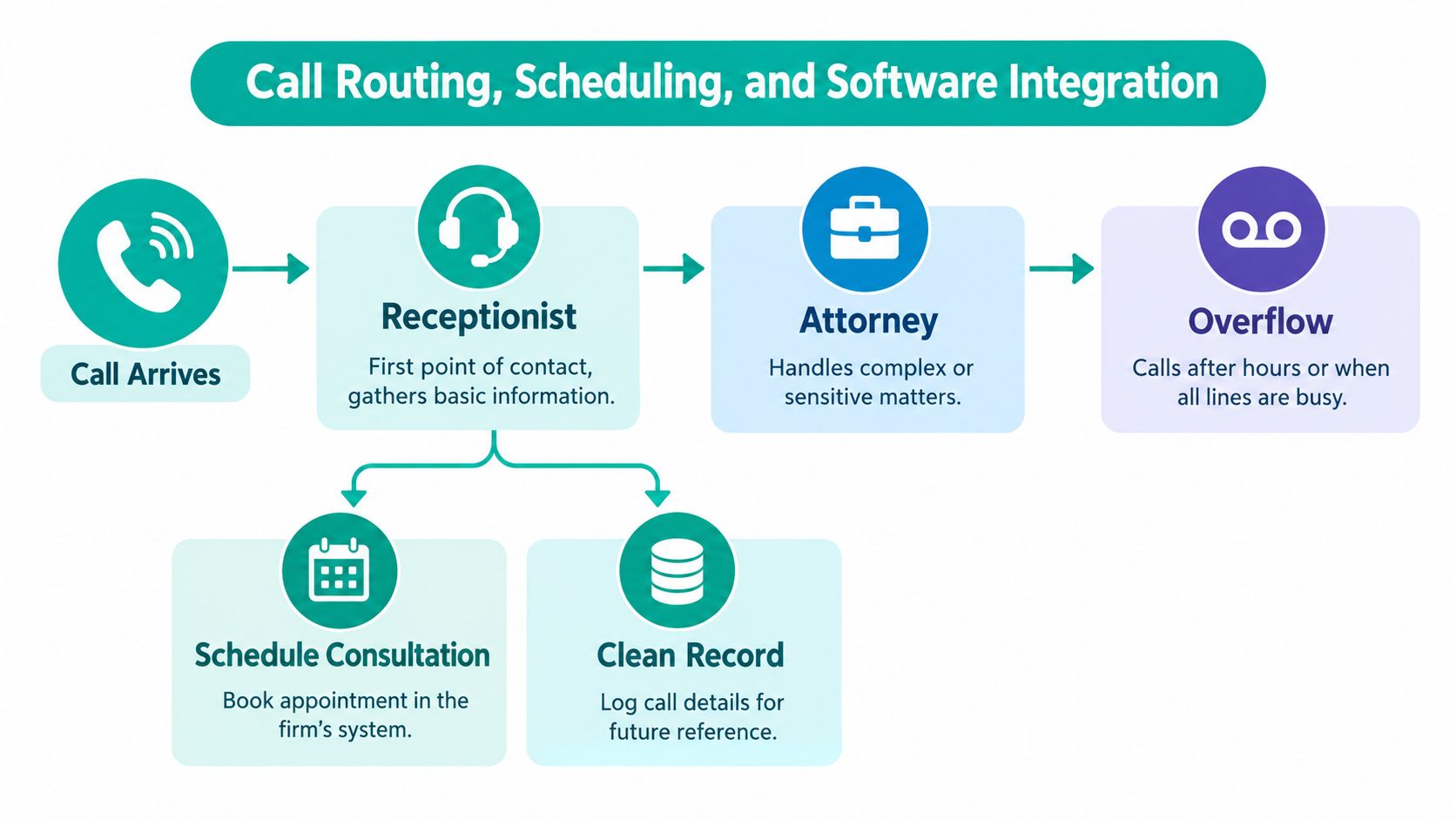
Warm transfers matter more than firms expect. Brief the attorney privately on who is calling and why, then introduce the caller. A cold transfer forces the caller to repeat a painful story and signals disorganization. For escalations, use secure internal messaging rather than repeating confidential facts aloud where others can hear.
Your receptionist may touch Clio, MyCase, Filevine, CASEpeer, SmartAdvocate, Smokeball, RingCentral, and DocketWise, depending on the practice. The tool list matters less than the connections. If the phone system, calendar, and case-management platform don't share information, you get double-booked consultations, intake notes stranded in a call log, and lead sources nobody can report on.
Appointment confirmations by text, email, or voicemail should confirm logistics only. State the firm name, date, and time. Don't include matter details, allegations, or anything you wouldn't want read by a family member holding the phone. The same restraint applies to reminders and rescheduling messages.
The fastest diagnostic I know is to pull ten recent intakes and trace each one from first ring to scheduled consultation. Every manual re-entry and every untracked handoff you find is a fixable leak.
Test the full path monthly, including after-hours routing. Systems drift when staff change, numbers are ported, or a phone tree is edited, and firms usually discover the break from an unhappy caller rather than from their own check.
Treat the reception desk as a confidentiality-controlled function. ABA guidance applying Model Rule 1.6 requires reasonable efforts to prevent inadvertent or unauthorized disclosure of information related to a client's representation, and virtual-practice guidance emphasizes competence, diligence, communication, and secure technology use ABA guidance on cybersecurity and confidentiality basics. The receptionist is usually a nonlawyer, so attorney supervision isn't optional decoration. It's the control that makes delegation defensible.
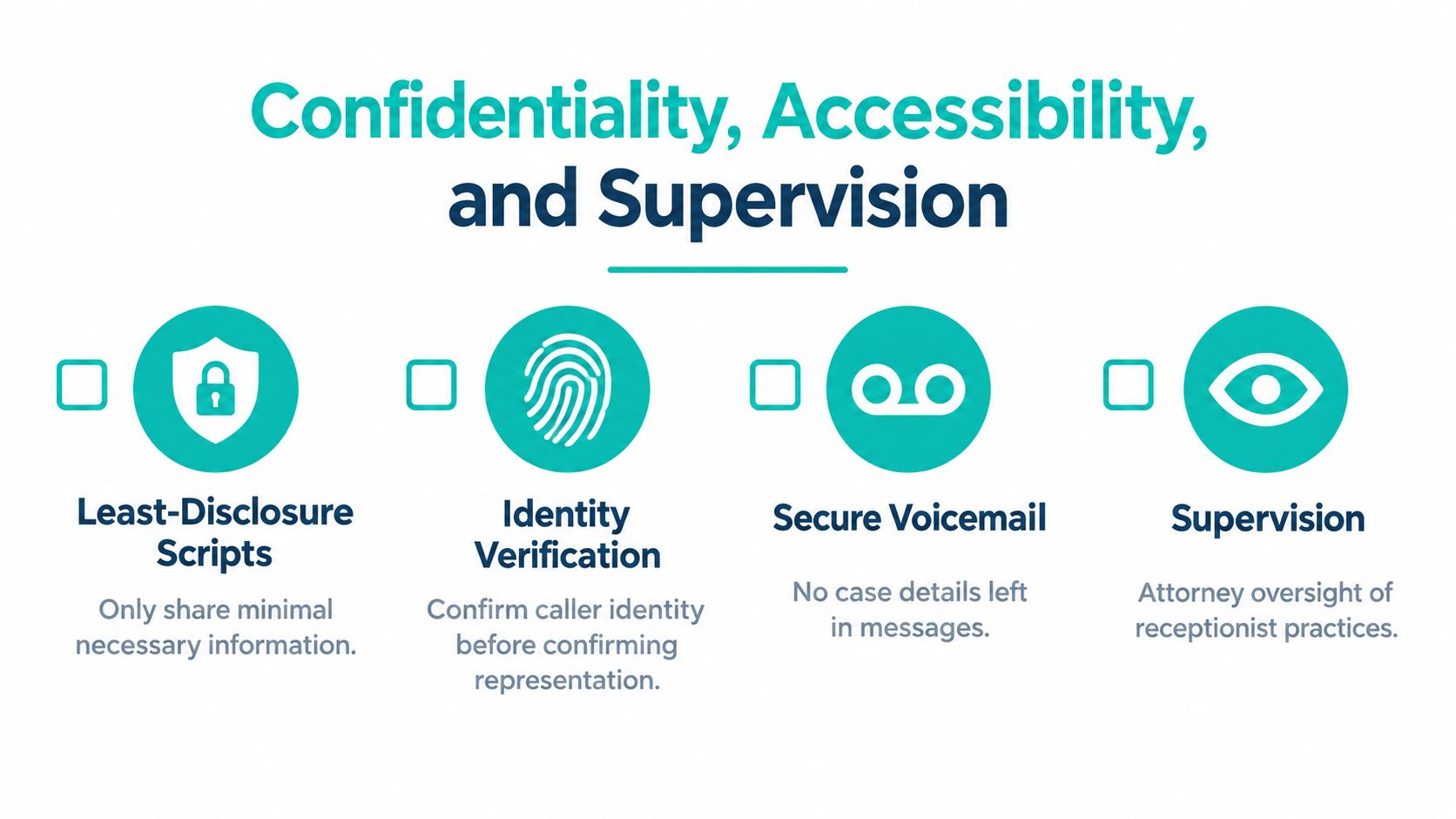
Clio specifically cautions that firms should communicate through secure channels and keep client communications confidential, which extends to how recordings, voicemail, intake forms, email, and calendars are accessed Clio guidance on responding faster through secure channels. The same discipline applies to inbox handling, so firms pairing reception with a virtual email assistant workflow should apply identical access and disclosure rules across both channels.
Write the onboarding packet down. Cover confidentiality obligations, phishing and identity verification, password management, incident reporting, shared-device rules, and the boundary between administrative intake and legal advice. Remote workspaces need explicit rules about who can overhear calls and where notes may be stored.
The U.S. Department of Justice states covered businesses must communicate effectively with people who have communication disabilities, identifying hearing-aid-compatible phones, TTY, captioned telephones, videophones, and other voice, text, or video systems as possible auxiliary aids, and staff must accept relay calls and treat them like other calls DOJ Title III primer on effective communication. Train staff not to hang up on unfamiliar relay patterns, test your phone tree with relay services, and record accommodation preferences without unnecessary medical detail.
Confirm your specific obligations with qualified counsel, since requirements vary by circumstance. Pair that advice with periodic quality audits of calls, access permissions, and vendor settings. Governance only works if someone checks it.
If you don't measure reception, you'll manage it by anecdote. A Clio study found only 56% of phone calls to law firms were answered by a person, 39% went to voicemail, more than half of firms receiving voicemails failed to respond within 72 hours, 82% of prospective clients considered timeliness important, and 79% expected a response within 24 hours U.S. Bureau of Labor Statistics occupational profile for receptionists. Those figures tell you what to instrument first. Answer rate and callback speed are where client confidence is won or lost.
Add risk and access measures alongside volume. Track accommodation resolution time and abandonment by channel so you can tell whether relay and other auxiliary-aid callers connect. Answer rate alone can look healthy while a whole group of callers fails to get through.
Review a simple dashboard weekly. Audit a sample of recorded calls monthly against your script, checking verification, data minimization, and accurate logging. Refresh scripts and routing quarterly, or sooner after a staffing or software change. When answer rate drops, check coverage and routing before blaming the receptionist. Most declines I've traced were schedule gaps, broken overflow rules, or a calendar nobody trusted enough to book into.
Set targets from your own baseline rather than borrowed benchmarks. Measure for several weeks, fix the largest leak, then remeasure. That sequence gives partners a credible story, a reception investment tied to consultations booked and risk reduced, instead of a staffing request based on feeling busy.
A law firm reception desk is a governed intake and confidentiality workflow, not a phone-answering task. Its design determines whether prospective clients reach you, whether they book and show, and whether sensitive information stays protected from the first interaction. Scripts, routing, software integration, supervision, and accessibility aren't separate projects. They're one system, and the caller experiences its weakest part.
Start this week with two moves. Write a one-page intake standard covering the five data points, verification, booking authority, and after-hours escalation. Then pull your current human answer rate and callback time as a baseline. Once you can see the numbers, the staffing choice between in-house, dedicated remote, and virtual service coverage becomes a practical decision instead of a guess.
If you need dedicated bilingual reception and intake coverage without rebuilding your workflow, VirtualLegal connects U.S. firms with pre-vetted Latin American professionals experienced in law firm call answering, routing, scheduling, and case-system updates. You interview before you hire, so you can test fit against your scripts and software first. Visit VirtualLegal to discuss the coverage model that fits your practice.