

 13 minutes read
A bad paralegal hire usually doesn't fail in one dramatic moment. It fails in small ways, the intake note that never gets updated, the follow-up call that slips a day, the file packet that reaches an attorney half-finished, the billing entry that can't be reconciled later. If you've ever taken a shortcut because a matter was piling up, you already know how fast that kind of drift turns into client frustration and wasted lawyer time.
That's why paralegal staffing agencies need to be vetted like workflow partners, not just resume suppliers. A credible agency should understand legal software, confidentiality, intake pressure, and how remote support fits your practice, especially if you're hiring across time zones. The right question isn't just who can send a candidate fastest, it's who can send someone who fits your process, your risk tolerance, and your communication style.
For medical practices reviewing remote support vendors, the logic is the same. When a staffing provider handles patient-facing or billing work, the vetting process has to cover compliance, responsiveness, and the ability to operate inside your systems without creating exposure. The same pressure-test that protects a law firm also helps a healthcare organization avoid weak handoffs and preventable mistakes.

A plaintiff-focused firm once brought in a remote contractor to handle intake calls and document coordination during a busy stretch. The caller experience looked fine on paper, but the details broke down fast, follow-ups were missed, clients repeated themselves, and the billing team spent extra time cleaning up entries that should've been recoverable from the first pass. That kind of failure doesn't usually come from laziness. It comes from a weak screening process and a poor match between the agency's vetting and the firm's actual workflow.
The legal staffing market is not a tiny side channel. One industry estimate places the U.S. legal staffing market at about $10 billion in annual revenue (legal staffing market overview). That scale matters because it explains why agencies can be a recurring workforce solution, not just an emergency backfill. Firms use them for document review, overflow support, and steady operational coverage when cases spike or internal hiring slows.
For medical practices, the lesson is practical. If a staffing provider is going to touch sensitive communication, scheduling, billing, or intake, you need more than a fast shortlist. You need evidence that the agency can screen for role fit, not just availability. A generalist marketplace may surface a warm body quickly, but a credible legal support agency should be able to explain how it checks legal software familiarity, communication discipline, and remote reliability before anyone reaches your inbox.

Practical rule: if the agency can't describe how it screens for confidentiality, tool fluency, and workflow fit, it's not really reducing your risk.
A serious agency doesn't sell speed alone. It shows how it sources, how it screens, and how it handles remote work, including contractor setup, replacement terms, and communication standards. That matters because agencies that work only from resumes often miss the details that cause placement failure later, especially in remote roles where there's less supervision and fewer chances to recover from a bad fit.
The same principle applies whether you're hiring a paralegal, a legal assistant, or a remote patient-support role. If the work depends on accuracy, confidentiality, and response time, vetting has to be part of the service, not an afterthought.
When agencies can't speak to those points clearly, the placement may still look good on a résumé, but it's much more likely to create cleanup work for your team later. For a law-firm-specific example of how remote assistant coverage fits operationally, this overview of a law-firm assistant role is a useful reference point.
The main difference between agencies is usually not the job title. It is the quality of the screen behind it. A candidate pool built from prior legal-assistant networks or law-firm referrals usually looks very different from one pulled from generalist gig platforms, because the first group is more likely to understand deadlines, confidentiality, and legal workflows.
That does not mean every strong candidate needs years in the same practice area. It does mean the agency should be able to explain how it filters for remote reliability, software familiarity, and the judgment legal and healthcare teams rely on every day. When the screen is thin, the résumé tends to matter more than the work habits, and placements start to wobble.
| Vetting Step | Minimal Screening | Strong Screening |
|---|---|---|
| Resume review | Checks titles and dates | Checks role relevance and legal workflow match |
| Software proficiency | Candidate self-reports tools | Candidate proves ability with the tools you use |
| Confidentiality review | General professionalism promise | Specific discussion of handling sensitive information |
| Background checks | Not clearly defined | Documented and role-appropriate |
| Interview process | One short call | Structured interview with role-specific questions |
| Remote readiness | Assumed from availability | Tested for response discipline and work habits |
A stronger screen should also show whether the candidate has worked in a U.S. law-firm environment before. That matters because it usually means the person has already handled intake pressure, attorney preferences, and the pace of client-facing legal support. For practices with sensitive communication patterns, that background is often more useful than general admin experience.
A candidate who knows the tools and the cadence of the work is usually easier to train than one who only knows the title.
Ask how the agency evaluates legal-software proficiency, not just whether it asks about it. The answer should include examples of tools, role-specific tasks, and how the agency checks for accuracy. If the work involves document organization, scheduling, or follow-up, the agency should be able to explain how it tests those skills before sending a shortlist.
Ask about background checks, confidentiality controls, and who conducts the interviews. A team that relies on self-reported experience can still be useful for low-risk administrative work, but it becomes a problem when the role touches privileged information, client records, or billing details. The more your workload depends on the candidate being right the first time, the more those screen details matter.
For law firms that want pre-vetted remote support, Virtual Legal Assistants connects U.S. firms with bilingual legal support professionals in Latin America, including paralegal and administrative roles, and it emphasizes prior U.S. law-firm experience, software alignment, and role-specific screening. That model is useful when you want a shortlist that already reflects the pace and structure of a law-office environment, rather than starting from raw applicants.
A shortlist is not a hire. It's the start of the evaluation. The most reliable remote hiring process combines asynchronous video responses, a live interview, and a skills test, because each stage shows something different. One step reveals communication style, another shows how the person thinks in real time, and the third proves whether the candidate can do the work.
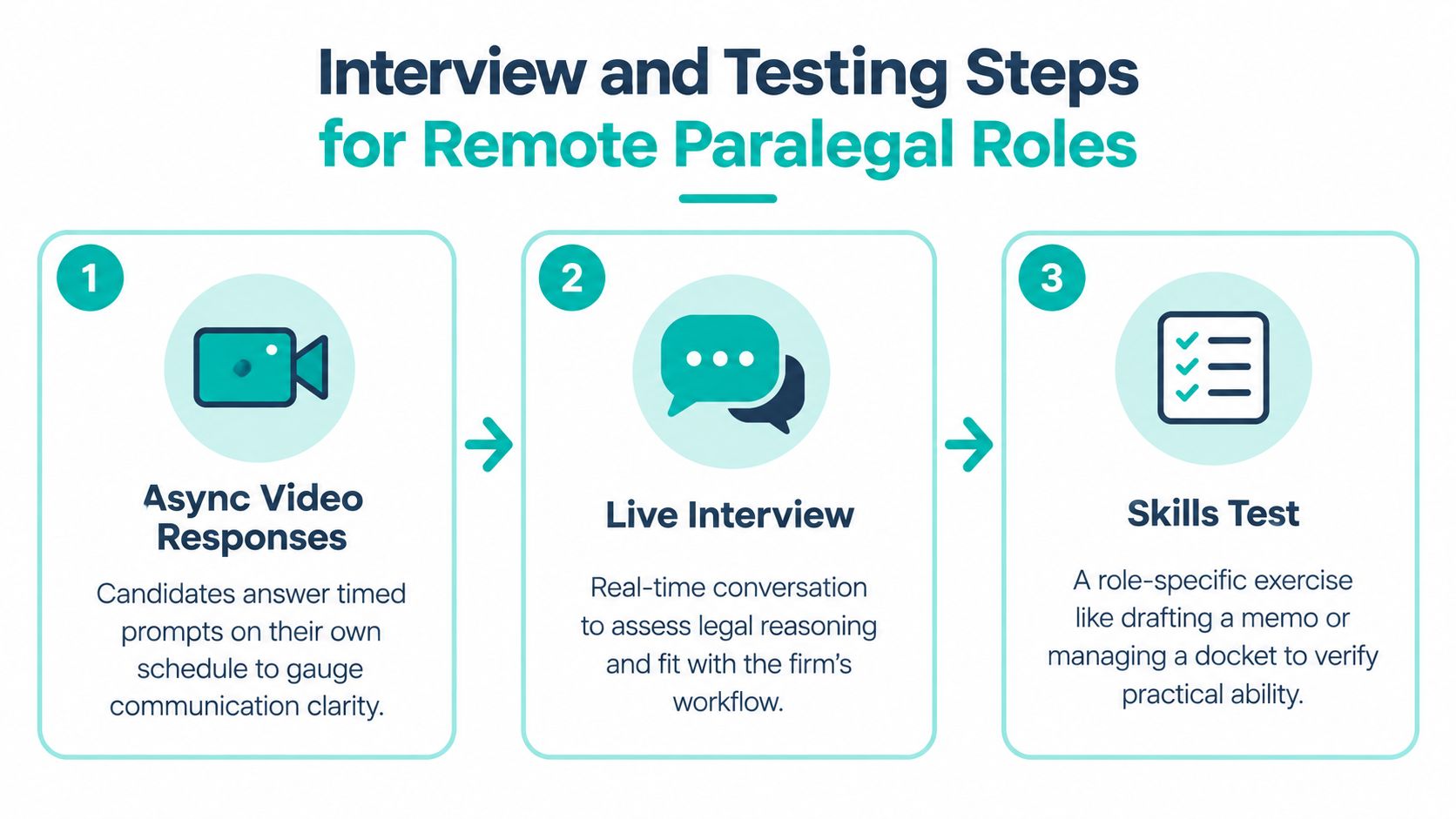
The point of the process isn't to make hiring slower. It's to catch mismatches before they show up in client communication or deadline work. In a remote environment, you can't rely on hallway corrections or casual shadowing, so the screening itself has to do more of the filtering.
If someone sounds polished but can't describe actual work behavior, that's a warning sign. So is an answer full of vague timelines, especially when the role requires daily responsiveness. Remote support succeeds when the candidate can explain how they work, not just what they've done.
An intake-heavy position needs more communication testing than a back-office support role. A document-prep role needs more accuracy and formatting review. A scheduling-focused role needs calendar discipline and follow-through. The best agencies understand that those are different jobs, even if they all sit under the broad paralegal or legal-assistant label.
Pricing looks simple until the hidden costs start showing up. Two agencies can quote a similar fee structure and still produce very different total costs once you factor in replacement cycles, onboarding time, software access, and the internal management required to make the placement work. That's why you should compare the pricing model, not just the number attached to it.
Hourly billing is common when the agency provides contractor support and bills for actual hours worked. It can be a good fit when caseloads fluctuate, but you still need to know whether the rate includes contractor-of-record services, payroll handling, or admin support.
Monthly retainer can work when you want a standing relationship and ongoing staffing support. This model often makes sense for practices with recurring needs, but the contract should spell out exactly what happens if the assigned person is unavailable or the role changes.
Project-based fees fit discrete work with a defined start and finish. They can be efficient for a matter with a clear scope, but only if the agency defines deliverables tightly enough that you're not paying extra later for scope drift.
| Pricing Model | Works Well For | Watch Closely For |
|---|---|---|
| Hourly billing | Variable workload and temporary coverage | Admin overhead, overtime handling, unclear inclusions |
| Monthly retainer | Ongoing support and steady demand | Whether replacements or changes are included |
| Project-based fees | Finite assignments with clear deliverables | Scope creep and vague completion terms |
The cost is rarely just the invoice. It's the time your team spends onboarding, reviewing, correcting, and re-explaining the work if the placement isn't a fit. If the agency is transparent, it should tell you what's included before interviews start, not after you've already invested time in candidates.
That last point matters more than many buyers expect. If the role touches protected information or sensitive client records, the staffing arrangement should reflect that reality from the start.
For an example of how one provider presents public pricing information for legal staffing engagements, Virtual Legal Assistants's cost overview is worth reviewing alongside other options. A transparent quote is easier to compare than a vague promise.
If pricing can't be explained before interviews, it's usually because parts of the service haven't been thought through carefully enough.
A remote paralegal can interview well and still miss the mark in week one if the workflow is unclear. The failure usually comes from weak onboarding, not weak ability. People get lost on where tasks live, who signs off, what needs escalation, and how quickly updates are expected. That risk grows when the role crosses time zones.
Start with the tools. The paralegal should know which systems the firm uses, where files are stored, how messages are routed, and what a finished task looks like. If the role includes scheduling or client communication, use sample scenarios instead of a welcome call alone.
Define escalation paths early. The remote hire needs to know what counts as urgent, who handles after-hours issues, and when they should pause and ask rather than guess. That protects responsiveness and work quality, which is the point of remote support.
Those basics matter whether the hire is part-time or full-time. They matter even more if your team is split across offices or time zones, because remote staff can become isolated fast when nobody defines the rhythm of work. The best onboarding plans cut ambiguity before it turns into a client-facing problem.
For teams that need a practical operating model for supervision and delegation, this guide to managing a remote legal assistant is a useful companion. It shows how remote staff work better when managers give them structure, clear checkpoints, and controlled access from the start.
The agencies worth using are the ones that make your hiring process more exact, not just faster. They should show you how they source candidates, how they screen for legal workflow fit, and how they handle remote setup, confidentiality, and replacement risk. If they can't explain those pieces clearly, the placement is probably being driven by availability instead of fit.
Treat the first shortlist like a test of the agency's discipline. Ask for screening evidence, run role-specific interviews, compare pricing in writing, and onboard with clear expectations for tools and escalation. If you do that consistently, paralegal staffing agencies become a real operational advantage instead of another source of turnover.
If you're evaluating remote legal support right now, Virtual Legal Assistants connects U.S. law firms with pre-vetted bilingual professionals who are screened for workflow fit, tools, and scheduling alignment. Visit Virtual Legal Assistants to see how their hiring process fits the kind of staffing controls described here.