

 17 minutes read
A practice manager may start the day trying to solve two very different staffing problems: appointment requests, referral documents, and billing records are piling up, while a physician-owner's calendar, inbox, and sensitive communications need constant judgment. Those problems may both be called “administrative support,” but they don't require the same hire.
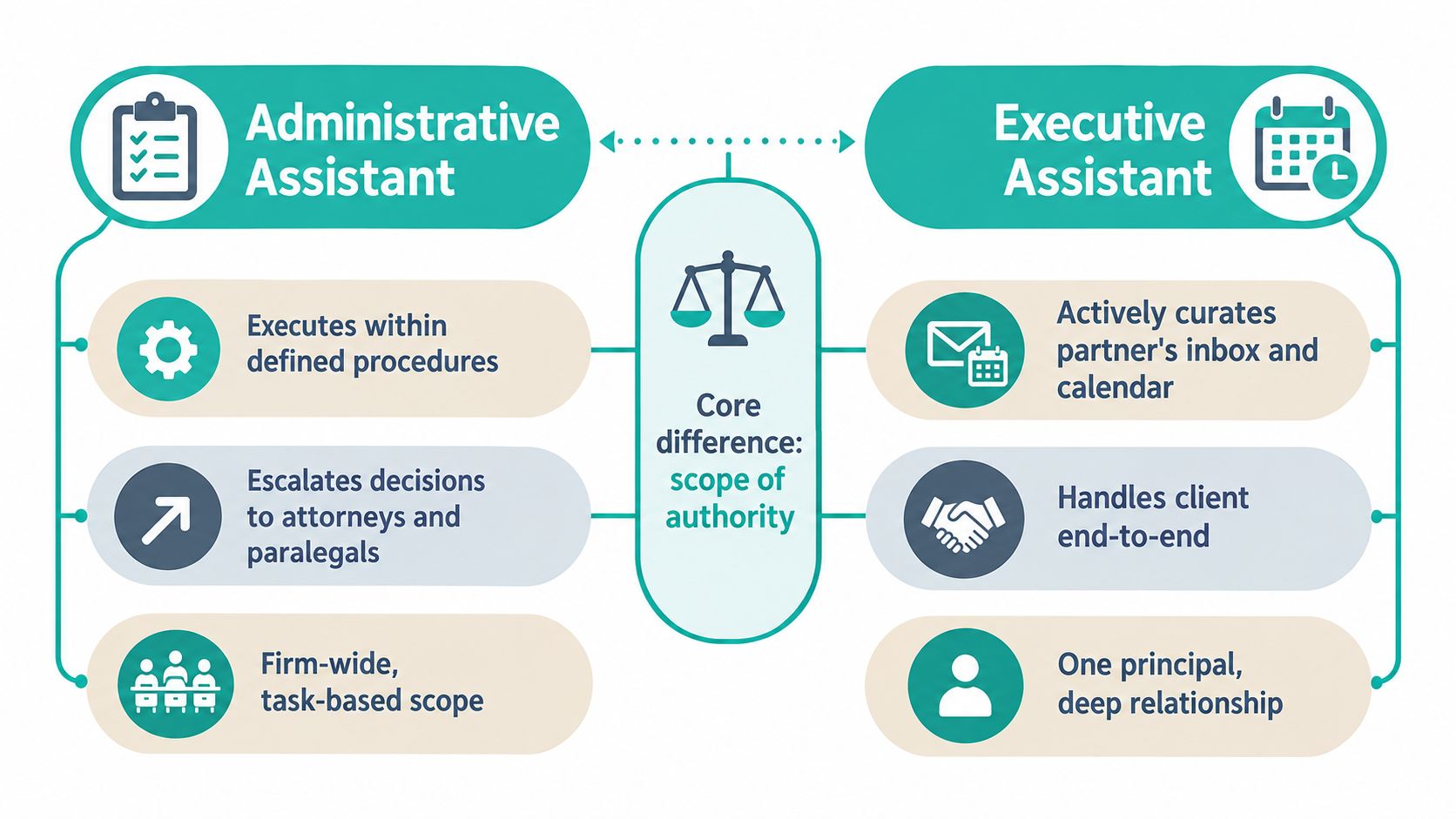
The difference between administrative and executive assistant roles is primarily scope of authority, not title prestige. An administrative assistant keeps defined workflows moving for a team, department, or practice. An executive assistant works closely with one senior leader, curates priorities, controls access, and makes delegated decisions with limited supervision. The same distinction applies in law firms, where one role may support several attorneys while the other acts as an operational gatekeeper for a managing partner.
For medical practices, this guide separates the roles by daily responsibilities, discretion, confidentiality, qualifications, compensation, remote suitability, and staffing model. It also gives you a practical way to decide whether you need a medical administrative assistant, an executive-level practice coordinator, or one hybrid professional who can cover both functions.
A managing partner needs someone to sort competing meetings, protect preparation time, and decide which requests deserve immediate attention. A law firm may instead need a reliable assistant to coordinate calendars for several attorneys, maintain billing records, format documents, and route client messages according to established procedures. Those jobs overlap, but they aren't interchangeable.
The core distinction is scope of authority. An administrative assistant generally provides routine organizational support across a department, team, office, or practice. An executive assistant provides higher-level, often individualized support to a senior leader. The U.S. Bureau of Labor Statistics overview of secretaries and administrative assistants describes administrative work such as scheduling appointments, preparing documents, maintaining files, managing email, and providing information to callers. Executive support includes those activities plus research, reports, information requests, meeting coordination, and sometimes supervision.
Use four questions before you write a job description:
In a medical practice, appointment scheduling, referral-document organization, routine inbox support, and records-related routing usually sit inside an administrative workflow. A provider-facing executive assistant may instead coordinate leadership meetings, prepare operational materials, protect the physician-owner's calendar, and route sensitive requests before they reach the provider.

Practical rule: Hire for the authority the role must exercise, not the title you want to place on the organization chart.
The BLS occupational data for executive secretaries and executive administrative assistants shows that executive support is a specialized segment of the broader administrative category. The difference isn't that one role is valuable and the other isn't. It's that the executive role carries more proximity to decision-makers, more confidential information, more complex coordination, and more responsibility for anticipating needs.
Small practices often don't need two specialists. A strong generalist can handle scheduling, patient communication, document coordination, billing support, and selected provider-facing work. Split the roles only when the practice has enough volume, complexity, or confidentiality to justify separate ownership.
Administrative assistants and executive assistants may both manage calendars, prepare documents, and coordinate communications. The deciding factor is who owns the outcome and how much judgment sits behind each task.
An administrative assistant in a medical practice may coordinate appointments for several providers, organize referral documents, update records-related systems, enter invoice information, manage routine inbox requests, and follow established escalation rules. In a law firm, the same role may handle filing coordination, intake calls, document formatting, scheduling for multiple attorneys, and billing administration.
An executive assistant may curate one physician-owner's calendar, screen and prioritize the executive inbox, draft correspondence, coordinate travel, prepare leadership materials, and serve as the first point of contact for high-value relationships. In a law firm, that person may manage a partner's access to clients, prepare meeting materials, and coordinate competing demands across firm leadership.
| Task Category | Administrative Assistant | Executive Assistant |
|---|---|---|
| Calendar management | Books appointments and meetings within defined scheduling rules, often for multiple professionals | Owns one principal's calendar, resolves conflicts, protects priorities, and controls access |
| Inbox support | Routes messages, answers routine questions, and escalates exceptions | Screens, prioritizes, drafts responses, and decides which matters reach the principal |
| Patient or client communication | Handles approved scripts, intake follow-up, scheduling, and routine status requests | Represents the principal's priorities and manages sensitive or high-value communications |
| Documents and records | Formats documents, maintains files, updates systems, and coordinates recurring paperwork | Prepares briefing materials, reports, presentations, and decision-ready information |
| Billing and expenses | Enters invoices, routes billing questions, and follows established processes | Reviews expense information for the principal, coordinates approvals, and tracks exceptions |
| Meetings | Schedules participants, sends logistics, and maintains agendas or notes | Choreographs participants, prepares the principal, tracks commitments, and follows up on decisions |
| Travel | Books routine travel according to policy | Builds travel around priorities, changes plans quickly, and coordinates multiple stakeholders |
| Escalation | Sends non-routine issues to a provider, attorney, manager, or paralegal | Resolves routine conflicts independently and escalates only matters requiring principal judgment |
The same task can carry a different level of risk. Inbox triage for a shared practice mailbox may involve routing a referral or answering a scheduling question. Inbox triage for a physician-owner may involve sensitive financial information, a patient complaint, a vendor dispute, or a request that affects the provider's schedule and reputation.
For a more law-firm-specific view of partner-facing responsibilities, compare this executive assistant duties guide. The useful lesson for medical practices is straightforward: define the assistant's decision rights before you define the task list.
Give administrative assistants ownership of repeatable processes. That might include appointment coordination, insurance verification support, referral follow-up, medical administrative documentation, billing administration, and case-system or practice-management updates.
Give executive assistants ownership of the leader's operating rhythm. That might include calendar strategy, meeting preparation, correspondence, leadership projects, confidential requests, and follow-through across departments. Neither role should diagnose patients, make clinical decisions, or perform licensed work unless the person is appropriately authorized and the assignment complies with applicable requirements.
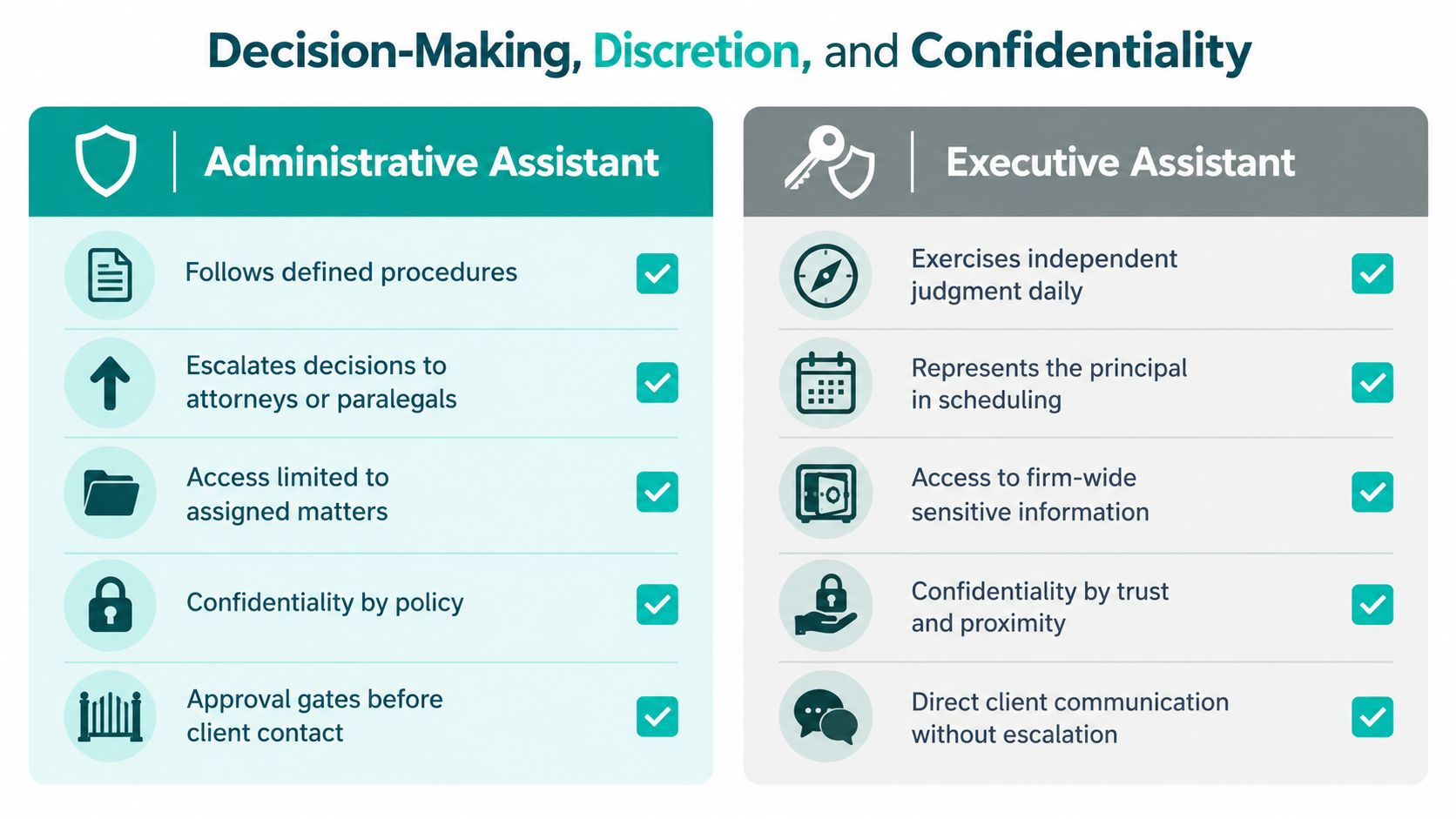
The administrative assistant executes inside defined procedures and escalates decisions to providers, managers, attorneys, or paralegals. The executive assistant receives delegated authority to decide how the principal's priorities should be represented.
That can mean declining or rescheduling a meeting, rewriting a message for the principal's review, prioritizing one request over another, or resolving a routine scheduling conflict without asking for step-by-step direction. The role isn't clinical or legal decision-making. It is judgment about access, timing, preparation, communication, and follow-through.
An executive-level role is probably justified when the assistant must:
For a medical practice, confidentiality has more than one layer. A remote assistant may access patient records, billing details, referral information, or identifiable communications even when the title says “administrative assistant.” The U.S. Department of Health and Human Services explains that an outside person or organization performing services involving protected health information may be a HIPAA business associate, and that covered entities generally need satisfactory assurances in a written business associate agreement. Review the HHS business associate agreement provisions before granting access.
HIPAA obligations and recommended security practices are not the same thing. Your practice should define minimum necessary permissions, use individual accounts, document access rules, establish incident escalation, and confirm contractual requirements with qualified compliance counsel. A background check and confidentiality agreement may also be appropriate, especially for anyone handling provider compensation, strategic plans, patient information, or sensitive client matters.
The test is not whether the assistant has an impressive title. It's whether the person can be trusted to make the right operational decision when the information is sensitive and the provider is unavailable.
The qualification gap is measurable. In 2025, prior work experience was required for 87.2% of U.S. executive secretaries and executive administrative assistants, while on-the-job training was required for 74.0%, according to the BLS occupational requirements data. For the broader secretary and administrative-assistant group, prior experience was required for 65.3% of positions, while on-the-job training was required for 87.3%.
Education requirements also vary by employer and role. The same BLS data indicates that a high-school diploma was required for 57.9% of executive-assistant roles, and occupational responses identified associate degrees, high-school diplomas, and some college without a degree among common requirements. These figures don't create a universal hiring rule. They show that executive roles more often demand evidence of judgment before the person starts.
| Dimension | Administrative Assistant | Executive Assistant |
|---|---|---|
| Typical work profile | Repeatable coordination, records, scheduling, inbox support, billing administration, and document handling | Individualized support, calendar ownership, research, reports, meeting preparation, confidential communications, and priority management |
| Training pattern | More likely to learn established processes through workplace training | More likely to require relevant experience before hiring |
| Evaluation focus | Accuracy, turnaround time, documentation habits, software use, and escalation discipline | Judgment, anticipation, stakeholder management, confidentiality, meeting readiness, and follow-through |
| Medical-practice fit | Scheduling, patient coordination, referral support, insurance verification, billing support, and practice administration | Physician-owner support, leadership coordination, sensitive communications, operational projects, and provider calendar ownership |
| Compensation benchmark | Assess by workload, coverage, complexity, and number of professionals supported | Assess by decision authority, confidentiality, calendar complexity, and direct accountability to the principal |
Compensation should follow complexity rather than title. The BLS reported a 2023 median wage of $33.80 per hour, or $70,310 annually, for executive secretaries and executive administrative assistants, with the 90th percentile at $50.00 per hour, or $104,000 annually. Those figures describe the U.S. occupational market and can vary materially by geography, employer, experience, and actual responsibilities.
A medical practice should price the role against concrete requirements: the number of providers supported, calendar volume, response-time expectations, software proficiency, confidentiality tier, and escalation authority. Don't pay an executive premium for a position that mainly needs accurate scheduling and document routing. Don't hire a low-cost task executor when the physician-owner expects someone to protect time, manage access, and resolve competing demands.
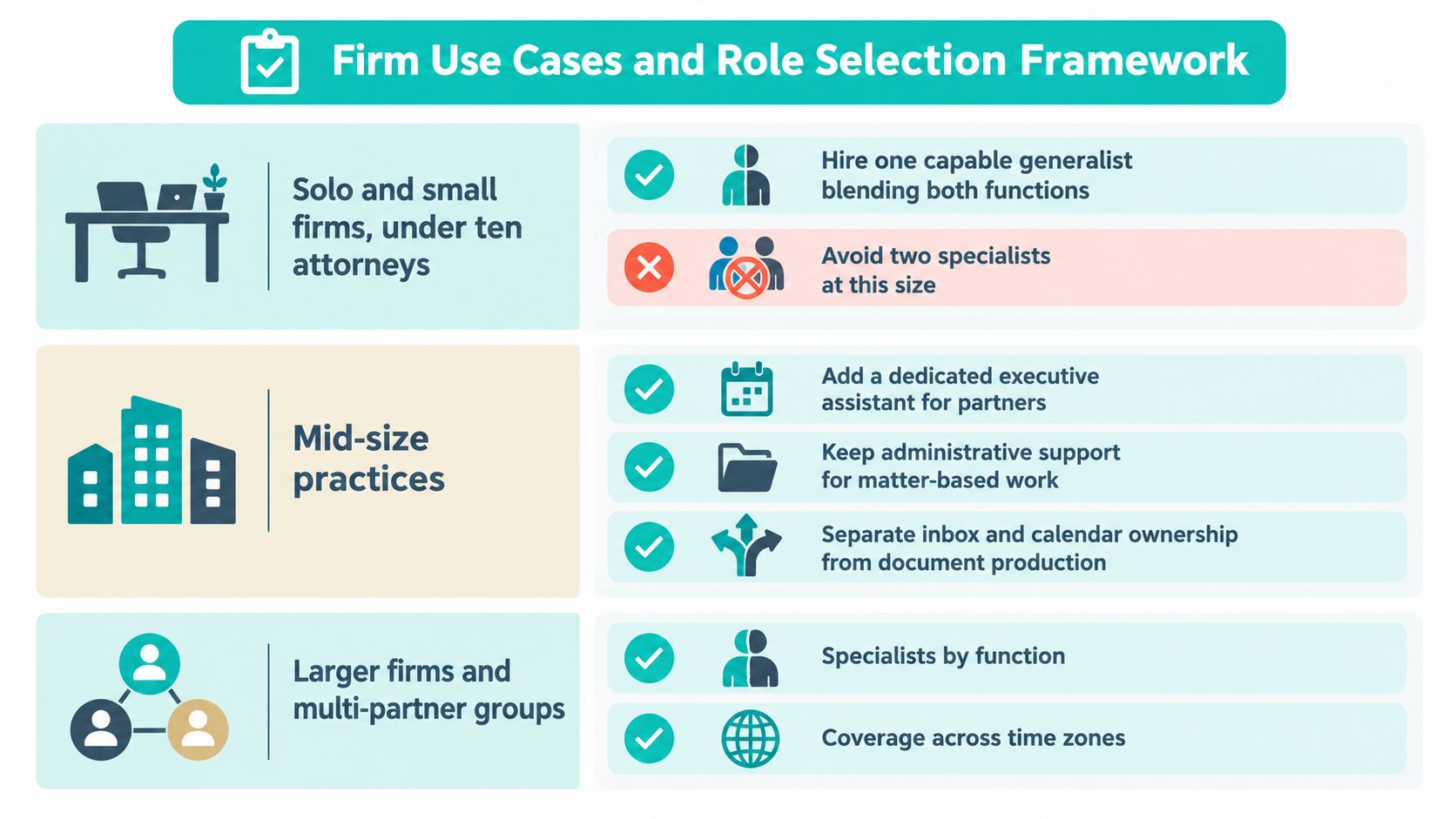
A solo practice or small office often needs one capable generalist. That person may combine appointment scheduling, patient follow-up, referral coordination, billing administration, inbox handling, and limited executive support for the physician-owner. Hiring two specialists too early can create handoffs without solving the underlying workload.
A growing medical practice may need separate ownership. One assistant can manage patient coordination, insurance verification, prior-authorization support, records-related routing, and recurring administrative work. Another can support the physician-owner or leadership team with calendars, confidential communications, meetings, and operational projects.
The same logic applies to law firms. A practice group may use administrative support for filings, logistics, billing, and document coordination, while executive assistants remain aligned to managing partners and practice leaders. A larger organization may need specialists by function and coverage across time zones rather than one person expected to master every workflow.
Who owns the work? If the assistant supports several providers or a department, start with an administrative role. If one leader's priorities determine the workload, define an executive-assistant role.
How much judgment is required? Scheduling within rules points to administrative support. Reordering priorities, controlling access, and resolving exceptions points to executive support.
What information will the assistant access? Patient records, billing information, referral details, and identifiable communications require documented privacy controls. Provider compensation, strategic planning, and leadership materials raise the trust threshold further.
What breaks if the role is vacant? If missed tasks create backlogs in scheduling, intake, or records routing, hire for workflow reliability. If the provider loses control of time, relationships, and high-value decisions, hire for executive support capacity.
Use this law-firm assistant staffing guide as a parallel framework when comparing matter-based support with partner-facing support. For medical practices, translate “matter-based work” into patient access, referral, billing, and records workflows.
A useful job description should name the systems and boundaries. Specify whether the assistant will use a practice-management platform, coordinate with patients, handle insurance-related documentation, communicate with referral sources, or support a provider directly. State what the person may decide independently and what must always be escalated.
Remote staffing works well when the output is digital, the process is documented, and the practice can control access. Calendar triage, inbox routing, appointment scheduling, referral follow-up, expense processing, billing administration, and practice-management system updates can often be assigned remotely. A remote medical receptionist or patient coordinator can also support live communication when schedules overlap with the practice's working hours.
Remote work is a poor fit when the role depends on physical files, onsite errands, sealed materials, hands-on equipment, or frequent in-person meetings. A practice may still use a hybrid model, with remote administrative support for digital workflows and onsite coverage for physical logistics. A law firm may need the same arrangement for courtroom materials, deposition support, or documents that cannot leave the office.
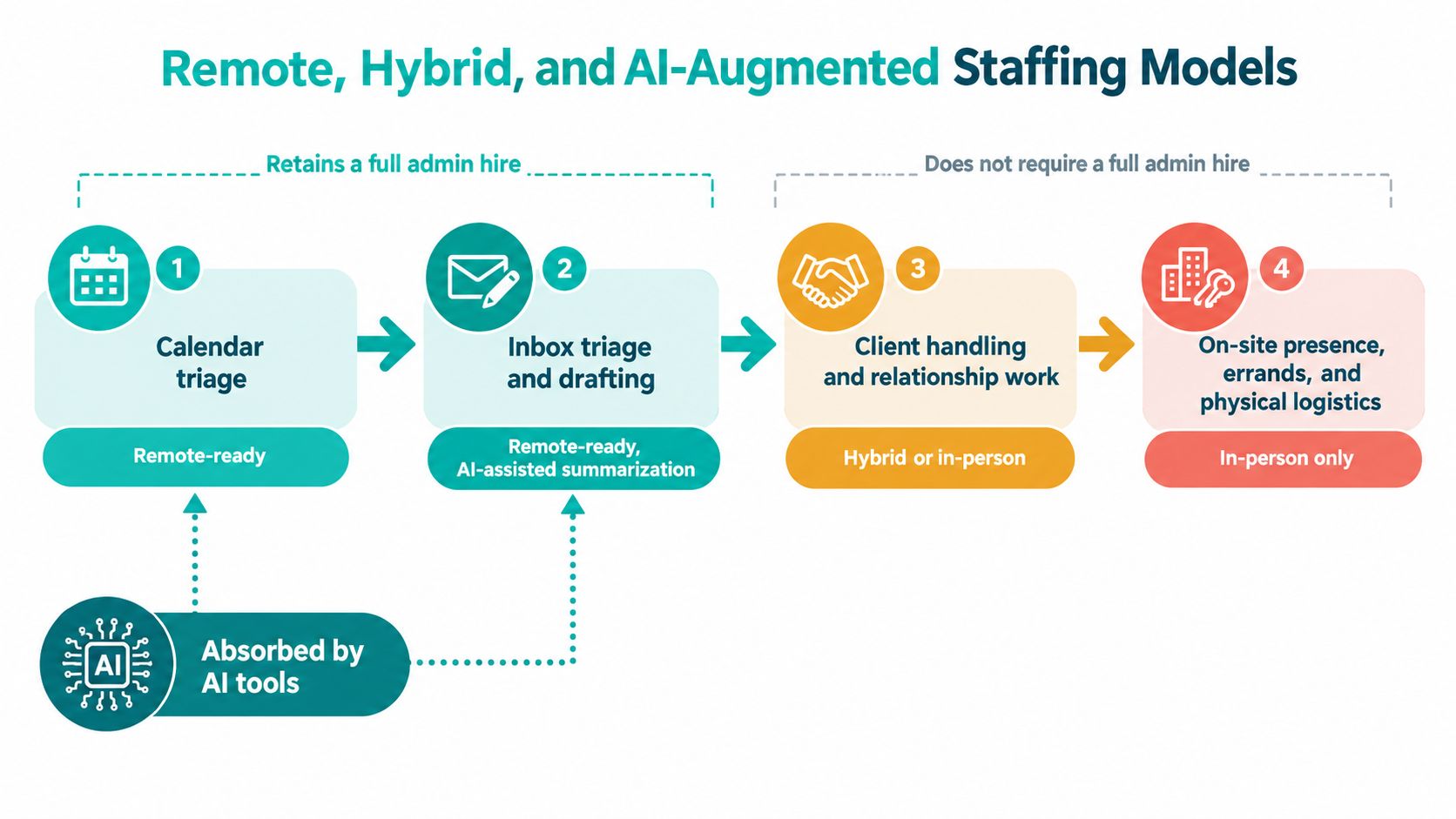
AI tools can assist with drafting, document organization, scheduling suggestions, transcription, and structured summaries. That doesn't remove the distinction between assistant roles. It changes which tasks deserve human attention.
KPMG reported that 66% of surveyed organizations were using AI agents for administrative duties in April 2025, up from 27% in its earlier measurement, as described in its AI Pulse survey coverage. The relevant question for a medical practice isn't whether software can produce a draft. It's who verifies the draft, protects sensitive information, identifies an exception, and decides when a patient or provider issue requires escalation.
A 2025 survey of administrative professionals found that 76% believed AI would enhance rather than replace the need for strong human skills, while 72% reported receiving no soft-skills training during the prior year, according to the cited profession report. The practical implication is clear: train assistants in judgment, privacy, communication, and exception handling instead of measuring value only by automated task volume.
Use automation with approval gates. An assistant may use a transcription or summarization tool, but a qualified human should verify patient-facing or provider-facing output before it is sent. Do not place protected health information into a tool until your compliance team has confirmed the vendor, contract, permissions, and workflow are appropriate.
For practices that want to evaluate a structured remote staffing arrangement, remote legal assistant management support offers a useful comparison point for supervision, workflow documentation, and communication discipline. The same operating principles apply to remote healthcare staff, with HIPAA-specific controls added.
Make the hiring decision in four steps. Start by classifying the workload, then map confidentiality, benchmark the cost against complexity, and test the hybrid model before committing to a permanent structure.
Create a list of recurring work from the previous operating cycle. Mark each task as routine, exception-based, or principal-facing. Scheduling, filing, intake, patient follow-up, billing support, and system updates generally indicate an administrative need when the procedures are clear.
Calendar ownership across several partners or providers, board-level or leadership coordination, sensitive correspondence, and direct control over executive access indicate an executive need. If the role must continually decide what the principal should see, when the principal should respond, and which meeting deserves priority, an executive assistant is not optional.
Separate access into practical tiers. One tier may cover scheduling and general communications. Another may include patient records, billing information, and referral details. A higher tier may include provider compensation, strategic plans, acquisition discussions, or sensitive client information.
Give each tier only the permissions required for the assigned work. Document escalation rules, review agreements with qualified counsel or compliance professionals, and make privacy expectations part of onboarding rather than an afterthought.
Use measurable operating requirements instead of title assumptions:
The BLS executive-assistant wage benchmark can inform U.S. compensation discussions, but it shouldn't replace a role-specific assessment. A remote administrative assistant may be the right investment for a large queue of repeatable work. An executive assistant costs more because the practice is buying judgment, access control, and direct support around a principal.
A solo or small practice should ask one direct question: Is the bottleneck the office, or is it the provider? If the office is the bottleneck, start with an administrative generalist. If the provider is the bottleneck, start with executive support. If both are constrained, test one hybrid professional with clearly separated blocks of responsibility.
Use a 30-day pilot checklist:
The right answer to the difference between administrative and executive assistant roles is not a more impressive title. It's a precise match between authority, confidentiality, workflow complexity, and the leader or team being supported.
Virtual Legal Assistants connects U.S. law firms with pre-vetted remote professionals for administrative assistance, intake, case management, reception, and executive support, including bilingual English-Spanish talent aligned with U.S. working hours. Review candidate options and staffing terms at Virtual Legal Assistants, then choose a role based on the workflows and decision rights your firm needs.
An administrative assistant is the right choice when your practice needs reliable execution across scheduling, documents, intake, billing, records, and recurring coordination. An executive assistant is the right choice when one provider, partner, or leader needs someone to control access, prioritize competing demands, manage confidential information, and anticipate what comes next.
Start with scope and authority, not title. Define the systems the person will access, the decisions they may make, the work that must be escalated, and the outcomes you'll review during a pilot. A hybrid assistant can serve a small organization well, but only when the role's administrative and executive responsibilities are clearly separated.