

 15 minutes read
Generic offshore virtual assistants cost $4 to $20 per hour, while U.S. specialists charge $25 to $45 or more. Bilingual legal virtual assistants from managed LATAM providers typically cost around $12 per hour, offering a practical balance between U.S. workflow alignment and cost efficiency.
That answer challenges the most popular advice about virtual assistant fees, which is to choose the lowest advertised hourly rate. A law firm isn't buying minutes on a timesheet. It's buying reliable intake, accurate calendar management, clean case-system updates, timely client follow-up, and attorney capacity that would otherwise be consumed by routine work.
A comparison must weigh headline rate and effective hourly cost. A low-cost generalist may require extensive instruction, create rework, or leave after the firm has invested time in training. A specialized assistant with legal-software experience may cost more per hour but deliver more productive hours with less supervision. This guide explains the market tiers, the premium created by legal specialization, the hidden costs of freelance marketplaces, and a practical way to calculate attorney leverage before you approve a remote staffing budget.
The lowest hourly rate rarely produces the lowest cost for a law firm. A marketplace listing at a few dollars per hour can look attractive until someone accounts for screening, interviews, onboarding, software training, quality control, missed follow-ups, and the attorney or manager time spent correcting preventable errors.
Legal support also carries a workflow premium. A person who can manage a generic inbox isn't automatically prepared to handle a consultation pipeline, request medical records, update a matter in Clio or Filevine, follow a filing checklist, or communicate with clients in a way that reflects a firm's procedures. Those tasks depend on judgment about process, not legal advice, but process errors still consume staff time and can damage client confidence.
The headline rate is what a vendor or freelancer advertises. The effective hourly rate is what the firm pays for usable output after adding management time, setup, software access, replacement costs, and unproductive capacity.
A $6-per-hour assistant who needs constant correction may be more expensive than a $12-per-hour legal assistant who completes a defined workflow independently. The difference isn't just speed. It's whether the assistant can follow the firm's intake script, recognize when a task needs escalation, document the next action, and keep the matter moving without making the attorney reconstruct what happened.
One legal staffing benchmark cites virtual legal assistant rates of about $6 per hour for intake and administration and $10 per hour for legal assistant work, while another benchmark places a dedicated virtual legal assistant at an average of $9.60 per hour across 2,015 hires and 51 standardized roles. The same source contrasts a support cost of $6 to $10 per hour with an average attorney billing rate of $349 per hour, illustrating why delegation can create significant advantage when the transferred work is properly scoped. See the published remote legal assistant pricing benchmarks for the underlying figures.

Practical rule: Budget for productive work delivered, not access to a person's time.
Attorney leverage means moving work away from a provider or senior employee who can use that time for higher-value legal work. Calendaring, intake follow-up, records requests, document preparation, billing administration, and case-status updates can all be candidates, provided the firm defines the boundaries clearly.
That doesn't mean every task should be delegated. Legal analysis, strategy, client advice, supervision of legal work, and decisions reserved to licensed professionals remain with the appropriate people. A remote assistant can prepare information, organize documents, and route an issue. The attorney still makes the legal decision.
Before comparing quotes, list each task and classify it:
A sensible budget starts with the first three groups and establishes an escalation path for the fourth. Firms that need help defining responsibilities can use a structured guide to managing a remote legal assistant before comparing providers.
Virtual assistant fees don't form one universal market rate. They separate into bands shaped by geography, labor-market expectations, service depth, language ability, time-zone overlap, and whether a provider supplies management or replacement support.
A widely cited 2026 benchmark based on 394 U.S. profiles places the average U.S. virtual assistant rate at $19.45 per hour, with a reported range of $12.21 to $29.66 per hour. The same benchmark cites a worldwide survey of 147 virtual assistants, reporting an average of $31.48 per hour, with U.S.-based assistants averaging $35.61 per hour and Philippines-based assistants averaging $11.33 per hour. Those figures show why a single “average VA rate” can mislead a law firm comparing markets. The 2026 virtual assistant pricing benchmark provides the source context.
Low-cost offshore generalists typically fall around $4 to $20 per hour, according to a 2026 cost comparison covering 14 companies. That guide reports U.S. assistants commonly charging $25 to $45 per hour, offshore assistants in India or the Philippines commonly charging $4 to $20 per hour, and a broader range of $7 to $65 per hour depending on location, experience, and skill set. This tier can work well for tightly documented administrative tasks that don't require frequent live collaboration.
Mid-range global freelance support sits between entry-level offshore work and premium domestic specialists. These assistants may bring stronger written communication, bilingual ability, legal software experience, or more ownership of a workflow. The firm often pays for greater reliability and overlap rather than just for a different country of residence.
Higher-cost U.S. specialists generally serve firms that need domestic labor-market alignment, detailed administrative ownership, or a narrow professional skill set. A U.S. specialist can be the right choice when the role requires local presence, extensive same-day coordination, or an employment structure the firm prefers to manage directly. The premium isn't automatically wasteful, but the firm should connect it to a defined operational requirement.
| Tier / Model | Typical Hourly Rate | Best Use Case for Law Firms |
|---|---|---|
| Offshore generalist | $4 to $20 | Documented back-office work, data entry, basic scheduling, and routine administrative support |
| Global freelance or specialized support | Varies by geography, experience, and service depth | Intake, bilingual communication, case coordination, and software-specific workflows |
| U.S. virtual assistant | $25 to $45 typically | Client-facing coordination, domestic workflow overlap, and higher-touch specialist support |
| U.S. specialist or premium support | $45 or more in some models | Complex systems work, senior administrative ownership, or narrow expertise |
These bands should guide questions, not replace them. Ask what the rate includes, who manages the assistant, whether software access is included, how coverage works during absence, and what happens if the match fails. A $12 rate with structured onboarding may be more useful than a lower rate that leaves the firm responsible for every operational detail.
The gap between U.S. and Philippines averages in the cited worldwide survey is $24.28 per hour, a difference of more than 200% per hour. That spread explains why global staffing is attractive, but it doesn't prove that the lowest-cost market suits every law firm.
A personal injury firm may need live intake and rapid lead follow-up. An immigration practice may value bilingual English-Spanish communication and consistent client reminders. A firm handling document-heavy litigation may care more about careful file organization and software proficiency than phone coverage. The right tier follows the workflow.
A generic administrative assistant and a legal virtual assistant may both manage calendars, but the similarity ends quickly. Legal support requires familiarity with matter-based work, confidentiality expectations, escalation rules, client communication, and the firm's case-management software.
A recent benchmark places offshore generalist virtual assistants around $8 to $20 per hour, U.S.-based assistants around $25 to $45 or more, and specialist assistants, including technical or bookkeeping support, at $15 to $75 or more. It also notes that monthly packages may bundle hours, software, and management, which can raise the effective hourly cost when those services are included. The legal and administrative virtual assistant pricing benchmark explains the role-complexity premium.
A legal receptionist or appointment scheduler may need a clear script, reliable phone coverage, and accurate calendar handling. An intake specialist needs stronger communication skills and a defined process for recording facts, routing leads, and booking consultations. A case manager may need to track milestones, follow up with clients, and maintain consistency across active matters.
Billing support, records requests, and document preparation sit in different places on the risk and skill spectrum. The more a role owns a workflow, touches multiple systems, or communicates directly with clients, the less useful it is to compare that role with basic data entry.
Use a responsibility matrix before you request quotes:
| Role | Core responsibility | Skills to verify |
|---|---|---|
| Intake specialist | Lead response, qualification, follow-up, and consultation booking | Communication, scripts, CRM or case-system updates |
| Legal assistant | Matter support, document preparation, and filing coordination | Legal workflow familiarity, accuracy, document handling |
| Case manager | Milestone tracking and client follow-up | Organization, escalation discipline, case-management experience |
| Billing support | Invoice preparation, payment follow-up, and administrative records | Billing procedures, spreadsheet accuracy, software experience |
| Administrative assistant | Calendar, inbox, documents, and back-office coordination | Prioritization, written communication, dependable execution |
A firm shouldn't pay a specialist premium for tasks that require only a written checklist. It also shouldn't assign client-facing or systems-heavy work to an inexpensive generalist without testing the relevant skills. The legal virtual assistant task guide can help managers separate routine delegation from work that needs deeper legal workflow experience.
Clio, MyCase, Filevine, CASEpeer, SmartAdvocate, Smokeball, RingCentral, and DocketWise all support different processes and permissions. An assistant doesn't need to master every platform, but a firm should verify the tools that matter to the role.
Software experience reduces the time required to explain basic navigation and helps the assistant understand where a task belongs. It doesn't eliminate training. Every firm should still provide role-specific procedures, access controls, templates, and escalation instructions.
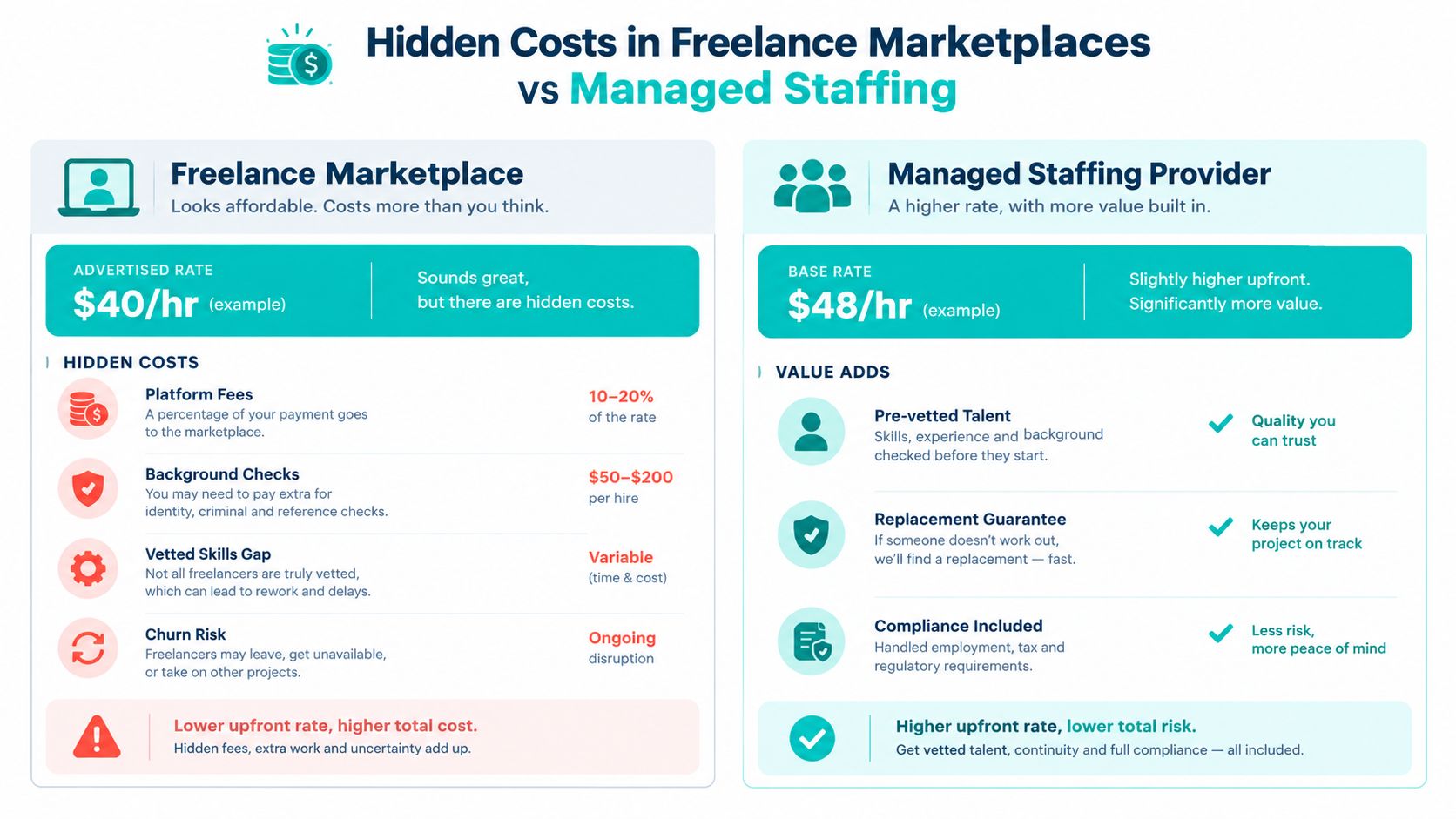
Freelance marketplaces give law firms access to a broad talent pool, but the advertised rate usually represents only the assistant's labor. The firm still carries the work of sourcing, screening, checking references, confirming skills, handling contracts, granting access, supervising output, and replacing the person if the arrangement fails.
Managed staffing costs more visibly because it bundles some of that work into the service. A provider may handle candidate vetting, international payroll, onboarding, account management, and replacement support. The comparison is fair only after both models are normalized to the same scope.
Start with the proposed hourly or monthly fee. Then add every cost the firm would incur under that hiring model:
A marketplace rate may still win when the firm has an experienced operations manager, a mature training system, and enough internal capacity to handle hiring. A managed provider may be more economical for a solo attorney or small practice that can't spare several days for candidate evaluation and onboarding.
Ask each provider to state the same information:
Package pricing isn't automatically better than hourly pricing. Hourly billing suits variable workloads and early pilots. A monthly package can work better when the assistant owns a stable queue such as intake follow-up, calendar management, or billing administration. The key is to define the deliverable and monitor productive output rather than assuming that purchased hours equal completed work.
A legal email assistant, for example, should have a documented queue, response standards, routing rules, and a clear boundary for messages that require attorney review. Firms considering that role can review the responsibilities of a virtual email assistant before requesting a proposal.
The simplest ROI model compares the assistant's fully loaded cost with the value of attorney or senior staff time recovered. It shouldn't assume every recovered hour becomes billable. Some hours may improve client service, reduce backlog, prevent missed work, or allow the attorney to take on matters that otherwise would have been delayed.
The legal-industry benchmark cited earlier uses an average attorney billing rate of $349 per hour and compares it with remote legal support priced at $6 to $10 per hour. That is a market illustration, not a promise that every delegated hour becomes revenue. Your calculation should use the actual work recovered, the person who receives the time, and the realistic percentage of that time that can be used productively.
Use this formula:
Monthly value delivered = recovered productive hours × value per productive hour
Then calculate:
Net monthly contribution = monthly value minus all-in assistant cost
For a personal injury firm, transferred work might include medical-record follow-up, intake scheduling, client reminders, and case-system updates. For an immigration practice, it might include consultation booking, document-request tracking, bilingual follow-up, and administrative status updates. In both examples, the assistant supports the workflow but doesn't provide legal advice or make legal decisions.
Track the baseline before hiring:
After implementation, compare output and quality rather than just logged hours. Did the assistant complete the assigned queue? Were escalations routed correctly? Did the attorney spend less time on administration? Did the firm maintain accurate records?
The strongest first tasks have four characteristics:
Calendar coordination is often a good starting point because the output is easy to inspect. Intake follow-up can also be highly valuable when the firm provides approved scripts and escalation rules. Records requests and document preparation may work well after the assistant understands naming conventions, filing standards, and matter permissions.
Don't begin with every administrative task at once. Start with one workflow, define ownership, and create a short quality-review period. Expand the role only after the assistant consistently handles the first queue without creating additional work for the attorney.
Paying a premium for legal experience or software familiarity can be rational when the cost of confusion is high. A candidate who understands U.S. law-firm pace, client confidentiality expectations, and systems such as Clio or Filevine may reach useful productivity faster than someone with a lower rate but no relevant context.
That advantage still needs verification. Ask candidates to complete a practical assessment, explain how they would escalate an uncertain client message, and demonstrate how they would document a task in the relevant system. The firm should verify references and define access permissions before the assistant handles live matters.
Virtual assistant fees should be evaluated as an all-in operating cost, not a marketplace sticker price. Offshore generalists may suit structured back-office work, U.S. specialists may fit high-touch requirements, and managed bilingual LATAM talent can provide a useful middle path for firms that need English-Spanish communication, U.S. schedule overlap, and familiarity with legal workflows.
Before hiring, identify one recurring queue, document the expected output, and calculate the value of the attorney or senior employee time it could recover. Compare hourly or monthly quotes only after adding supervision, software, onboarding, continuity, and replacement considerations. Confirm who handles payroll, contracts, access, quality review, and coverage.
A transparent proposal should state the role, hours, deliverables, included support, management responsibilities, and replacement terms. It should also make clear which work remains with attorneys and licensed professionals. That approach gives practice managers a defensible budget and reduces the risk of choosing a low rate that produces little usable capacity.
Virtual Legal Assistants connects U.S. law firms with pre-vetted bilingual legal support professionals in Latin America for roles such as intake, reception, case coordination, legal assistance, and administration. Visit Virtual Legal Assistants to review interview-before-hire staffing options aligned with your firm's schedule, software, and workflow.