
 16 minutes read
A caller reaches your firm while you're in court, your paralegal is speaking with an existing client, and the office line rolls to voicemail. The caller may never try again, and your team may not know what was missed. That situation is common enough to make receptionist coverage an operational issue, not merely a convenience.
A law firm virtual receptionist can answer calls, manage website inquiries and live chat, capture structured intake information, route urgent matters, and schedule consultations. The useful version is not a person who just writes down a name and phone number. It's a supervised intake workflow with defined scripts, conflict-screening fields, secure system access, escalation rules, and measurable service levels.
The choice still involves trade-offs. A generic answering service may provide coverage but lack legal-specific judgment. A dedicated remote receptionist can follow your procedures closely but needs training, access controls, and ongoing supervision. This guide explains how to define the role, build call routing and scheduling, integrate tools such as Clio and RingCentral, measure performance, and hire support without creating new confidentiality or unauthorized-practice risks.
At 11:20 a.m., a new caller reaches the firm while the lawyers are in hearings and the front desk is tied up with existing clients. If the only backup is voicemail, the firm loses more than a call. It loses the chance to collect the facts needed for a safe, timely next step. That is why the modern law firm virtual receptionist role should be built as a controlled intake function, with supervision, documented limits, and clear handoffs.
The market has already moved in that direction. The American Bar Association's 2022 Legal Technology Survey found that 80% of surveyed firms didn't offer live chat, while only 3% were certain that their firms did offer it. Among firms that offered live chat, 63% said a virtual receptionist handled it, compared with 25% using an in-house receptionist. In other words, where firms did provide that front-door coverage, virtual reception was the most common staffing model.

In practice, the job is broader than answering the phone. It usually includes identifying who is calling, separating prospective clients from existing clients and third parties, collecting intake details in approved fields, scheduling consultations, responding to website inquiries and live chat, flagging urgent matters, and creating a complete task for follow-up.
The difference is discipline. A written list of law firm receptionist's responsibilities should describe observable actions, not vague expectations. “Be professional” is hard to train and harder to audit. “Confirm whether the caller is a current client, capture opposing-party names for screening, transfer court calls to the assigned team, and timestamp every qualified lead” gives supervisors something they can monitor.
That level of specificity protects the firm as much as it improves service.
Coverage alone is not enough. A receptionist can answer every call and still create risk if the intake record is incomplete, if urgent matters sit in a queue, or if the caller receives statements that sound like legal advice. I have seen firms focus on speed to answer and ignore what happens after the greeting. The result is a clean call log and a messy intake pipeline.
The right workflow depends on the practice. A personal-injury intake may need accident details, injury status, insurance information, and adverse parties. A family-law intake may need hearing dates, existing orders, whether children are involved, and whether the caller already has counsel. An immigration practice may need the caller's preferred language, current procedural stage, and upcoming deadlines. These are administrative screening fields. They help the lawyer decide what happens next. They do not authorize the receptionist to advise the caller.

Practical rule: The receptionist's job is to improve the attorney's next decision, not to make that decision on the attorney's behalf.
That boundary matters because legal reception sits close to confidentiality, conflicts, and unauthorized practice concerns. Trained and supervised nonlawyer staff can support intake, but firms still need clear limits on what may be discussed, what must be escalated, and what must wait for a lawyer. ABA Formal Opinion 506 describes nonlawyer work that can be delegated with proper supervision, including collecting initial matter information, performing an initial conflict check, determining whether the inquiry concerns an area the firm handles, explaining approved process information, and obtaining a prospective client's signature on the firm's agreement.
The line is crossed when the caller asks what legal action to take, wants individualized advice, seeks fee negotiation outside approved rules, or asks for interpretation of the engagement agreement. Those issues belong with a lawyer. A strong virtual receptionist setup accepts that trade-off. It gives the receptionist enough structure to move matters forward efficiently, while keeping judgment calls, advice, and exception handling where they belong.
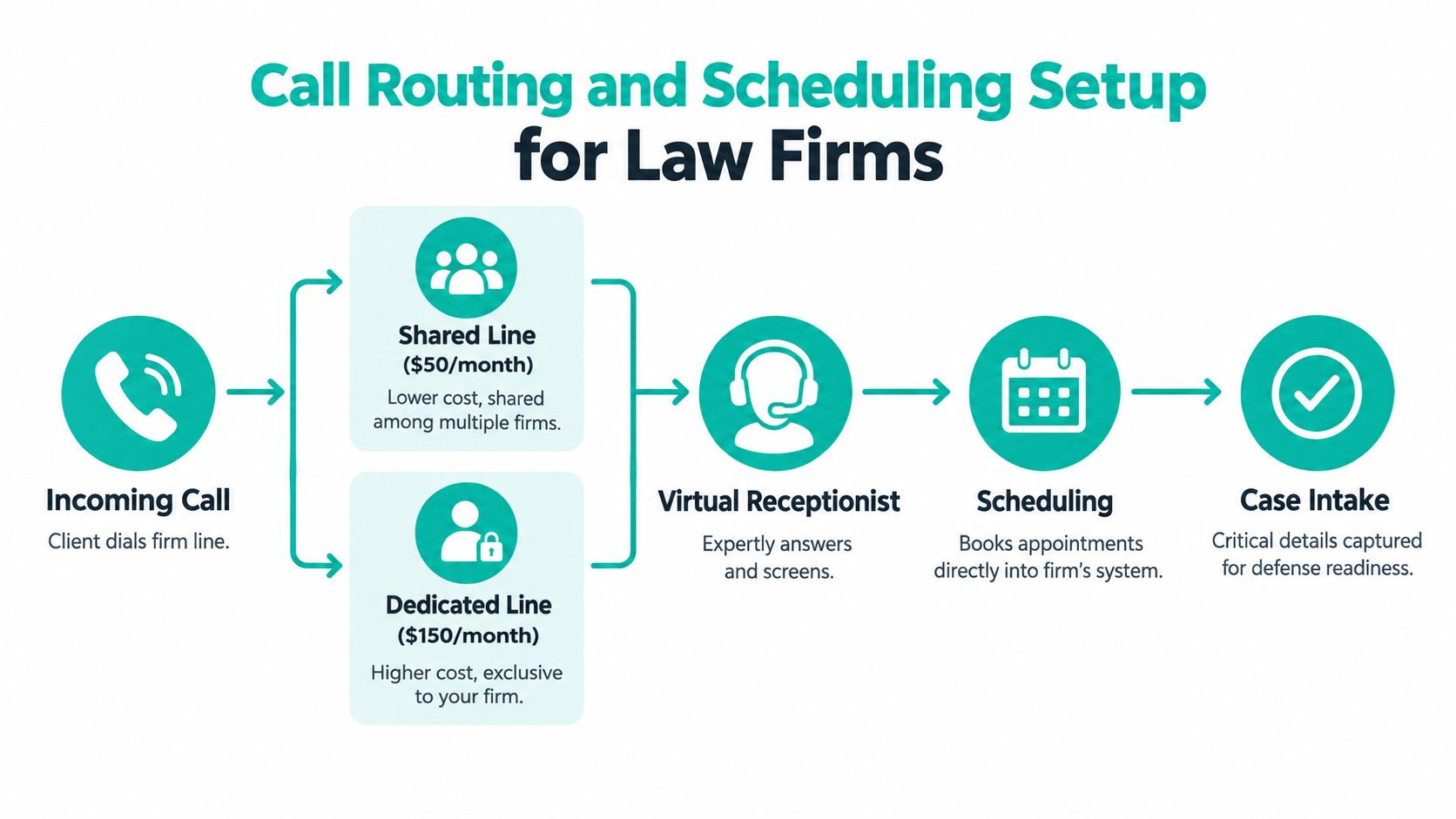
Call architecture determines whether a virtual receptionist can do useful work or merely create another message queue. The right design depends on whether you need overflow support, a dedicated front door, after-hours coverage, or separate treatment for several practice groups.
A shared line is generally simpler for a small firm. The receptionist answers through a common firm number and routes calls using a decision tree. A dedicated line gives a practice group, campaign, or office its own greeting and rules. A shared line can reduce complexity, while a dedicated line can make attribution and routing clearer. Neither arrangement is automatically safer. Confidentiality depends on permissions, training, account separation, and the provider's procedures.
| Setup | Works well when | Main risk | Control to require |
|---|---|---|---|
| Shared firm line | A solo or small firm needs one consistent front door | Callers may be routed too broadly | Use caller-type and practice-area rules |
| Dedicated practice-group line | Different departments use different intake criteria | Staff may maintain duplicate procedures | Assign one owner for each script and queue |
| Overflow coverage | In-house staff answer most calls but need backup | Handoffs can feel inconsistent | Use the same greeting, fields, and escalation tree |
| After-hours coverage | The firm needs reception outside business hours | Urgent calls may sit in a general inbox | Define an on-call person and immediate escalation method |
Professional-responsibility guidance on office sharing emphasizes separate communication channels, clear public identification, staff instruction, and procedures that prevent access to unrelated client files. The same logic applies to outsourced reception. A receptionist who handles calls for multiple firms should have distinct accounts, approved devices and workspaces, and access limited to the matters and fields required for your assignment.
Start with the caller categories, not the phone platform. At minimum, define separate handling for:
A caller saying “I have court tomorrow” shouldn't be placed in the same queue as a general website inquiry. The receptionist should capture the court date, matter identifier if known, callback number, and the firm's approved urgency classification. The escalation tree should name the responsible person, the backup person, and the required notification channel.
Scheduling creates another point of failure. A receptionist shouldn't see every calendar detail if the only required information is consultation availability. Use appointment types, buffer rules, locations, duration, and eligibility criteria that match the firm's process. If a lawyer only accepts new consultations for certain practice areas, that restriction should appear in the scheduling workflow rather than depend on memory.
A calendar management system for law firms should support controlled availability rather than expose the entire calendar. Confirm the appointment with the caller, record the preferred contact method, and create a task for any pre-consultation documents. Review cancellations, rescheduling, and no-show procedures before launch. A booking that lands on an attorney's calendar without the required intake information is not a successful handoff.
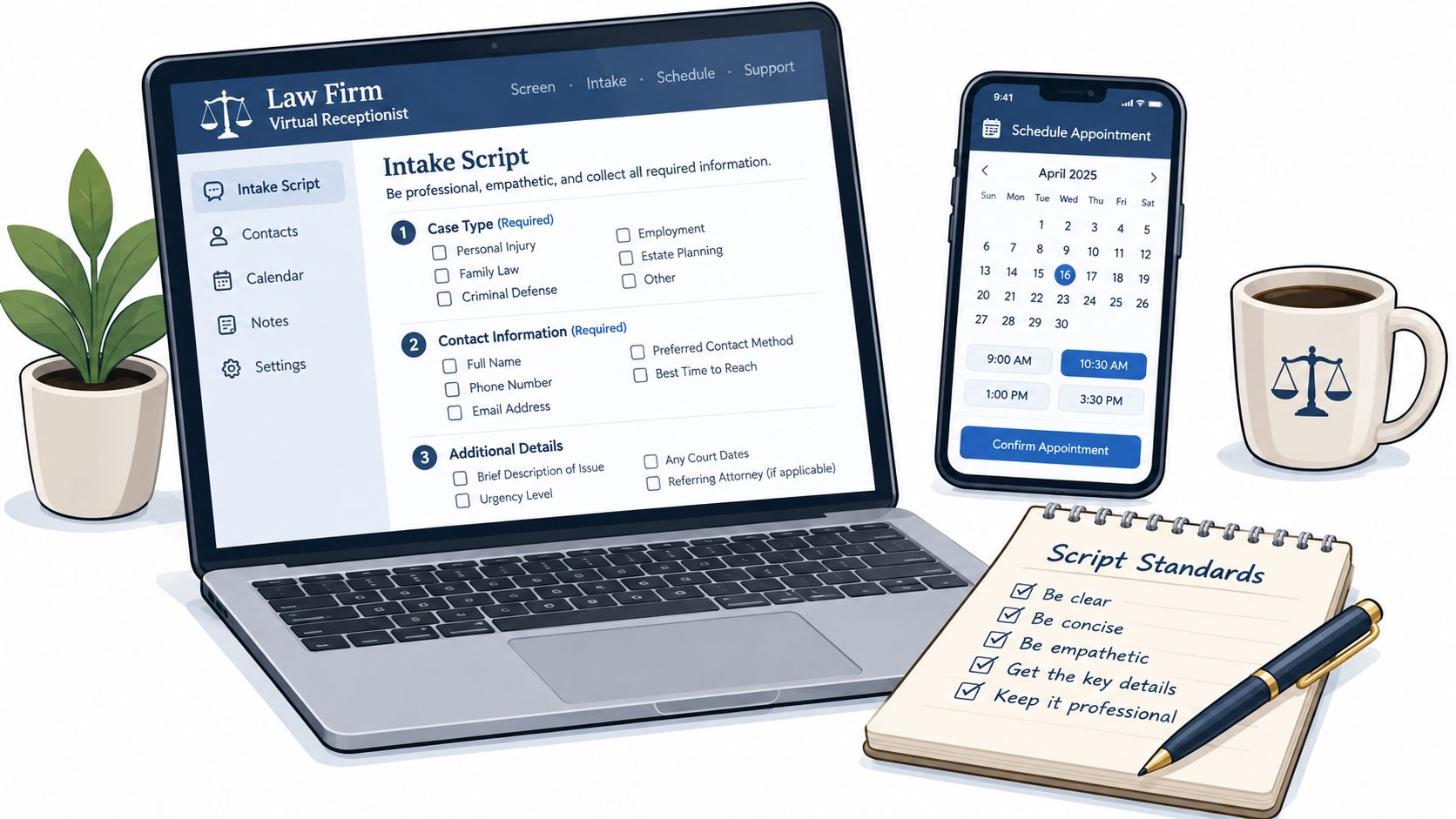
A legal receptionist script is more than a call outline. It is the control point between a routine inquiry and a record that can affect conflicts, confidentiality, scheduling, and supervision. If the script is too loose, staff collect facts the firm did not mean to request, promise follow-up they cannot control, or send half-complete information into the wrong system. If it is too rigid, callers feel blocked and urgent facts get missed. The right standard gives the receptionist clear authority, clear limits, and a clear handoff path.
Start with the smallest set of facts needed to identify the person, classify the matter, and decide where the call goes. For most firms, that means:
That first layer should be easy to deliver consistently. It is administrative intake, not an invitation to tell the full story. In practice, the biggest script failure is overcollection. A caller starts describing every event in detail, the receptionist tries to be helpful, and the firm ends up storing a long narrative before it has completed a conflict check or assigned a lawyer. That creates avoidable risk and usually does not improve intake quality.
The script should therefore include stop rules as well as questions. Staff need direct language for moments when a caller begins giving unnecessary detail. A simple redirect works: the receptionist can explain that the firm first needs basic contact, matter, and conflict-screen information, then attorney review or consultation can follow. That keeps the call useful without turning it into unsupervised legal intake.
For conflict screening, enter only the firm's approved fields in the case-management system before opening a detailed record. Names, opposing parties, and limited matter identifiers may be enough for the first pass. If a possible conflict appears, route the matter to the designated attorney or intake supervisor. The receptionist should never tell the caller that the firm has cleared a conflict, has a conflict, or has agreed to take the matter.
This boundary has to be written into the script, not left to judgment. Receptionists can explain process. They can say what practice areas the firm handles, how consultations are scheduled, what information is needed before the appointment, and what approved fee-agreement steps look like. They should not suggest legal strategy, predict results, interpret documents, negotiate legal positions, or confirm representation.
That distinction is easy to state and harder to maintain on live calls. A caller asks, “Should I sign this?” or “Do I need to file tomorrow?” and the receptionist wants to keep the conversation moving. The safer script gives a firm answer without sounding evasive: the receptionist can record the issue, note any deadline, and arrange attorney contact, but cannot advise the caller what action to take. In my experience, teams perform better when that language is practiced out loud and attached to specific trigger questions rather than treated as a general principle.
It also helps to distinguish the receptionist role from the more involved intake function described in what a legal intake specialist does. Some firms combine those functions. Others separate them. Either way, the firm should decide who is allowed to gather only routing facts, who may conduct a fuller intake under supervision, and who may discuss engagement terms with the lawyer's involvement. As noted earlier, the client must have a real opportunity to communicate with the lawyer about the fee agreement and scope of representation.
Software integration saves time, but every new connection creates another place where legal information can appear, persist, or be sent to the wrong person. A receptionist may touch the phone platform, practice-management system, calendar, email, CRM, and sometimes billing or document tools in a single call flow. If those systems are connected without role limits, a basic scheduling user can end up seeing notes, financial data, or privileged documents that have nothing to do with intake.
Use a controlled sequence before granting access:
The ABA guidance on confidentiality and office-sharing arrangements supports safeguards such as separate channels, clear instructions, access controls, and procedures that prevent exposure to unrelated client files. Remote reception does not reduce the firm's responsibility. Supervision still applies, and so does vendor oversight.
A successful deployment is not just an API test. It is a judgment test. Before launch, run scenarios that force the receptionist to choose the right script path under pressure: a wrong number, a distressed caller, an existing client, a request for confidential information, an interpreter need, opposing counsel, a possible conflict, and an urgent court matter. Require read-back confirmation for names, dates, phone numbers, email addresses, and appointment times. Small errors at this stage create big downstream cleanup.
Language coverage matters too. A bilingual English-Spanish receptionist may improve caller access, but bilingual ability does not replace intake training. The same boundaries still apply. Test both languages using the firm's real practice-area labels, consultation types, deadline language, and emergency instructions so staff are not improvising on live calls.
The outbound side also needs review. The Federal Trade Commission's Telemarketing Sales Rule applies to certain telemarketing campaigns involving interstate calls and addresses disclosures, misrepresentations, calling times, and do-not-call requests. Routine appointment follow-up is not automatically telemarketing, but a scripted solicitation campaign may raise a different compliance question. Counsel should review that workflow, especially where state solicitation rules add another layer of requirements.
Call volume is easy to report and easy to misunderstand. A busy receptionist may receive many calls that are spam, wrong numbers, existing-client requests, or matters outside the firm's practice. The useful question is whether the firm accurately classifies, documents, routes, and closes the interactions that matter.
Track a baseline before changing the workflow, then compare it with post-launch performance over a four-week pre-launch and post-launch period. The comparison should use the same definitions and practice areas. Don't treat a higher booking count as success if the firm also sees more duplicate leads, incomplete records, calendar errors, or missed urgent calls.
| KPI | What it tells you | Warning sign |
|---|---|---|
| Answer rate | Whether priority calls reach a person or approved intake path | Repeated gaps during court, lunch, or overflow periods |
| Abandonment rate | Whether callers leave before reaching reception | Long queues or unclear menus |
| Complete-intake rate | Whether required fields are captured accurately | Attorneys still need to call for basic facts |
| Qualified-lead rate | Whether inquiries fit the firm's defined criteria | Many bookings fall outside practice scope |
| Booked-consultation rate | Whether eligible inquiries reach a scheduled next step | Intake is collected but not converted into action |
| Callback latency | How quickly staff respond to high-intent inquiries | Tasks remain unassigned or overdue |
| Transcription accuracy | Whether recorded information matches the caller's words | Names, dates, and phone numbers require correction |
| Error and rework rate | How often staff repair routing or data-entry mistakes | Repeated misclassification or duplicate records |
Set a defensible service baseline: live answering for priority calls, immediate escalation for emergencies, and human follow-up within five minutes for high-intent leads. These are operating targets, not universal legal conversion guarantees. The ABA guidance on virtual practice and confidentiality supports documented safeguards, secure devices, strong passwords, multifactor authentication, and information that remains secure, indexed, and retrievable.
Review a sample of calls every week. The review should ask whether the receptionist used the correct greeting, captured the necessary fields, screened names appropriately, avoided advice, assigned the task correctly, and documented consent where required. A monthly review of 100 calls can provide a consistent operational sample, with any misrouting, privacy incident, or missed urgent message investigated within one business day.
Technology should support judgment rather than hide its absence. Recent ABA survey reporting found legal AI adoption at 30% of respondents, up from 11% in 2023, while 54% identified time savings or efficiency as the primary benefit, 56% reported reliability concerns, and 47% reported privacy or security concerns. Those figures support a hybrid approach. Automation can assist with routing, reminders, and structured capture, while trained staff handle ambiguous facts, emotional callers, language differences, and escalation.
A law firm virtual receptionist works best when the firm treats the role as a supervised intake workflow, not a remote voicemail replacement. Define caller categories, write practice-specific scripts, capture conflict-screening information, separate administrative intake from legal advice, and route urgent or ambiguous matters to a lawyer or designated intake supervisor.
Secure integration matters just as much as conversational quality. Use individual accounts, least-privilege access, multifactor authentication, retention limits, read-back confirmation, and documented procedures for recordings, transcripts, shared inboxes, and user removal. Then measure answer rate, abandonment, intake completeness, qualification, booking, callback speed, transcription accuracy, and rework against a consistent baseline.
Virtual Legal Assistants offers pre-vetted, bilingual English-Spanish legal receptionists and intake professionals with prior U.S. law-firm experience, interview-before-hire, and schedules aligned with U.S. working hours. If your firm needs dedicated call coverage or structured intake support, Virtual Legal Assistants can help you evaluate a remote role against your existing systems and escalation rules.