

 14 minutes read
A small-firm morning can go sideways before the first court deadline. A phone rings while an attorney is meeting with a client, two appointments land on the same calendar slot, a new matter sits incomplete in the practice-management system, and a billing follow-up slips behind other work. None of those tasks requires legal judgment, but each one can interrupt it.
Administrative assistant services give a firm defined support for recurring work such as calendar and inbox management, client communication, document coordination, billing administration, and case-system updates. The arrangement works best when the firm specifies what the assistant owns, what requires attorney review, and which records or systems the role needs to access. A remote assistant can organize a workflow and carry out approved procedures; the attorney remains responsible for legal advice, strategy, and decisions.
That distinction matters for supervision and confidentiality, but also for hiring. A generalist who can manage a calendar may not be ready to update matters accurately in Clio or handle a sensitive intake handoff. This guide covers the work legal administrative assistants can take on, how firms can compare hiring models, and how to vet and onboard remote support. It also offers practical metrics for checking whether the arrangement is improving intake, billing, and case progression rather than merely moving tasks to another person.
A firm's administrative workload is a set of repeatable processes, not a catchall job description. One assistant might manage an attorney's calendar, screen a shared inbox, prepare routine correspondence from an approved template, and update matter records. Another might focus on reception and consultation booking, while a separate billing assistant follows up on invoices and keeps payment notes organized. The right shape depends on the firm's caseload and where work regularly stalls.

The dividing line is administrative execution versus legal judgment. An assistant can enter a client's contact details, schedule a consultation, organize documents according to firm procedure, and route a message to the responsible attorney. The assistant shouldn't interpret the client's legal position, recommend a course of action, decide whether a filing is appropriate, or send legal advice without attorney direction. A clear boundary protects clients and gives the assistant a workable escalation path instead of requiring guesswork.

Administrative support organizes and executes firm processes. Attorneys retain legal decision-making.
That principle should inform the job description, access permissions, training, and daily supervision. When the role is vague, firms often end up with duplicated entry, inconsistent client follow-up, or attorneys reviewing work that should have been defined more carefully before the hire. When duties are specific, the firm can assess whether it needs one generalist or dedicated support for intake, reception, case administration, or billing.
Administrative services are not automatically a substitute for an on-site employee. A role that depends on physical mail handling, in-person client reception, or close coordination around paper files may need local coverage or a hybrid arrangement. Remote support is better suited to tasks the firm can document, route through approved systems, and review without relying on physical presence. The sections below focus on those operational choices, including how to set up access and measure whether the work is being done reliably.
A useful job description names recurring tasks and sets a clear review boundary for each one. The duties below are common in small and midsize firms, but the balance varies: a plaintiff firm may prioritize prompt lead response and matter setup, while an immigration practice may need organized document collection and bilingual communication.
| Duty | What the assistant handles | Where attorney review is required |
|---|---|---|
| Calendar and deadline coordination | Schedule meetings, maintain calendar entries, send reminders, and flag conflicts using firm procedures. | Determine legal deadlines, resolve conflicting deadline instructions, and approve changes that affect a matter. |
| Inbox and client communication | Route messages, send approved scheduling updates, and record communications in the appropriate system. | Answer legal questions, interpret advice, or send sensitive substantive guidance. |
| Document coordination | Organize files, apply naming conventions, prepare approved templates, and track requested records. | Review legal substance, approve privilege-sensitive drafting, and decide what to file. |
| Billing administration | Prepare invoices for review, record payment follow-ups, and route billing questions. | Approve adjustments, make disputed-fee decisions, or provide legal explanations of charges. |
| Case-system updates | Enter contacts, classify documents, create assigned tasks, and maintain matter records. | Decide legal strategy, change substantive case status, or determine the significance of evidence. |
Calendar work needs particular care because a scheduling entry and a legal deadline aren't interchangeable. An assistant may enter a date supplied by an attorney, set reminders, and flag a conflict, but the firm should define who verifies the underlying deadline and how discrepancies are escalated. In a litigation practice, that distinction helps prevent an administrative calendar from being mistaken for the attorney's legal deadline control.
Inbox and intake work also needs a written boundary. A receptionist or intake specialist can capture caller details, explain the consultation process using approved language, and book an appointment. They shouldn't assess legal merit or promise an outcome. For a task-by-task view of common support work, firms can compare their proposed duties with this guide to virtual legal assistant tasks.
Document preparation varies just as much. An assistant can populate a firm-approved form with information supplied by the client or attorney, format correspondence, and track missing records. The responsible attorney should review substantive language and make filing decisions. Writing those limits into onboarding material makes supervision practical, especially when the assistant works remotely and can't rely on quick in-office clarification.
Administrative support is a substantial U.S. occupational category, not a staffing label invented for remote work. The Bureau of Labor Statistics reported approximately 3.5 million secretary and administrative-assistant jobs in 2025, including about 157,600 legal secretaries and administrative assistants. The same occupational data projects an overall employment decline of 2% from 2025 to 2035, while estimating about 314,400 openings annually as workers retire, change occupations, or leave the labor force (BLS occupational and employment context).
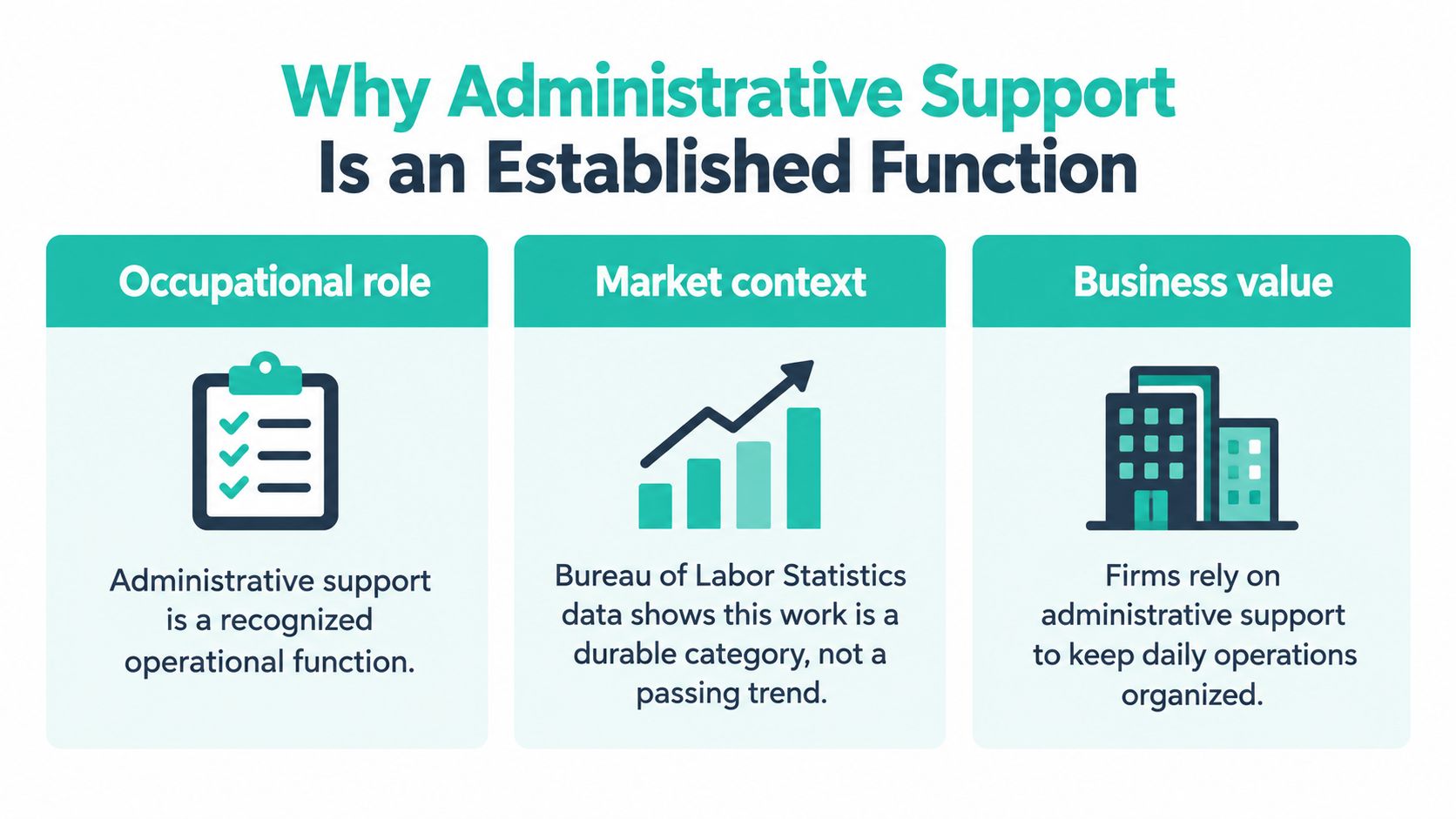
Those figures describe a broad labor market, not a guarantee that any particular firm will find a suitable candidate quickly. They do show that administrative work remains a recurring operational need even as technology changes how employees handle records, scheduling, and documents. For a law firm, the legal-administrative segment includes work such as calendar coordination, client communication, filing support, billing, and case administration.
The U.S. economic classification for NAICS 561110, Office Administrative Services, covers establishments providing day-to-day office support such as billing, recordkeeping, personnel administration, and logistics. It excludes firms that supply the operating staff needed to run a client's complete business. Census Bureau Economic Census data identified 31,170 firms under that classification in 2017, a historical measure showing that office-administrative support was separately counted as a business category (industry and occupational projections overview).
That distinction maps well to legal operations. A firm can delegate defined administrative tasks while keeping control of legal work, client relationships, and case strategy. The assistant maintains a record or routes a follow-up; the firm decides what that record means and what action to take.
The hiring challenge is less about whether the function exists and more about defining the work precisely enough to staff it. A law firm may have a real need for intake coverage but not enough consistent work for a dedicated full-time receptionist. Another firm may have enough volume to separate intake, billing, and case updates. Job design should follow the actual workflow, not the assumption that every firm needs the same kind of assistant.
No hiring route is right for every firm. Local in-house hiring offers direct supervision and easier access to physical office work, but recruiting, payroll, benefits, and coverage planning stay with the firm. Generalist marketplaces provide access to a broad range of freelancers, but the firm must assess legal workflow experience, confidentiality practices, software familiarity, and continuity itself. A specialized legal staffing provider may take on more screening and contracting administration, though it won't solve a poorly defined role or replace attorney supervision.
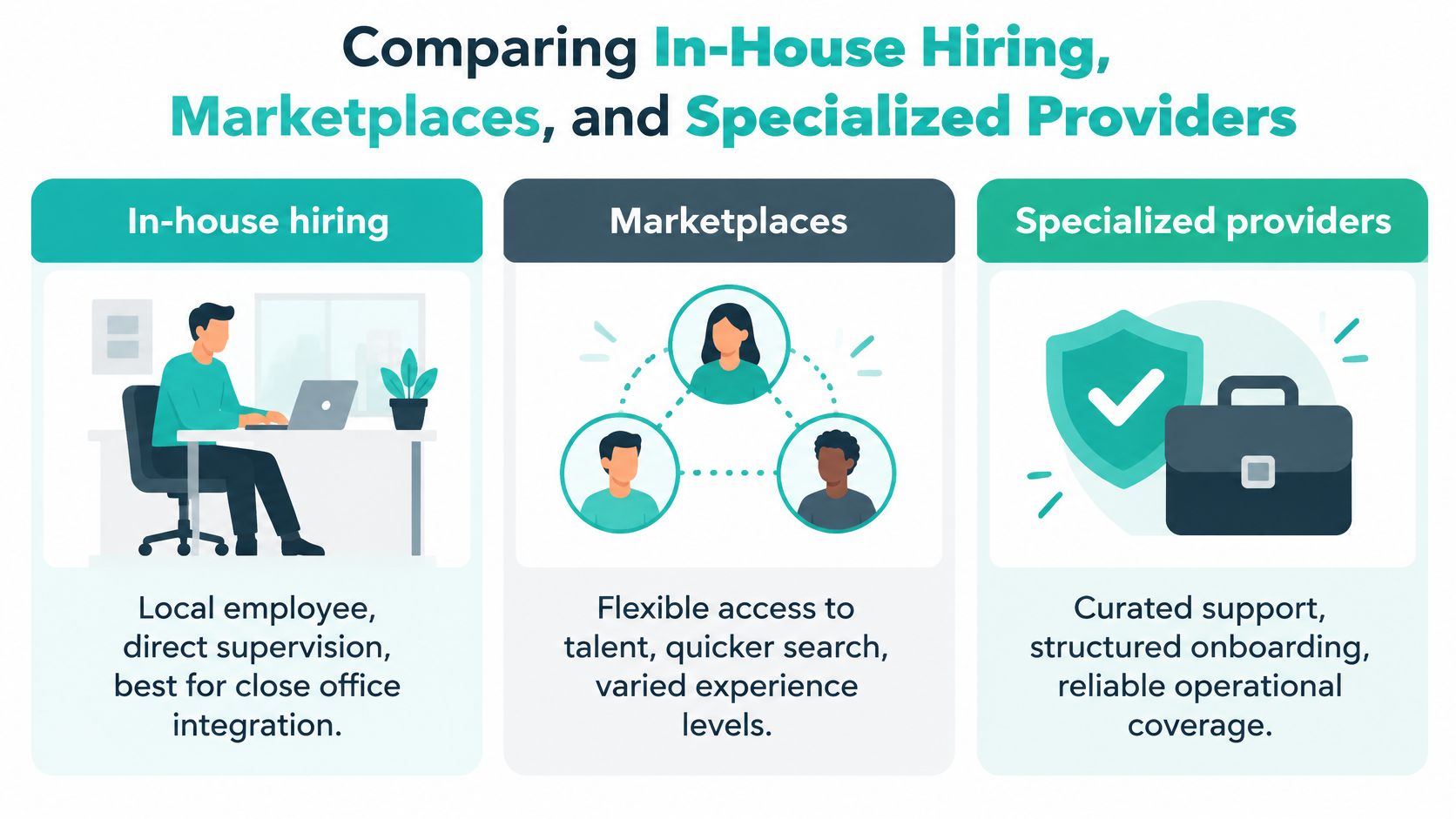
| Hiring model | Often works well when | Trade-offs to assess |
|---|---|---|
| In-house employee | The work requires office presence, close daily coordination, or physical handling of files and mail. | The firm handles recruiting, payroll and employment administration, and coverage when the employee is unavailable. |
| Generalist marketplace | The role is narrow, the firm can vet directly, and flexible project-based help is suitable. | Experience varies; the firm must verify legal workflow skills, manage agreements, and plan for continuity. |
| Specialized legal provider | The firm needs legal-administrative experience, software alignment, or help with candidate sourcing and contracting. | The role still needs firm-specific training, clear access limits, and attorney oversight. |
The visible hourly rate doesn't capture every cost. A lower rate may be offset by duplicate data entry, slow lead follow-up, or attorney rework if the assistant hasn't used the firm's systems or doesn't understand its procedures. Conversely, a specialized provider may be unnecessary when a local employee must greet walk-in clients or handle work that can't be performed remotely.
VirtualLegal sources and vets bilingual English-Spanish professionals based in Latin America with prior U.S. law-firm experience. Its offerings include part-time and full-time engagements from $12 per hour, monthly rolling terms, interview-before-hire with no deposit, Contractor of Record and international payroll support, and a shortlist fitted to each firm's needs, typically delivered within 24 hours. Firms considering that model should confirm the current scope, pricing, and included support directly through VirtualLegal's legal assistant cost information.
The decision should start with the firm's constraints. If the role needs an employee physically present, remote staffing won't meet the requirement. If the problem is inconsistent intake or case-system updates, a remote hire can be useful only when responsibilities, tools, and escalation procedures are defined before the person starts.
A remote hire should be evaluated against the work the firm actually needs done. Start with a written role definition: list recurring tasks, priorities, expected communication patterns, and the decisions the assistant must escalate. Then create an access matrix that identifies each system, the level of permission required, and the data or functions the assistant must not access.
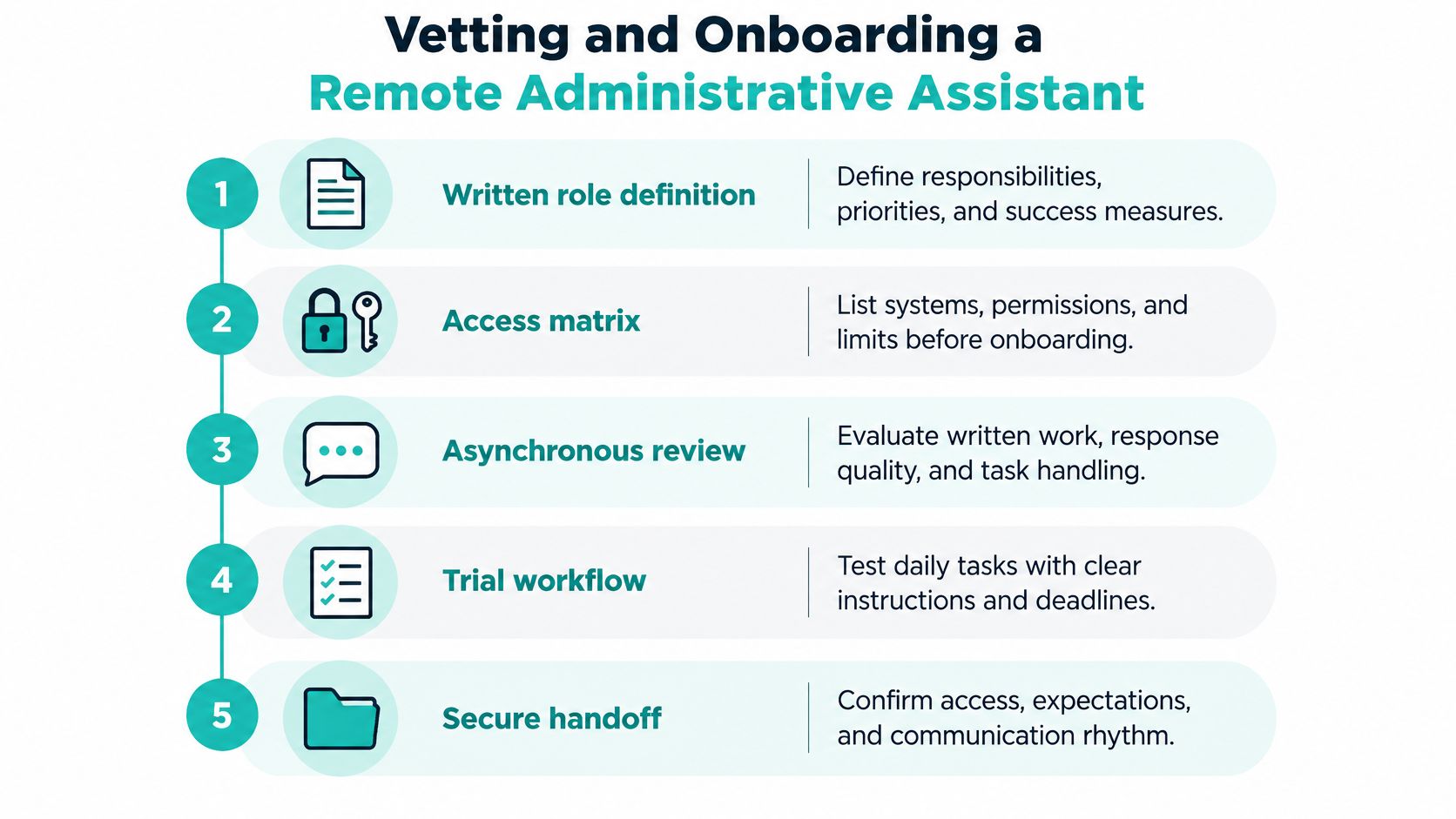
A structured screening process can combine an asynchronous exercise, a live interview, a role-specific skills test, and a background check. Assess written communication, calendar handling, attention to detail, familiarity with the firm's tools, confidentiality awareness, and bilingual communication if the caseload calls for it. The firm can use this guide to hiring a virtual legal assistant as a reference when organizing its candidate evaluation.
Access rule: Give the assistant the permissions needed for assigned duties, not unrestricted remote access to the firm's systems.
An assistant who says they know Clio, MyCase, Filevine, or another case-management platform still needs to show how they work inside the firm's configuration. Use a mock matter to test whether the candidate can create a contact, assign the matter type, upload and classify documents, schedule a deadline supplied for the exercise, record a communication, and produce a status report. Check accuracy and adherence to instructions, not just speed.
Before day one, configure role-based accounts, multifactor authentication, firm-managed password controls, encrypted connections, and approved file-transfer methods. The Federal Trade Commission advises limiting access to sensitive assets according to job necessity and requiring secure connections for remote access; it also recommends secure home-network practices, including WPA2 or WPA3 wireless encryption (FTC small-business cybersecurity guidance). Apply the same authorization and monitoring standards to domestic and international staff.
Create a documented process for reporting suspected phishing, reviewing access, and revoking permissions when responsibilities change or an engagement ends. Avoid shared credentials. The firm should also define who reviews unusual downloads or record changes and how the assistant raises a concern when instructions conflict. Security requirements can vary by firm and circumstances, so confirm obligations with qualified counsel or compliance professionals.
A firm can't judge an assistant's contribution from a general sense that the inbox feels lighter. The useful question is whether the assigned workflow is becoming more dependable without creating extra attorney review. Pick measures tied to the role, record the current baseline, and agree on when the firm will review results.
For intake and reception, practical measures include missed-call rate, median lead-response time, consultation-booking rate, and intake completeness. For case administration, track days from signed engagement to matter setup, overdue-task rate, and the share of work returned for correction. Billing support can be assessed through billing follow-up cycle time and whether payment notes are recorded consistently. These metrics help distinguish a staffing issue from a process issue: if a task has no owner or clear procedure, a new hire may just inherit the confusion.
One generalist can be enough when task volume is manageable, duties fit a coherent schedule, and the assistant can move between the firm's approved workflows without losing ownership. A coordinated support pod makes more sense when intake, reception, case progression, and billing each need separate coverage or different system permissions. Dividing work can improve role clarity, but it also creates handoffs. The firm should decide who owns a lead or task at each transition and where the completed work is recorded.
Time-zone overlap and bilingual coverage should be evaluated against the work, not treated as benefits on their own. If a client raises a live issue outside the assistant's authority, the assistant needs a named escalation contact and a clear process for documenting the handoff. Without that path, the assistant may delay a response or overstep in an effort to be helpful.
The lowest hourly rate can become the highest operational cost when unclear duties create duplicate entry, slow follow-up, or attorney rework.
Compare engagement proposals by the whole arrangement, not just the hourly rate. Part-time support can fit a firm with predictable administrative tasks that don't require continuous coverage. Full-time support may make sense when intake, scheduling, case updates, and billing follow-up create a steady workload and the firm can define a full workday of responsibilities. Overbuying hours leaves capacity unused; understaffing intake can leave calls and follow-ups waiting.
Ask whether the quote covers recruiting and vetting, contracting, payroll administration, onboarding support, and replacement support if the arrangement doesn't work out. Clarify who manages timesheets, handles routine personnel administration, and resolves an absence or performance issue. For an international engagement, confirm the provider's role in Contractor of Record coverage and payroll rather than assuming those services are included.
Monthly rolling terms can reduce the commitment associated with a long contract, but the firm should still understand notice requirements, billing cadence, minimum hours, and what happens when the role changes. Interview-before-hire gives the firm a chance to assess communication and task fit before selecting a candidate. No deposit removes one up-front payment from the decision, but it doesn't replace a clear contract or a careful review of service terms.
Rates depend on the role's complexity, working hours, and required software proficiency. Compare providers using the same task list and ask them to identify what is included and what is billed separately. A receptionist role centered on call routing differs from an assistant expected to maintain matter records and support billing, so proposals should reflect the actual responsibilities.
Match the engagement size to observed workload. If the firm is unsure, define the priority tasks first, then agree on which work takes precedence when the assistant's available hours are full. That makes a part-time arrangement easier to evaluate and gives the firm a concrete basis for changing coverage if demand shifts.
Administrative assistant services work best when a law firm defines the role before hiring, limits system access to what the work requires, and reviews performance using measures tied to intake, billing, and case progression. The assistant can organize and carry out firm processes, but attorneys retain legal decisions and should set the review and escalation rules.
In-house hiring, a generalist marketplace, and a specialized legal staffing provider each suit different operational needs. Start by writing the responsibilities and access matrix, then interview candidates against that standard and test the workflows they'll handle in practice. That gives the firm a clearer basis for choosing both the person and the engagement model.
VirtualLegal connects U.S. law firms with bilingual legal administrative professionals based in Latin America and supports candidate sourcing, vetting, and onboarding. If you're defining remote coverage for intake, calendars, billing, or case administration, visit VirtualLegal to review the service and decide whether it fits your firm's workflow.